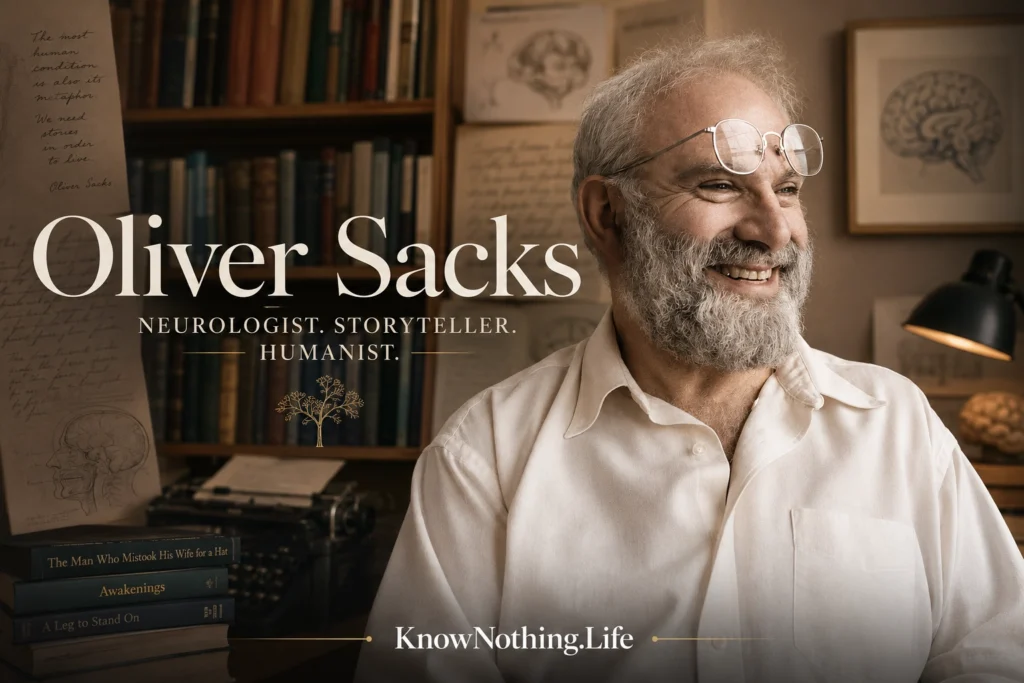
Oliver Sacks was a British-born neurologist, naturalist, and writer whose clinical narratives transformed the public understanding of the brain. He wrote about patients who could no longer recognize faces, remember recent events, perceive color, control sudden movements, or experience their own limbs as belonging to them. Yet Sacks rarely treated these individuals as collections of symptoms. He investigated how each person adapted to neurological change, preserved identity, and constructed a workable world through music, habit, art, relationships, faith, or intellectual discipline. His writing joined medical observation with biography, showing that neurological illness affects not only bodily functions but the stories through which people understand themselves.
His best-known books include Awakenings, The Man Who Mistook His Wife for a Hat, An Anthropologist on Mars, Seeing Voices, Musicophilia, The Mind’s Eye, and Hallucinations. He also turned his observational method upon himself in A Leg to Stand On, Uncle Tungsten, and On the Move. Although he became celebrated as a literary physician, his central concern remained clinical: medicine must understand the disease while also attending to the particular person living through it. As he wrote, “One has to treat the lesion,” but must equally consider “the entire individual.”
Early Life and Medical Education
Oliver Wolf Sacks was born in London on July 9, 1933, the youngest of four sons in a medically accomplished Jewish family. His mother, Muriel Elsie Landau, was a surgeon, and his father, Samuel Sacks, was a general practitioner. Scientific conversation, medical stories, and experiments surrounded his childhood. During the Second World War, Oliver and his brother Michael were evacuated from London to a boarding school, an experience later associated with fear, isolation, and harsh discipline. After returning home, he found refuge in chemistry, minerals, numbers, and the history of scientific discovery—memories he later reconstructed in Uncle Tungsten: Memories of a Chemical Boyhood.
Sacks studied physiology and biology at Queen’s College, Oxford, and completed his clinical medical training at Middlesex Hospital. He moved to North America in 1961, undertaking further training at Mount Zion Hospital in San Francisco and completing a residency in neurology and neuropathology at UCLA. California also became the setting for a more turbulent private life involving motorcycles, weightlifting, long-distance swimming, intense drug use, and uncertainty about his professional direction. In 1965, he moved to New York, where encounters with chronically institutionalized patients gave his career a lasting purpose.
Awakenings and the Patients of Beth Abraham
In 1966, Sacks began working as a consulting neurologist at Beth Abraham Hospital in the Bronx. There he encountered patients who had survived the epidemic of encephalitis lethargica, or “sleeping sickness,” that spread internationally between 1916 and 1927. Many had remained for decades in states of profound immobility, rigidity, mutism, or diminished initiative. They could appear frozen and unreachable, although Sacks came to understand that complex personalities and emotional lives persisted beneath their severe physical limitations.
Sacks treated these patients with the then-experimental drug levodopa, or L-dopa. Some experienced astonishing returns of movement, speech, appetite, and emotional engagement, but the improvement was rarely simple or permanent. Patients developed involuntary movements, psychological disturbances, changing sensitivities to medication, and unpredictable cycles of activity and withdrawal. Sacks documented these responses in Awakenings, published in 1973. The book rejected the tidy medical story of treatment followed by cure; it presented awakening as a complicated negotiation among brain chemistry, personal history, institutional life, and time. The work later inspired Harold Pinter’s play A Kind of Alaska and the 1990 film Awakenings.
The Case History as Biography
Sacks’s writing revived an older tradition of richly detailed medical case histories associated with physicians such as Jean-Martin Charcot and the Russian neuropsychologist A. R. Luria. A conventional case report might identify age, diagnosis, test results, and treatment. Sacks wanted to know what a neurological condition felt like from within and how it reorganized a person’s surroundings. His patients were not illustrations attached to theories; their distinctive lives often revealed dimensions of perception and identity that established theories had overlooked. This approach required extended observation in homes, hospitals, streets, workplaces, concerts, and other environments where abilities appeared differently than they did during formal examinations.
The Man Who Mistook His Wife for a Hat, published in 1985, became the clearest expression of this method. Its title case concerns a musician with visual agnosia who could see individual features but could not assemble them into recognizable objects or faces. Other chapters examine memory loss, Tourette’s syndrome, savant abilities, altered body awareness, and neurological conditions that changed a person’s relation to space or time. Sacks’s purpose was not to make unusual patients into spectacles. At his best, he showed that apparent deficits can coexist with preserved abilities and that people often create unexpected forms of order when familiar neurological capacities disappear.
Language, Music, and Different Ways of Being
Sacks extended his inquiry beyond individual clinical cases in Seeing Voices, an exploration of Deaf culture, sign language, and the consequences of denying children full access to language. The book presented signed languages as complete linguistic systems rather than substitutes for speech. In The Island of the Colorblind, he traveled to Pacific communities to investigate congenital color blindness and a progressive neurological condition found on Guam. An Anthropologist on Mars presented seven extended portraits, including an artist who lost color vision, a surgeon with Tourette’s syndrome, and animal scientist Temple Grandin, whose description of herself inspired the book’s title.
Music became one of Sacks’s most important subjects because it could sometimes reach capacities inaccessible to ordinary instruction. People immobilized by parkinsonism might move fluently to rhythm; individuals with severe memory disorders could retain songs; and patients with aphasia might sing words they could not easily speak. In Musicophilia: Tales of Music and the Brain, Sacks examined musical hallucinations, amusia, perfect pitch, involuntary musical imagery, and the use of music in neurological care. Music did not erase disease, but it could temporarily organize movement, recall, attention, and identity. His work helped popularize the view that art is not merely recreation added after medical treatment; for some patients, it is part of the structure through which coherent action becomes possible.
The Physician as Patient
Sacks occasionally became the subject of his own neurological narratives. In A Leg to Stand On, he described injuring his leg during a mountaineering accident and subsequently experiencing it as alien or absent despite its physical presence. The experience challenged the distance normally separating physician and patient. Knowing the anatomy and prognosis did not prevent terror when the limb ceased to feel integrated into his body image. The book became a meditation on proprioception, rehabilitation, and the inadequacy of medical language when it neglects lived experience.
Later works made his personal life increasingly visible. The Mind’s Eye included his experience of ocular melanoma and visual impairment, while Hallucinations discussed both patients’ experiences and his own experimentation with psychoactive drugs. In On the Move: A Life, Sacks wrote candidly about sexuality, addiction, celibacy, shyness, professional rejection, physical passions, and his late relationship with writer Bill Hayes. The memoir revealed that the empathetic observer of unusual minds had himself often felt isolated and different. It also showed how his restless energy—expressed through motorcycles, swimming, travel, reading, and correspondence—fed the curiosity that animated his clinical work.
Major Works and Final Reflections
Sacks’s bibliography ranged far beyond the books that made him famous. Migraine, his first major medical book, treated migraine as a complex neurological experience involving visual phenomena, changes in sensation, disturbances of time, and altered body perception. Oaxaca Journal recorded a botanical expedition with fern enthusiasts, while The River of Consciousness explored evolution, memory, creativity, and the continuity of experience. The posthumous collection Everything in Its Place gathered clinical narratives with essays on swimming, libraries, science, aging, and the natural world. Together, his books joined neurology with music, chemistry, botany, travel, autobiography, and the history of ideas.
After serving for many years at Albert Einstein College of Medicine and holding an adjunct appointment at New York University, Sacks became professor of neurology and psychiatry at Columbia University in 2007 and its first Columbia University Artist. He returned to NYU as a professor of neurology in 2012. When metastatic cancer made his remaining time limited, he composed the essays collected in Gratitude. “My predominant feeling is one of gratitude,” he wrote, reflecting not only on achievement but on the privilege of having perceived, thought, loved, and participated in life. He died in New York on August 30, 2015, at the age of eighty-two.
Lasting Influence
Oliver Sacks helped establish narrative medicine as an indispensable companion to neurological science. His case histories demonstrated that objective description and subjective experience need not be enemies. Brain imaging, pathology, and cognitive testing may identify damaged systems, while an individual’s history reveals how that damage changes a particular life. By concentrating on adaptation as well as impairment, Sacks also anticipated ideas now associated with neurodiversity: neurological difference may create genuine disability while also producing distinctive strategies, sensitivities, and forms of understanding.
His work continues to attract ethical questions about privacy, literary reconstruction, and the authority physicians exercise when telling patients’ stories. Those questions are part of his legacy because Sacks made the clinical narrative culturally powerful again. His finest writing never asks readers merely to marvel at a strange brain. It asks them to recognize a person whose world has been altered and whose humanity cannot be reduced to the alteration. In doing so, Sacks brought medicine, literature, and neuroscience together around a shared principle: every neurological condition occurs within a singular life, and understanding that life is part of understanding the condition.
OLIVER SACKS BOOKS
Migraine (1970)
Awakenings (1973)
A Leg to Stand On (1984)
The Man Who Mistook His Wife for a Hat (1985)
Seeing Voices: A Journey Into the World of the Deaf (1989)
An Anthropologist on Mars (1995)
The Island of the Colorblind (1997)
Uncle Tungsten: Memories of a Chemical Boyhood (2001)
Musicophilia: Tales of Music and the Brain (2007)
The Mind’s Eye (2010)
Hallucinations (2012)
On the Move: A Life (2015)
Gratitude (2015)
The River of Consciousness (2017)
Everything in Its Place: First Loves and Last Tales (2019)
Letters (2024)