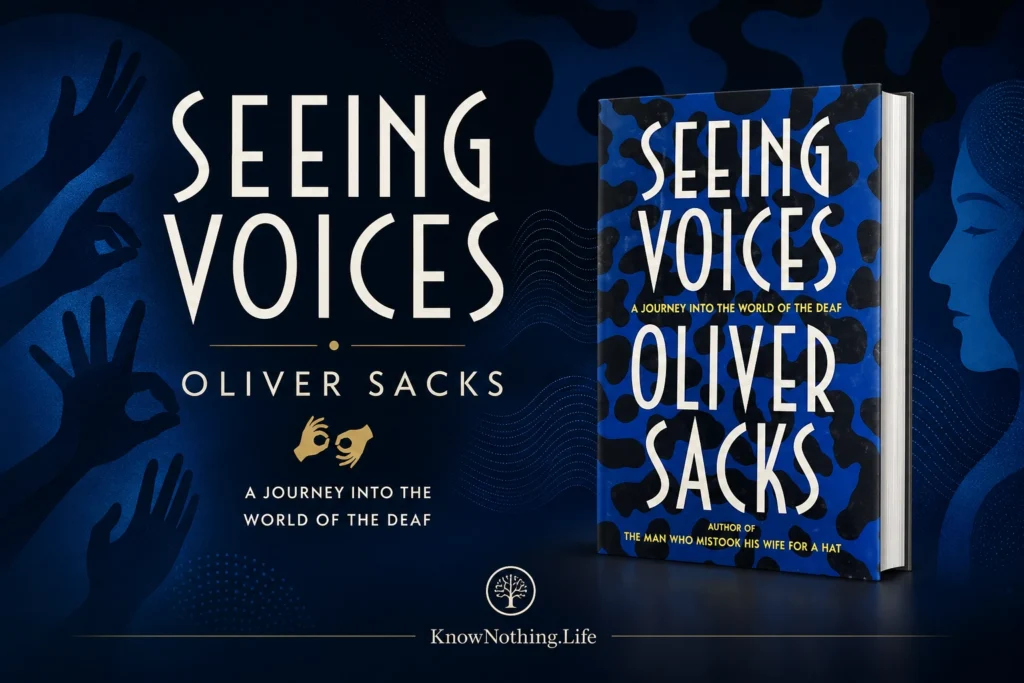
Oliver Sacks’ Seeing Voices differs markedly from neurological books such as Awakenings and The Man Who Mistook His Wife for a Hat. Rather than centering on an individual neurological disorder, Sacks turns toward an entire linguistic and cultural community. Published in 1989, the book grew from his realization that he had given remarkably little thought to what deafness meant beyond the medical fact of not hearing. As he later described it, he had previously focused on individuals; in Seeing Voices, he encountered a community with its own history, language, institutions, traditions, political struggles, and ways of organizing experience. The book moves across three interconnected subjects: the historical treatment of Deaf people, the linguistic and psychological significance of signed languages, and the emerging Deaf civil-rights movement that Sacks witnessed directly at Gallaudet University.
Its most important argument is deceptively simple: language does not have to be spoken to be language. A visual-manual language can possess grammar, syntax, morphology, metaphor, humor, poetry, storytelling, abstraction, and all the expressive possibilities associated with spoken language. This recognition transforms the meaning of deafness. If a Deaf child has access to a fully developed visual language, the absence of hearing does not imply an absence of language, thought, culture, or intellectual potential. Sacks consequently moves away from viewing deafness solely as a deficit requiring correction and toward understanding Deaf life through language and community. That shift gives Seeing Voices its philosophical importance. The book is ultimately about what language does for human beings—and what happens when social institutions either provide or obstruct access to it.
The Historical Struggle Over Deaf Education
The first portion of Seeing Voices traces the long and often painful history of Deaf education. Sacks describes periods in which signed communication was embraced as a legitimate means of education, followed by the rise of oralism, which attempted to educate Deaf children primarily through speech, lip-reading, and the suppression of signing. The conflict became particularly intense during the nineteenth century. Educators influenced by figures such as Thomas Hopkins Gallaudet and Laurent Clerc helped establish a strong American signing tradition, while later advocates of oral education argued that spoken language would better integrate Deaf people into hearing society. After the 1880 International Congress on the Education of the Deaf in Milan endorsed oral methods, signing was marginalized in many schools for generations.
The philosophical disagreement underlying this history concerns what educators believed a Deaf person ought to become. Oralist approaches often treated successful adaptation to the hearing world as the primary goal, whereas sign-based education allowed Deaf children to participate directly in a language accessible through vision. Sacks increasingly recognizes that this is not simply a disagreement about educational technique. It concerns power, identity, and who is allowed to define normal human communication. The history also provides a warning against confusing modality with language itself. Speech is one way in which language can be expressed, but language is a cognitive and social system rather than a synonym for vocal sound. The distinction would become far stronger scientifically as linguists demonstrated that signed languages possess the same kinds of structural organization expected of natural languages.
William Stokoe and the Recognition of ASL as a Language
One of the central intellectual figures in Seeing Voices is linguist William C. Stokoe. Working at Gallaudet, Stokoe challenged the then-common assumption that American Sign Language consisted primarily of gestures, pantomime, or simplified representations of English. His 1960 monograph Sign Language Structure analyzed ASL systematically and demonstrated that signs could be decomposed into meaningful linguistic contrasts involving hand configuration, location, and movement. Stokoe’s work helped establish signed-language linguistics as a serious scientific field. Gallaudet itself credits Stokoe, together with Deaf colleagues Dorothy Casterline and Carl Croneberg, with establishing the linguistic study of ASL.
The discovery had consequences far beyond linguistics. If ASL is a natural language rather than a collection of gestures, then older assumptions about the relationship between speech and thought become unstable. Human language must operate at a more abstract level than the muscles used to produce it. Spoken languages organize linguistic contrasts through patterns of sound; signed languages organize them spatially and visually. Both can form complex grammatical systems. Sacks understands this as evidence for the flexibility of the human brain. Language is not biologically tied to the mouth and ear. It can be instantiated through eye, hand, face, body, and visual space. In that sense, Seeing Voices belongs beside works concerned with the fundamental nature of language—from Ferdinand de Saussure’s Course in General Linguistics to later psycholinguistics—because it asks which aspects of language are essential and which merely reflect the sensory channel through which a particular language happens to operate.
Language Before Speech
The psychological importance of this distinction became even clearer through developmental research conducted around the time Sacks was writing. Laura-Ann Petitto and Paula Marentette reported in Science in 1991 that Deaf infants exposed to signed languages from birth produced forms of manual babbling with rhythmic and structural characteristics analogous to vocal babbling in hearing infants. Their findings suggested that babbling is not simply an exercise of the speech muscles. Instead, it reflects a deeper language-learning process capable of operating through different sensory and motor channels.
This finding supports one of the central intuitions of Seeing Voices: speech and language must be distinguished. A child acquiring ASL does not first develop “real language” somewhere internally and then translate it into gestures. Signing is itself linguistic development. The insight also speaks to long-standing philosophical arguments about whether language merely expresses thoughts that already exist or participates in structuring thought itself. Lev Vygotsky’s Thought and Language, for example, emphasized the developmental interaction between language, social experience, and higher mental processes. Sacks approaches similar territory through Deaf children: language is not merely a device for communicating finished thoughts to other people. It provides symbolic systems through which children categorize experience, preserve memory, share attention, construct narratives, participate in culture, and develop increasingly complex forms of self-reflection.
Why Early Language Access Matters
One of the most consequential themes in Seeing Voices concerns children who reach later childhood without fluent access to either signed or spoken language. Sacks draws on historical and clinical examples to describe the enormous difficulties that can result when early communication is severely restricted. Modern language-acquisition research has provided strong evidence for the importance of this issue. Rachel Mayberry and colleagues found that individuals exposed to a first language from infancy—whether signed or spoken—later demonstrated stronger language-learning abilities than individuals who had little accessible linguistic experience early in childhood. Crucially, the problem was not deafness itself and was not specific to signing. The major factor was delayed access to a first language.
Mayberry’s research on ASL also found persistent effects of age of first-language acquisition among Deaf adults who began learning ASL at different ages. Those acquiring a first language only after early childhood often showed long-lasting difficulties that differed from the ordinary challenge of learning a second language later in life. These findings make one of Sacks’s central concerns more urgent: the developing brain needs accessible language. A Deaf child surrounded by speech that cannot be reliably perceived is not necessarily receiving equivalent linguistic experience simply because people are talking nearby. From a psychological perspective, the issue is therefore not whether children should be exposed to sound or sign as an ideological matter. The deeper developmental question is whether they have rich, meaningful, fully accessible linguistic interaction early enough for normal language development to unfold.
Sign Language and the Organization of the Brain
Sacks was fascinated by what signed languages reveal about brain organization. At first glance, one might expect language expressed through space and movement to depend on completely different cerebral systems from spoken language. Yet research has shown substantial overlap in the core language networks engaged by signed and spoken languages, particularly in the left hemisphere, even while sign also places distinctive demands on visual-spatial processing. The important implication is that the brain appears to organize language partly according to linguistic function rather than merely according to whether information arrives through ears or eyes.
Deafness and signing also provide a powerful window into neuroplasticity. Daphne Bavelier and Helen Neville reviewed evidence that sensory experience can alter the organization of neural systems, with auditory deprivation associated with changes in how remaining senses are processed. However, they emphasized that these changes are selective rather than a universal enhancement of vision and that researchers must distinguish effects of deafness from effects of learning and using a visual language. Later work similarly found that Deaf individuals do not simply “see better” in every respect; enhancements appear especially in aspects of visual attention relevant to peripheral information and demands normally supported by multisensory processing. Sacks’ more poetic claims about intensified visual intelligence therefore require qualification, but his larger insight remains sound: different developmental experiences can reorganize how a human brain allocates attention and processes information.
Deaf Culture and the Difference Between Disability and Identity
Perhaps the most important transformation in Sacks’s thinking occurs when he encounters Deaf culture. From a conventional medical perspective, deafness is defined through loss: a sensory capacity is reduced or absent. That fact is real and can matter greatly in particular situations. But Sacks learns that it does not exhaust what being Deaf can mean. For people who share a signed language, institutions, history, social networks, literature, humor, artistic traditions, and collective identity, deafness can also provide membership in a cultural and linguistic community. The uppercase term “Deaf” became increasingly associated with this cultural understanding, although individual preferences and identities vary considerably.
This distinction parallels broader philosophical debates between purely medical models of disability and social or cultural models. A medical model locates disability principally within an impaired body; social approaches ask how environments, institutions, communication systems, and assumptions about normality create or intensify disadvantage. Seeing Voices shows why both biological and social realities matter. A Deaf person cannot hear an auditory alarm, but whether this produces exclusion depends partly on whether the environment also provides visual information. A Deaf student may encounter barriers in a lecture delivered exclusively through inaccessible speech while thriving in an environment where information is available through ASL. Sacks’ shift is therefore from asking, “What capacity does this person lack?” toward also asking, “What kind of world has been built around this person, and whose mode of communication has been treated as normal?”
Deaf President Now and the Politics of Self-Determination
The final major section of Seeing Voices moves from language into politics. Sacks personally witnessed the Deaf President Now movement at Gallaudet University in March 1988. After the university’s board selected hearing candidate Elisabeth Zinser as president despite two Deaf finalists, students, faculty, alumni, and members of the wider Deaf community shut down the campus. Their demands included Zinser’s resignation, the appointment of a Deaf president, greater Deaf representation on the Board of Trustees, and protection for participants in the protest. After a week, the movement succeeded, and I. King Jordan became Gallaudet’s first Deaf president.
For Sacks, the protest demonstrates that language and culture inevitably connect to questions of agency. A community whose members have repeatedly been spoken for insists upon speaking—or signing—for itself. Gallaudet now describes Deaf President Now as a watershed in self-determination and empowerment for Deaf and hard-of-hearing people, while historical accounts place the movement within a larger struggle for civil rights and institutional control. The event also exposes a contradiction at the center of paternalism. An institution may claim to serve a community while still assuming that leadership must come from outsiders. DPN rejected that premise. Its demand was not merely symbolic representation; it asserted that Deaf people possessed the knowledge, competence, and authority to direct institutions central to their own lives.
Language as a Social Inheritance
The deepest philosophical claim in Seeing Voices concerns the relationship between biology and culture. Humans possess biological capacities for language, but no child invents a complete language alone. Languages exist within communities and are passed from one generation to another through interaction. Sacks argues that distinctively human capacities for language, thought, communication, and culture are therefore biological possibilities that require a social world to become fully realized. His formulation echoes Vygotsky’s view that higher psychological functions emerge through social interaction before becoming internalized within individual cognition.
Signed languages make this principle unusually visible because their existence breaks the assumption that language naturally belongs to sound. What matters is not the specific sensory channel but participation in a symbolic community. Petitto and Marentette’s work on manual babbling indicates that the developing brain is prepared for linguistic organization across modalities, while Mayberry’s findings demonstrate the lasting consequences when early accessible language is absent. The combination leads to an important conclusion: the human capacity for language may be biological, but a usable language must be given socially. Language is simultaneously brain function, learned system, interpersonal relationship, and cultural inheritance.
Why Seeing Voices Still Matters
Parts of Seeing Voices inevitably reflect the perspective and terminology of a hearing physician encountering Deaf culture in the late 1980s. Signed-language linguistics, Deaf Studies, disability scholarship, bilingual education research, and neuroscience have all advanced considerably since then. Some of Sacks’ language can sound overly romantic, and modern readers should avoid treating “the Deaf” as a single homogeneous population. There are many signed languages, not one universal “Sign,” and Deaf and hard-of-hearing people differ widely in language histories, use of technology, educational backgrounds, cultural identities, and relationships to both Deaf and hearing communities. Sacks’ importance lies partly in the fact that he visibly changes his own framework as he learns.
What survives most powerfully is the book’s challenge to assumptions about language and human possibility. Stokoe’s linguistics demonstrated that ASL possesses genuine linguistic structure; developmental studies showed that children can acquire signed language through the same fundamental language-learning capacities that support spoken language; research on delayed first-language acquisition demonstrated why early accessibility matters; and neuroscience revealed a brain capable of reorganizing itself around different sensory and linguistic experiences. Seeing Voices draws these issues together into something larger than a study of deafness. It asks what human beings require in order to enter a shared world of meaning.
Sacks ultimately discovers that the absence of hearing does not imply silence in the intellectual or cultural sense. Hands can speak, eyes can listen, visual space can carry grammar, and communities can build complex cultures around modes of communication unfamiliar to outsiders. Seeing Voices therefore belongs among Sacks’ most philosophically ambitious works. Its central insight is that language is larger than speech, intelligence is larger than any single sensory modality, and human identity emerges through the interaction of brain, language, community, history, and culture.