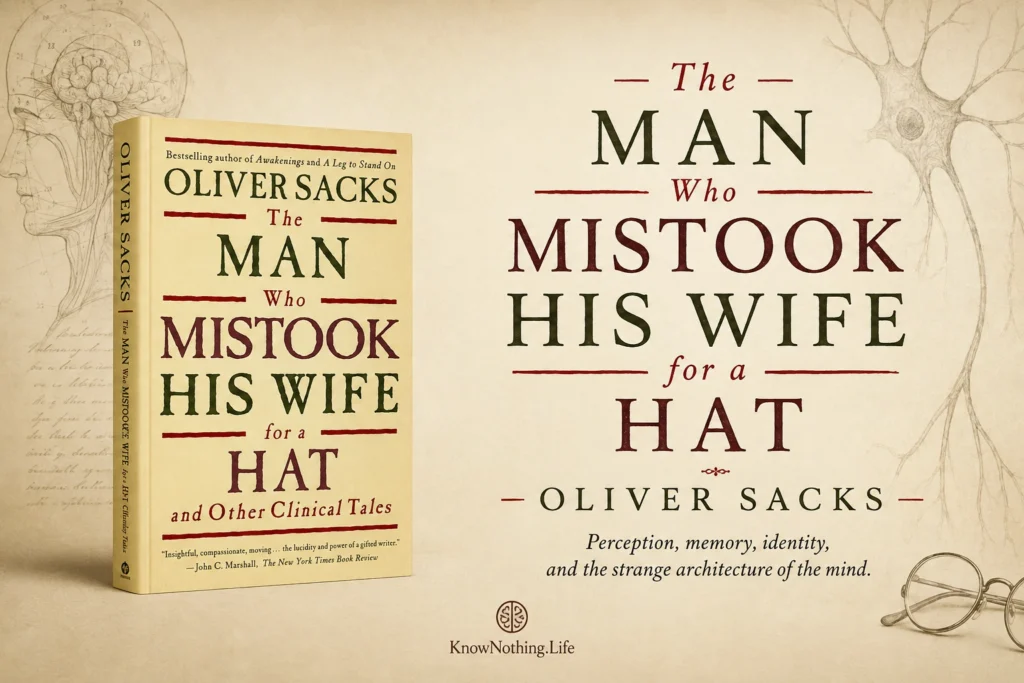
Oliver Sacks’ The Man Who Mistook His Wife for a Hat is one of the most influential works of popular neurology because it asks readers to look beyond diagnosis and consider what neurological illness actually does to a person’s world. First published in 1985, the book collects twenty-four clinical narratives organized into four broad sections—“Losses,” “Excesses,” “Transports,” and “The World of the Simple.” The patients experience disturbances of recognition, memory, proprioception, attention, movement, perception, identity, and intellectual development. Some have lost capacities that most people never realize they possess; others experience an excess of neurological activity; still others inhabit altered worlds of reminiscence, hallucination, music, numbers, or unusually concrete forms of thought. Sacks described the pieces as short narratives, essays, and even parables rather than conventional clinical reports, reflecting his desire to preserve the individuality of the people behind the neurological syndromes.
That method owes a considerable debt to Soviet neuropsychologist Alexander Luria, especially The Mind of a Mnemonist and The Man with a Shattered World. Luria championed what he called “romantic science,” an approach that resisted reducing human beings to isolated variables and tried instead to preserve the richness of an individual life. Sacks corresponded with Luria during the 1970s and repeatedly acknowledged his influence. The result is a form of neurological writing that sits between medicine, psychology, biography, and philosophy. Sacks does not deny the importance of lesions, neural systems, or diagnostic categories; he asks what those mechanisms mean when they alter the way a particular person recognizes a spouse, remembers yesterday, inhabits a body, makes music, or understands the surrounding world.
Dr. P and the Difference Between Seeing and Recognizing
The title case concerns Dr. P, a talented musician whose eyesight in the ordinary sense remains functional but whose ability to recognize what he sees has become profoundly disturbed. He can inspect parts of objects in extraordinary detail while failing to grasp the meaningful whole. Faces become collections of features rather than immediately recognizable people. In the book’s unforgettable culminating episode, he reaches toward his wife’s head as though it were his hat. What appears at first like absurd behavior becomes evidence of a profound dissociation: vision is not the same thing as recognition. Dr. P receives visual information, but the normal transformation of that information into coherent, meaningful objects has broken down.
Modern neuroscience places such symptoms within the family of visual agnosias. Visual object agnosia refers to an inability to recognize familiar objects visually that cannot simply be explained by poor visual acuity, language impairment, intellectual decline, or loss of the underlying conceptual knowledge. Different forms can selectively disrupt the processing or integration of shape, objects, words, faces, or spatial relationships. Contemporary reviews specifically cite Sacks’s title patient as a famous example of high-level visual-recognition disturbance. Research has also shown that object recognition depends on distributed visual networks rather than on a single act of “seeing.” Damage can leave elementary vision relatively intact while disrupting the construction of meaningful perceptual wholes. Dr. P therefore illustrates one of the book’s central lessons: the seamlessness of ordinary consciousness hides a complex architecture. Neurological disease can separate processes that everyday experience makes appear indivisible.
Faces, Wholes, and the Construction of a Perceptual World
Dr. P’s difficulty recognizing faces brings the discussion close to prosopagnosia, or face blindness. Face recognition normally feels instantaneous, yet contemporary research shows it involves multiple stages, from encoding facial structure to generating familiarity and linking that familiarity with knowledge about a particular person. Acquired prosopagnosia can occur following brain injury, while developmental forms occur without an obvious acquired lesion. Research particularly implicates regions within occipitotemporal networks, including areas associated with the fusiform gyri, although face recognition depends on a larger distributed system. Studies of prosopagnosia have become especially valuable precisely because selective impairment can reveal the component processes normally hidden within effortless recognition.
The philosophical significance is equally important. Maurice Merleau-Ponty argued in Phenomenology of Perception that perception is not the passive reception of disconnected sensory data. We normally encounter meaningful wholes—a face that belongs to a friend, a chair that can be sat upon, a room that invites movement—because perception is already organized through our embodied engagement with the world. Dr. P’s condition reveals what happens when that organization breaks apart. He may describe contours, colors, shapes, and geometrical relations correctly while missing the human or practical significance that normally arises immediately. The world remains visible but becomes less familiar. Sacks’ neurological case therefore converges with a phenomenological insight: reality as experienced is not simply delivered to consciousness; it is continuously organized into meaningful forms.
Memory and the Fragility of Personal Continuity
“The Lost Mariner” presents another of the book’s most affecting cases. Jimmie G., a former sailor with profound amnesia associated with Korsakoff syndrome, remains mentally situated decades in the past. He can speak intelligently and behave socially, yet new experiences fail to establish durable continuity. A conversation may disappear soon after it occurs. The man standing before Sacks possesses language, personality, habits, and remote memories, yet lacks much of the ordinary autobiographical bridge between one moment and the next. The case forces the reader to ask how much personal identity depends upon memory. If yesterday cannot be joined to today, what makes a life feel like one continuous life rather than a succession of disconnected moments?
Modern research on Korsakoff syndrome confirms that it is far more than ordinary forgetfulness. The syndrome is strongly associated with severe thiamine deficiency and can involve profound anterograde and retrograde amnesia, executive dysfunction, apathy, and confabulation. Studies of Korsakoff patients also contributed importantly to the realization that memory is not a single faculty: episodic memory, contextual memory, procedural learning, priming, and other functions can be disrupted to different degrees. Sacks turns this neuropsychological fact into an existential problem. William James described consciousness as a stream, but that stream depends upon memory continually binding the present to what preceded it. Jimmie’s tragedy is therefore not simply that he forgets facts. His neurological disorder damages one of the mechanisms through which time becomes biography.
The Disembodied Lady and the Invisible Sense of Self
In “The Disembodied Lady,” Sacks introduces Christina, a woman who loses proprioceptive sensation throughout much of her body. She retains muscular strength but loses the ordinary internal knowledge of where her limbs are and how they are positioned. Tasks that once occurred automatically now require intense visual supervision. She must watch herself in order to coordinate movement. When visual control is removed, her body can become almost inaccessible to voluntary action. Sacks calls attention to proprioception because it is one of the most important senses precisely because healthy people almost never notice it. Vision may tell us what is in front of us, but proprioceptive signals continually tell the nervous system where the body itself is.
The case anticipates themes Sacks explored more personally in A Leg to Stand On. It also connects strongly with modern work on body schema and embodiment. Contemporary neuroscience treats bodily awareness as the product of ongoing integration among proprioceptive, tactile, visual, vestibular, and motor information. When one of these systems is lost, conscious strategies may sometimes compensate, but ordinary embodied action becomes extraordinarily difficult. Merleau-Ponty’s philosophy again provides a useful parallel: the body is normally experienced not primarily as an object we inspect but as the practical means through which we inhabit the world. Christina reveals this principle clinically. Her disorder does not merely remove one sensory input; it changes the ordinary relationship between intention, movement, body, and world.
Tourette Syndrome and the Border Between Voluntary and Involuntary Action
The book’s second section, “Excesses,” challenges medicine’s traditional emphasis on neurological loss. In “Witty Ticcy Ray,” Sacks describes a man with Tourette syndrome whose rapid tics, gestures, vocalizations, and impulsive behavior have become interwoven with his personality and social style. Treatment can reduce the symptoms, but Ray experiences the change ambiguously. The tics interfere with life, yet the speed and spontaneity associated with them have also become connected to his creativity and sense of self. Sacks therefore faces a therapeutic question more difficult than simply suppressing abnormal movement: What happens when a neurological symptom has become entangled with a person’s identity?
Modern Tourette research strengthens another insight found in the case. Tics do not fit comfortably into a simple voluntary-versus-involuntary distinction. Many people experience uncomfortable premonitory urges that build before a tic and are temporarily relieved when the movement or vocalization occurs. Tics can often be suppressed for a time, but suppression may produce mounting discomfort. Researchers have consequently described them as partly “unvoluntary”—actions that involve awareness and limited control without being freely chosen in the ordinary sense. This complicates philosophical ideas of agency. Human action is not always divided neatly into things we choose and things that merely happen to us. Neurology reveals intermediate states in which desire, urge, inhibition, bodily pressure, and conscious decision overlap.
Neglect and the Possibility of Losing Half a World
Other cases demonstrate that perception can fail not because sensory information disappears but because attention no longer incorporates it into conscious experience. “Eyes Right!” concerns a patient who behaves as though one side of space scarcely exists. Such conditions belong to the family now called hemispatial neglect, most commonly associated with right-hemisphere injury and reduced attention toward the left side of space. A person may eat only from one side of a plate, groom one side of the face, or fail to respond to objects on the neglected side despite possessing basic sensory capacity there.
Modern neuroscience confirms that neglect is fundamentally different from blindness. It reflects disrupted systems of spatial attention and awareness and is often heterogeneous, with different patients showing different combinations of perceptual, representational, and motor deficits. The philosophical implications are unsettling. We ordinarily assume that the world exists in consciousness because our senses deliver it to us. Neglect shows that sensation alone is insufficient. Attention helps determine what becomes experientially present. A part of the environment can continue sending signals to the nervous system while effectively disappearing from the person’s lived world. Sacks repeatedly uses neurological disorders in this way—not merely as pathological curiosities, but as natural experiments revealing the hidden operations that make normal consciousness possible.
Excesses, Transports, and Minds That Do More Rather Than Less
Sacks’ decision to include “Excesses” and “Transports” is important because neurology historically became adept at describing functions that disappear after injury: paralysis, aphasia, blindness, amnesia. But nervous systems can also produce too much. Tics, compulsions, hallucinations, sudden reminiscences, heightened sensory experiences, and abnormal emotional states may emerge from excessive or disinhibited activity. The section titled “Transports” explores episodes in which memory or perception becomes unusually vivid, sometimes in association with seizures, migraine-like phenomena, drugs, or other changes in brain state. Instead of asking only what has been lost, Sacks asks what happens when normal constraints on neural activity are loosened.
This broader framework became characteristic of Sacks’ later books, especially Migraine, Musicophilia, and Hallucinations. It also points toward a fundamental psychological principle: normal cognition depends as much upon inhibition and selection as upon activation. Consciousness would not necessarily improve if every memory, sensation, impulse, and association became simultaneously available. The coherent mind is partly an edited mind. Neurological excess therefore provides another route into understanding normality. Just as amnesia reveals why forgetting and remembering must be balanced, Tourette syndrome reveals the importance of motor inhibition, and hallucination reveals the brain’s capacity to generate perceptual experience even when the corresponding external object is absent.
Music, Art, and Capacities That Survive Cognitive Loss
In “The World of the Simple,” Sacks turns to people whose conventional cognitive assessments might emphasize intellectual limitation but whose abilities in music, drawing, storytelling, calculation, or concrete perception can be remarkable. These chapters are among the clearest examples of his dissatisfaction with measuring people exclusively by deficits. A standard test may demonstrate what a person cannot perform under abstract conditions while failing to reveal capacities that emerge naturally through music, art, routine, or emotionally meaningful activity. Sacks repeatedly looks for the form in which a person’s intelligence actually lives.
Modern neuropsychology supports the broader principle that cognitive abilities can dissociate sharply. A person may lose semantic knowledge for words and objects while retaining sophisticated musical knowledge, as demonstrated in a published case of a semiprofessional musician with semantic dementia who retained expressive musical capacities despite severe verbal and object-semantic impairment. Research on Korsakoff syndrome likewise demonstrates that explicit and implicit forms of memory can be affected differently. Sacks’s literary language is less precise than contemporary cognitive models, but his clinical intuition was powerful: a global label such as “impaired” may conceal a highly uneven landscape of preserved and damaged abilities.
The Neurological Case History as a Story of Personhood
What ultimately distinguishes The Man Who Mistook His Wife for a Hat is not the rarity of its disorders but the way Sacks writes about them. He treats the neurological patient as a person attempting to create a workable life under altered conditions. This approach closely anticipates what Rita Charon later formalized as narrative medicine, which argues that good clinical care requires the ability to recognize, interpret, and respond to patients’ stories rather than relying on biomedical data alone. Laboratory results can reveal where function has failed, but they may not reveal how someone compensates, what the loss means personally, or which surviving capacities allow life to remain meaningful.
The approach should not be confused with modern controlled clinical research. Sacks’ pieces are literary clinical narratives, and even he described them as essays and parables as well as case histories. Their scientific value lies partly in detailed observation and hypothesis generation rather than statistical generalization. This is very much in the tradition of Luria’s “romantic science,” which sought to preserve the individual while still investigating the nervous system. Sacks’ enduring contribution was to demonstrate that understanding a disorder and understanding a person with that disorder are related but not identical achievements.
Why The Man Who Mistook His Wife for a Hat Still Matters
Much has changed in neurology since 1985. MRI, functional neuroimaging, computational models, genetics, network neuroscience, and decades of cognitive experimentation now allow researchers to describe many of Sacks’s disorders more precisely. Visual agnosia is divided into multiple subtypes; face recognition is analyzed through sophisticated cognitive and neural models; neglect is understood as a heterogeneous disturbance of attention; memory is divided into interacting systems; and Tourette syndrome is studied through cortico-striatal circuits and the neurobiology of premonitory urges. Yet modern research repeatedly confirms the broad lesson that made Sacks’s cases so compelling: the human mind is composed of partially separable systems whose interaction normally creates the illusion of effortless unity.
That is why the book remains more than a collection of unusual medical stories. Dr. P shows that seeing is not recognizing. Jimmie shows that memory helps construct continuity of self. Christina reveals the normally invisible sensory foundation of embodiment. Ray complicates the distinction between voluntary and involuntary action. Patients with neglect demonstrate that attention helps create the experienced world. Others show that music, art, humor, habit, and personality may survive even when conventional cognitive capacities are profoundly disrupted. Sacks’s central achievement is to make neurological disorder illuminate ordinary human life. By examining what happens when one component of consciousness disappears, intensifies, or becomes disconnected from the rest, The Man Who Mistook His Wife for a Hat asks perhaps the most important question in all of Sacks’s writing: What are the hidden neurological conditions that allow each of us to experience ourselves as one continuous, embodied, recognizable person?