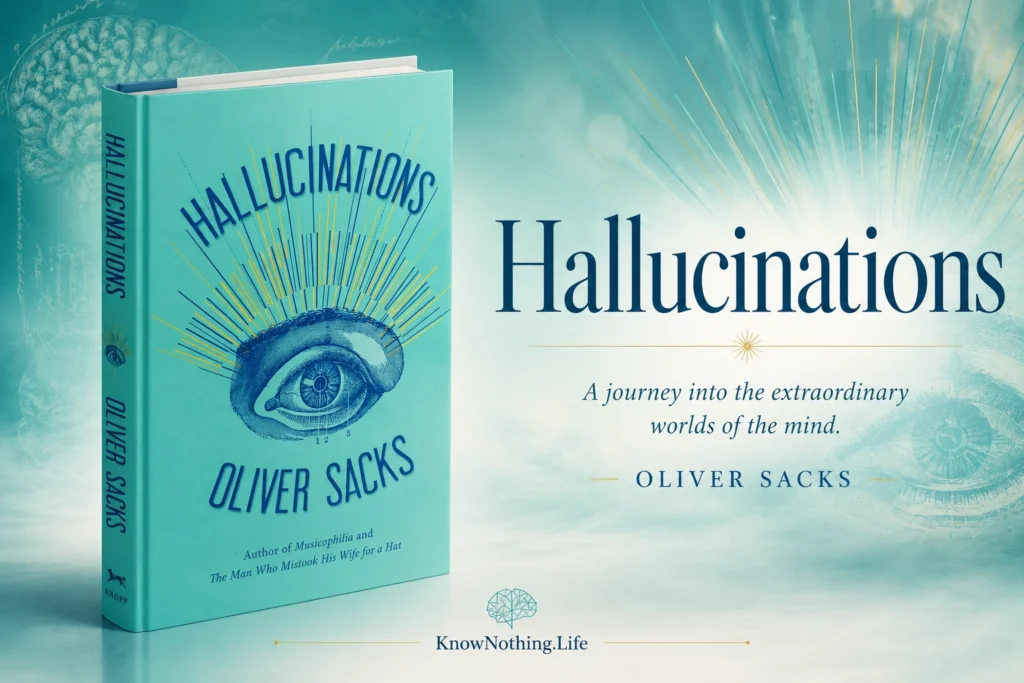
Oliver Sacks’ Hallucinations, published in 2012, begins by challenging one of the most entrenched assumptions about unusual perceptual experiences: seeing or hearing something that is not externally present does not automatically mean a person is psychotic. Hallucinations can accompany psychiatric illness, but they can also arise through migraine, epilepsy, Parkinson’s disease, visual or hearing loss, fever, sleep transitions, bereavement, medication, sensory deprivation, intoxication, and numerous other circumstances. Sacks draws upon patients, historical accounts, correspondence from readers, medical literature, and his own experiences to create something closer to a natural history of hallucination than a conventional textbook. The range is deliberate. His central argument is that the human brain possesses an intrinsic capacity to generate convincing perceptual worlds, and under certain conditions that ordinarily hidden ability becomes visible.
This makes Hallucinations a natural continuation of themes Sacks had explored throughout Migraine, Musicophilia, The Man Who Mistook His Wife for a Hat, and The Mind’s Eye. Perception is not simply an open window through which reality enters consciousness. The nervous system continuously interprets incomplete sensory information, compares it with memory and expectation, and constructs the coherent experiences we call seeing and hearing. Hallucinations make this constructive process conspicuous because perception continues even when the usual external stimulus is missing. Large population studies also support Sacks’ effort to remove hallucinations from an exclusively psychiatric framework. Research suggests that hallucinatory experiences occur among otherwise healthy people, with estimates varying greatly depending on definitions and methods; one large cross-national study found lifetime hallucination-like experiences in about 5 percent of respondents. The difference between ordinary perception and hallucination may therefore be less absolute than it first appears.
Charles Bonnet Syndrome and the Brain That Fills the Silence of Vision
One of Sacks’ favorite examples is Charles Bonnet syndrome, in which people with impaired eyesight experience vivid visual hallucinations while often retaining awareness that what they are seeing is unreal. The syndrome takes its name from the eighteenth-century Swiss naturalist and philosopher Charles Bonnet, who described the extraordinary visions experienced by his elderly grandfather after severe visual impairment. People with Charles Bonnet syndrome may see simple geometric patterns, brilliant colors, miniature figures, animals, faces, elaborate landscapes, or entire scenes. The hallucinations may be beautiful, amusing, disturbing, or simply bewildering. Crucially, they need not indicate dementia or psychiatric illness. Modern reviews estimate that the syndrome may affect roughly 11–15 percent of people with significant sight loss, though prevalence estimates vary because many people never report the experiences.
The prevailing explanation involves deafferentation or “release”: when normal visual input decreases, visual cortical systems no longer receive the amount of external stimulation they ordinarily process, and spontaneous activity may become experienced as imagery. Experiments provide an intriguing parallel. In one study described in the clinical literature, normally sighted volunteers were blindfolded continuously, and most eventually reported visual hallucinations. The philosophical implication is profound. The visual cortex is not a blank screen waiting for photographs from the eyes. It possesses organized tendencies capable of producing forms, colors, faces, and movement. Sacks therefore turns Charles Bonnet syndrome into an argument about normal perception: the brain does not merely receive images—it participates in making them.
Hearing Voices and the Continuum of Human Experience
Auditory hallucinations carry perhaps even greater stigma than visual ones because “hearing voices” has become culturally synonymous with severe mental illness. Sacks refuses that equation. Voices can occur in psychotic disorders, but they can also appear in people without psychiatric diagnoses, during sleep transitions, bereavement, sensory impairment, epilepsy, neurological illness, extreme stress, or sometimes without an obvious pathological cause. Studies of community populations reinforce this continuum. A national survey of 2,533 adults found that 7.3 percent reported having experienced auditory verbal hallucinations at some point, while only 16 percent of those people sought professional help. Cross-national research likewise indicates that hallucinations occur outside clinical populations and vary widely in significance, frequency, emotional content, and impact.
This perspective changes the psychological question from “Why does a diseased mind invent voices?” to the broader question “How does any brain determine whether an internally represented voice comes from itself or from the external world?” Inner speech is already a peculiar phenomenon: people routinely “hear” words internally while knowing those words are self-generated. Hallucination may involve alterations in how internally generated representations are attributed or weighted. Modern predictive-processing research adds another dimension. In a 2017 Science study, Albert Powers, Christoph Mathys, and Philip Corlett conditioned participants to expect a tone following a visual cue. Participants sometimes reported hearing tones that were not played, and people who regularly heard voices were particularly susceptible. Computational modeling suggested that unusually strong perceptual expectations—or “priors”—could help generate experiences in the absence of sufficient sensory evidence. Sacks’s clinical stories anticipated the broader conclusion: the brain’s capacity to generate voices is not foreign to perception but built from mechanisms perception normally uses.
Musical Hallucinations and Memories That Become Perceptions
Sacks had already explored involuntary music extensively in Musicophilia, and Hallucinations places musical hallucinations within a broader spectrum of internally generated experience. Some people hear complete songs, choirs, orchestras, hymns, or repeated fragments of music with extraordinary clarity despite the absence of an external source. These experiences often occur in older adults with hearing loss and can function as an auditory counterpart to Charles Bonnet syndrome. A review of musical hallucinations found strong associations with hearing impairment while also identifying epilepsy, focal brain lesions, medication or intoxication, and psychiatric illness among other possible causes.
What makes musical hallucination especially revealing is its relationship with memory. The brain is not usually generating meaningless acoustic noise. It may produce familiar hymns, childhood songs, melodies heard decades earlier, or music of deep personal significance. A review of reported cases noted that familiar and autobiographically meaningful music is common. The boundary between remembering a song and hearing it therefore becomes unstable. Normally, an imagined melody has what psychologists call a different phenomenological quality from externally heard sound; we know it is “in the head.” In musical hallucination, memory can acquire perceptual force. Sacks uses such cases to show that memory is not simply stored information. Neural systems capable of remembering music contain enough structural detail to recreate aspects of musical experience itself.
Migraine, Geometry, and the Visual Machinery of the Cortex
Sacks’ fascination with hallucination began partly through his lifelong study of migraine. Migraine aura can produce scintillating zigzags, fortification patterns, expanding arcs, flickering lights, blind regions, distortions of size, and occasionally more elaborate hallucinations. What fascinated Sacks was the recurrent geometry. Similar patterns appear across different people who have never met, suggesting that the structure of the visual system itself contributes to what they see. A modern review of migraine aura describes cortical spreading depolarization as a leading physiological mechanism and notes how mathematical models of neural excitation and inhibition can reproduce characteristic geometric visual forms.
These experiences give Sacks a route into an old philosophical problem: how much of perception belongs to the world and how much belongs to the perceiver? Immanuel Kant argued that experience is structured by capacities of the mind rather than simply copied from reality, while later phenomenologists such as Maurice Merleau-Ponty emphasized the active organization of perceptual experience. Migraine provides a neurological version of this insight. The zigzag seen during aura does not exist in external space, yet neither is it random fantasy. Its form reflects organized activity within a visual system evolved to represent edges, orientation, movement, and spatial relations. Hallucination can therefore reveal the anatomy of perception indirectly. Sacks treats the unusual image almost as a fossil imprint of neural architecture—a moment when the brain’s own geometry becomes visible to consciousness.
Sleep, Paralysis, and Creatures at the Edge of Consciousness
Some of the most universal hallucinations occur during the transition into or out of sleep. Hypnagogic experiences arise while falling asleep; hypnopompic experiences occur while waking. People may hear their names, see faces, experience vivid scenes, feel someone entering the room, or sense a threatening figure nearby. Sleep paralysis can intensify the experience dramatically: awareness returns while normal REM-related muscle inhibition persists, leaving the person awake but temporarily unable to move. In this condition an internally generated figure can be experienced not simply as an image but as an intensely convincing presence. Reviews of auditory hallucinations in healthy populations report sleep-transition experiences as common, with older epidemiological work estimating hypnagogic experiences in roughly a quarter of respondents and hypnopompic experiences in somewhat fewer.
Sacks is particularly interested in how such physiology may contribute to cultural traditions. Accounts of night demons, supernatural visitations, incubus figures, ghosts, and beings pressing upon sleepers recur across history. The neurological explanation does not prove that every religious or supernatural narrative arose from sleep paralysis, but it demonstrates how the brain can generate experiences possessing exactly the properties from which such narratives might grow: immobility, fear, sensed presence, visual form, and overwhelming conviction. William James, in The Varieties of Religious Experience, argued that unusual states of consciousness deserve psychological investigation regardless of the metaphysical interpretations attached to them. Sacks adopts a similar stance. Neuroscience can ask how an experience arises without dictating what meaning a culture or individual ultimately assigns to it.
Grief, Ghosts, and the Presence of the Dead
Bereavement offers another example of hallucination outside psychiatric illness. People who have lost spouses or other loved ones sometimes hear a familiar voice, glimpse the deceased person, feel someone sitting beside them, or experience an unmistakable sense that the person is present. Sacks treats these accounts with characteristic restraint. He neither interprets them as proof of an afterlife nor dismisses them as evidence of pathology. Instead, he asks how attachment, memory, expectation, and perception interact when a person who has occupied a central place in someone’s world suddenly disappears.
Research suggests such experiences are surprisingly common. In a classic study of 293 widowed people, almost half reported some form of experience involving their deceased spouse, most commonly a sensed presence; many regarded the encounters as comforting. Later studies have broadly confirmed that post-bereavement experiences can occur without mental illness and may persist for years. An interdisciplinary review concluded that the great majority of sensory or quasi-sensory experiences of the deceased are benign and should be understood within their biographical and cultural context rather than automatically pathologized. Sacks’s insight is psychologically subtle: the brain builds models not only of objects but of people. A loved one who has been predicted, heard, watched, and anticipated thousands of times may remain powerfully represented even after death removes the external person from the environment.
Parkinson’s Disease and the People Who Appear From Nowhere
Visual hallucinations are also important in Parkinson’s disease and dementia with Lewy bodies. People may see strangers in the room, children playing, animals passing nearby, or figures standing silently in peripheral vision. These hallucinations can be highly detailed and may initially occur with preserved insight. Earlier surveys found hallucinations in a substantial minority of people with Parkinson’s disease, while more recent reviews suggest that visual hallucinations may affect up to three-quarters of patients at some point over the entire disease course when minor phenomena are included. Their emergence is associated with interacting factors including disease progression, cognitive changes, sleep disturbance, visual processing, medication, and changes within distributed brain networks.
Sacks emphasizes that hallucinatory content alone rarely identifies the underlying cause. Seeing a person who is not there can occur in Charles Bonnet syndrome, Parkinson’s disease, sleep-related hallucination, bereavement, epilepsy, drug states, or psychosis, yet these phenomena differ greatly in context and mechanism. Clinical interpretation therefore requires attention to when, how, and with what level of insight the experience occurs. This is characteristic of Sacks’ approach to neurology as a whole. A symptom cannot be understood merely by assigning it a label. Its timing, accompanying symptoms, emotional meaning, sensory modality, medical context, and relationship to the person’s life all matter.
Psychedelics, William James, and Sacks’s Own Altered States
Unlike many of his books, Hallucinations includes remarkably candid accounts of Sacks’s own experiences with psychoactive drugs during the 1960s. As a young physician in California, he experimented with substances capable of profoundly altering perception, an episode he later discussed as part of the personal history that drew him toward studying hallucinations. The Oliver Sacks Foundation notes that psychedelics, together with Sacks’s own migraine experiences, helped launch his lifelong interest in unusual perceptual states. He describes these experiences historically and autobiographically rather than as recommendations, and the retrospective tone is often ambivalent: fascination exists alongside recognition of risk and compulsive behavior.
Sacks places drug-induced hallucination within humanity’s ancient pursuit of altered consciousness. Societies have used psychoactive plants and compounds in religious, medical, divinatory, and recreational contexts for millennia. Here he again approaches William James, who deliberately investigated altered states while writing The Varieties of Religious Experience. James was interested in the possibility that ordinary waking consciousness represents only one organization of mental life rather than the total range of possible experience. Sacks gives that proposition a neurological foundation. Change the chemistry, electrical activity, sensory input, or state of the brain, and what counts as immediate reality may change dramatically. The fact that these experiences can feel utterly convincing is not evidence that perception is unreliable in general; it is evidence that conviction itself is partly a product of the neural machinery producing experience.
Hallucination and the Predictive Brain
Modern neuroscience gives especially strong support to one of the larger conclusions emerging from Sacks’ stories: perception is an inference. The brain receives sensory signals that are incomplete and ambiguous, then uses previous experience and expectation to infer what probably caused them. Under ordinary conditions, sensory evidence and expectation constrain one another effectively. Hallucination may emerge when that balance shifts—for example, when sensory input becomes weak through blindness or deafness, when internally generated activity becomes unusually strong, or when expectations exert excessive influence over interpretation.
Powers and colleagues’ conditioned-hallucination experiment provides a particularly elegant demonstration. After learning that a visual cue predicted a faint tone, participants sometimes reported hearing the tone even when it was absent. Voice-hearers were more susceptible, and computational analysis implicated stronger weighting of prior expectations. Subsequent theoretical work describes hallucinations as an extreme illustration of the constructive nature of ordinary perception rather than as a completely alien cognitive process. This does not mean all hallucinations share one mechanism; Sacks’ book argues strongly against such simplification. But predictive processing provides a useful conceptual bridge between everyday perception and experiences once regarded as inexplicable.
Why Hallucinations Still Matters
The enduring importance of Hallucinations lies partly in its attack on stigma. A person who sees a tiny figure, hears a deceased spouse, wakes to a threatening presence, experiences a geometric migraine aura, or hears music in silence may be terrified less by the experience itself than by what they think it means about their sanity. Sacks repeatedly shows that hallucinations are symptoms and experiences, not diagnoses. Their significance depends upon context. Modern epidemiology strongly supports his broad view: hallucinatory experiences exist on a continuum and occur in people both with and without a need for psychiatric care.
More fundamentally, the book changes the way we think about normal perception. Hallucinations expose what the brain is always doing quietly: generating hypotheses, completing missing information, activating memories, constructing spatial scenes, representing absent people, and predicting what should come next. Charles Bonnet syndrome reveals what visual cortex can create when input fades. Musical hallucinations show memory acquiring sensory vividness. Migraine aura exposes the geometry of visual processing. Sleep phenomena blur dreaming and waking consciousness. Bereavement demonstrates how deeply other people become represented in the mind. Hallucinations therefore arrives at one of Oliver Sacks’s characteristic conclusions: neurological strangeness is valuable because it reveals something universal. The capacity to hallucinate is not simply a defect at the margins of human consciousness; it grows from the same creative neural machinery that allows all of us to perceive a coherent reality in the first place.