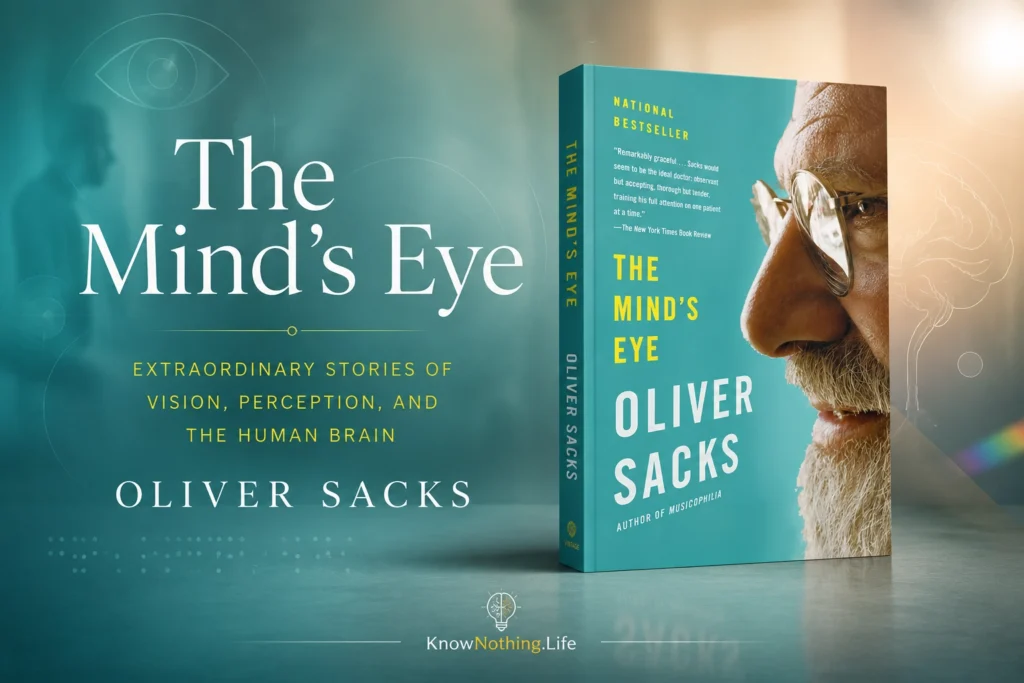
Oliver Sacks’ The Mind’s Eye, published in 2010, is a collection of neurological narratives about people whose relationships with vision, language, recognition, and spatial experience have been profoundly altered. Its subjects include a concert pianist who gradually loses the ability to read music and recognize objects, a novelist who can continue writing but can no longer read, a woman with severe aphasia who reconstructs a rich social life without ordinary speech, people unable to recognize familiar faces, a neurobiologist who unexpectedly develops stereoscopic vision in middle age, and blind individuals whose inner visual worlds vary enormously. Sacks ultimately enters his own book as a patient after an ocular melanoma damages his vision. The cases are joined by a deceptively simple question: What does it actually mean to see?
Like The Man Who Mistook His Wife for a Hat and An Anthropologist on Mars, The Mind’s Eye uses neurological disruption to expose processes that normally remain invisible. Healthy perception feels immediate: we open our eyes and assume the world simply appears. Sacks shows instead that successful vision requires many partially independent operations. The brain must distinguish forms, recognize objects and faces, interpret depth, connect visual marks with language, maintain spatial orientation, and integrate sensory information with memory and emotion. Damage can separate these processes in startling ways. A person may see letters without being able to read them, see a face without knowing whose face it is, or accurately judge distance without ever experiencing the vivid binocular depth most people take for granted. In this sense, The Mind’s Eye continues one of Sacks’s lifelong arguments: neurological disorders reveal the architecture of ordinary consciousness precisely by taking pieces of it apart.
Lilian and the Difference Between Looking and Recognizing
The opening case concerns Lilian, an accomplished concert pianist who begins encountering mysterious difficulties with musical notation. Notes that once carried immediate meaning become harder to interpret. The problem spreads to printed words and eventually to familiar objects. Sacks finds that her basic eyesight remains relatively good: she can discriminate colors, forms, movement, and depth. Yet when shown pictures, she may perceive individual lines or details without being able to synthesize them into a meaningful whole. She begins compensating by using color, context, location, and routine. An object sitting where it normally belongs may remain identifiable, while the same object moved somewhere unexpected becomes confusing. Her world is visually present but increasingly difficult to organize.
Lilian’s experience belongs to the broad territory of visual agnosia, disorders in which vision can remain sufficiently intact for someone to perceive visual features while recognition itself becomes impaired. Neuropsychologist Martha Farah’s influential Visual Agnosia describes a remarkable range of dissociations: some patients lose recognition of objects but not faces, others show the opposite pattern, and still others can guide an action toward an object despite lacking conscious recognition of what it is. The philosophical relevance recalls Maurice Merleau-Ponty’s Phenomenology of Perception. Perception is not merely the reception of raw sensory fragments; it normally gives us meaningful things—a piano, a cup, a familiar face—without requiring us to consciously reconstruct them from lines and colors. Lilian’s condition shows what happens when that normally effortless synthesis begins to dissolve. She can still look, but looking no longer guarantees recognition.
Howard Engel and the Strange Possibility of Writing Without Reading
Canadian novelist Howard Engel presents one of the book’s most extraordinary dissociations. After a stroke, Engel discovers that written words have become visually unintelligible. He can still speak, understand language, think in words, and—most astonishingly—write. What he cannot do normally is read, including reading what he himself has just written. The syndrome is known as alexia without agraphia, or pure alexia. It had been described as early as 1892 by French neurologist Joseph Jules Dejerine and remains one of neurology’s classic demonstrations that abilities we assume belong together can depend upon partially separable systems.
Pure alexia is particularly revealing because reading is culturally recent. Human beings have been reading for only a small fraction of evolutionary history, so there could not have evolved a brain system whose original biological purpose was reading books. Instead, literacy recruits preexisting systems for visual recognition and language. Contemporary research associates pure alexia particularly with damage affecting left occipitotemporal regions and their connections; patients can preserve speech and writing while reading becomes extremely slow, letter-by-letter, or temporarily impossible. Engel responds in quintessentially Sacksian fashion—not by accepting that his identity as a writer has ended, but by inventing compensations. He traces letters, uses auditory methods, and develops ways of continuing his literary work. The case becomes an argument that identity is not identical with any single neurological faculty. A writer may lose ordinary reading and still find a different path toward writing.
Aphasia and Communication Beyond Fluent Speech
Another subject, Pat, challenges the assumption that language and personhood disappear together when ordinary speech is severely damaged. After aphasia leaves her unable to construct normal sentences, she nevertheless remains socially expressive. Tone of voice, gesture, facial expression, humor, context, fragments of language, and intimate familiarity with other people allow communication to continue. Sacks presents her not as someone reduced to the absence of speech but as a person who gradually discovers other routes into relationship. The official description of The Mind’s Eye emphasizes that she rebuilds herself as an active and affectionate member of her community despite her profound linguistic limitation.
Her story connects with a larger theme running from Sacks’s Seeing Voices through Musicophilia: human communication is richer than propositional language alone. Speech is extraordinarily powerful, but social understanding also depends on rhythm, gaze, gesture, shared history, emotional expression, and embodied interaction. This makes Pat’s case philosophically important. If we define the self primarily through articulate verbal thought, severe aphasia appears to threaten personhood itself. Sacks refuses that conclusion. Instead, he observes what survives and what can be rebuilt. His method resembles the “romantic science” of Alexander Luria, whose The Man with a Shattered World likewise sought to understand neurological damage through the whole life of the patient rather than through deficits alone. A neurological test may accurately record that a sentence cannot be produced; it does not therefore describe everything the person can still mean.
Face Blindness and the Social Importance of Recognition
Sacks also turns to prosopagnosia, or face blindness, a condition he experienced to a significant degree himself. Someone with prosopagnosia may see a face clearly yet fail to recognize whose face it is. Severe cases can make close friends, spouses, children, or even one’s own reflection difficult to identify without compensatory clues such as hairstyle, clothing, voice, posture, or context. Sacks describes the social embarrassment and confusion this can create. A person may appear aloof, inattentive, eccentric, or rude when the real problem is that recognizing individuals visually requires far more deliberate work than it does for most people.
The condition is also a striking example of how human abilities exist along continua. Developmental prosopagnosia occurs without an acquired brain injury, and estimates of its prevalence depend greatly on diagnostic criteria. A large 2023 study of 3,116 adults found prevalence estimates ranging widely depending on the cutoffs used and cautioned against the often-repeated claim that precisely 2 to 2.5 percent of people have the disorder. At the other end of the continuum are “super-recognizers,” people with unusually strong face memory. Sacks’ discussion exposes the psychological importance of an ability most people never consciously practice. Recognizing a face instantly is not simply visual classification; it anchors social continuity. The familiar face tells us, before explicit reasoning begins, who is here. When that capacity fails, social reality itself becomes less automatic.
Stereo Sue and the Rediscovery of Three-Dimensional Space
One of the book’s most joyful cases is that of neurobiologist Susan Barry, known as “Stereo Sue.” Because of childhood strabismus, Barry had never experienced normal stereopsis—the vivid sense of three-dimensional depth produced when the brain combines the slightly different images received by the two eyes. Like many people without stereopsis, she had no difficulty understanding that the world was three-dimensional. She relied successfully on perspective, relative size, occlusion, motion parallax, shadows, and other monocular depth cues. She could calculate distance. What she lacked was a particular experience of spatial depth. After beginning vision therapy in her late forties, Barry unexpectedly developed stereoscopic perception and found ordinary scenes transformed. Objects appeared to stand out from one another, tree branches enclosed palpable volumes of air, and falling snow occupied layers of depth rather than appearing on a comparatively flat visual field.
Her experience challenged a long-standing assumption that binocular visual development was essentially fixed after an early critical period. Subsequent experimental work by Jian Ding and Dennis Levi showed that adult perceptual learning could produce substantial recovery of stereopsis in five adults who had previously been stereoblind or severely stereo-deficient. Participants reported that depth began to “pop out,” although recovered stereopsis remained less precise than typical stereovision. Later research has provided additional evidence that some adults can improve stereoscopic function through training or successful alignment. Barry herself subsequently published research reviewing people who acquired stereopsis in adulthood. The chapter therefore illustrates one of Sacks’s favorite themes: the adult brain is more plastic than older neurological theories often allowed.
Sacks Becomes His Own Neurological Case
The emotional center of The Mind’s Eye may be Sacks’s account of his own visual illness. After being diagnosed with an ocular melanoma, he undergoes treatment and eventually loses most functional vision in his right eye. The experience brings a dramatic reversal of his usual role. He is accustomed to interviewing patients about altered perception; now perception becomes strange from inside his own consciousness. He describes distortion, visual hallucinations, persistent afterimage-like phenomena, loss of stereoscopic depth, and a peculiar disappearance of portions of space corresponding to his damaged field. Objects do not necessarily appear as obvious black holes. At times they seem to cease existing spatially, revealing how the brain normally hides visual absence rather than displaying it as a blank patch.
This first-person investigation echoes A Leg to Stand On, in which Sacks’ injured leg had temporarily stopped feeling fully incorporated into his bodily self. In both books, objective pathology and subjective experience overlap without being interchangeable. An ophthalmologist can map retinal damage, but such a map does not tell us what it feels like when a portion of the visible world becomes unstable. Sacks turns the experience toward a philosophical problem: perception is not the same thing as the image theoretically falling upon the retina. The mind continuously fills gaps, establishes spatial continuity, predicts what should be present, and produces a coherent world from incomplete signals. What feels like direct contact with reality is therefore an extraordinary achievement of neural integration.
Blindness, Mental Imagery, and Seeing Without Eyes
The book’s most ambitious questions emerge when Sacks considers blindness. Losing sight does not produce a single psychological outcome. Some people who become blind retain extraordinarily vivid visual imagery and continue organizing memories and thoughts visually. Others gradually lose visual imagery and become more strongly oriented toward auditory, tactile, spatial, or linguistic representations. People blind from birth can also develop sophisticated spatial concepts without ever having visual experience. Sacks is especially interested in this diversity because it challenges any attempt to equate thinking with internal pictures. A person can be highly imaginative without visual imagery, just as another person can remain intensely “visual” after the eyes cease providing useful information.
Neuroscience reinforces this complexity. Research on congenitally blind participants shows substantial cross-modal plasticity, including recruitment of occipital regions during auditory and tactile processing. Studies have also found that mental-spatial imagery can engage networks normally associated with vision even in people blind from birth, while rare cases of cortical blindness show that vivid visual imagery can survive extensive loss of primary visual cortex. Sacks also discusses sensory substitution, including devices inspired by the pioneering work of Paul Bach-y-Rita that translate visual information into tactile stimulation. Research using tongue-based tactile displays demonstrated that blind participants can learn to extract spatial information through patterns delivered to the tongue. Such experiments blur the ordinary boundaries separating “seeing,” “touching,” and “knowing where something is.”
The Mind’s Eye and the Philosophy of Perception
The title of the book refers to more than visual imagery. The “mind’s eye” is the internal system through which sensory information becomes meaningful experience. Sacks’s patients reveal that there is no single faculty called vision. Lilian can see details without recognizing objects. Howard can generate written language without visually decoding it. People with prosopagnosia perceive faces without accessing identity. Sue Barry understands depth before she experiences stereoscopic depth. Blind individuals can represent space without optical vision. Sacks himself can lose visual input without encountering a simple black void. Each case separates functions that ordinary experience fuses together.
This perspective places The Mind’s Eye close to the philosophical tradition of William James and Merleau-Ponty. In The Principles of Psychology, James emphasized that consciousness comes to us as an organized stream rather than as isolated sensory atoms. In Phenomenology of Perception, Merleau-Ponty argued that perception is inseparable from the embodied way we inhabit and act within a world. Sacks reaches similar conclusions through neurology. A disturbance of perception does not merely remove information from consciousness; it can reorganize the practical world itself. A printed page becomes meaningless decoration, a familiar face becomes anonymous, a previously flat-looking tree suddenly occupies astonishing depth. Neurological variation demonstrates that what seems to be a single objective world is encountered through biological systems with different capacities and histories.
Why The Mind’s Eye Still Matters
The Mind’s Eye is ultimately a book about adaptation rather than deficit. Sacks never denies the severity of neurological loss. Lilian’s recognition problems are devastating; Howard’s alexia threatens the practice around which his professional identity has been built; blindness can demand a complete reorganization of daily life. Yet the nervous system and the person do not merely register what has disappeared. They begin constructing alternatives. Location substitutes for recognition. Touch substitutes for visual reading. Sound replaces printed text. Monocular cues create workable depth without stereopsis. Auditory and tactile information can assume functions ordinarily assigned to vision. The brain changes, but so do habits, environments, technologies, relationships, and identities.
That insight connects The Mind’s Eye with nearly every major work Sacks wrote, from Awakenings and A Leg to Stand On to Seeing Voices, Musicophilia, and An Anthropologist on Mars. His neurological subjects reveal that human identity is neither infinitely flexible nor rigidly determined by a specific neural arrangement. We depend profoundly upon the brain, but when one pathway is lost, the organism often searches for another. Modern work on perceptual learning, sensory substitution, developmental prosopagnosia, and cross-modal plasticity has given increasingly precise scientific language to many of the processes Sacks described clinically. The enduring lesson of The Mind’s Eye is therefore larger than vision itself: we do not simply receive reality through the senses. The brain continuously constructs a usable world from whatever information, capacities, memories, and strategies remain available to it.