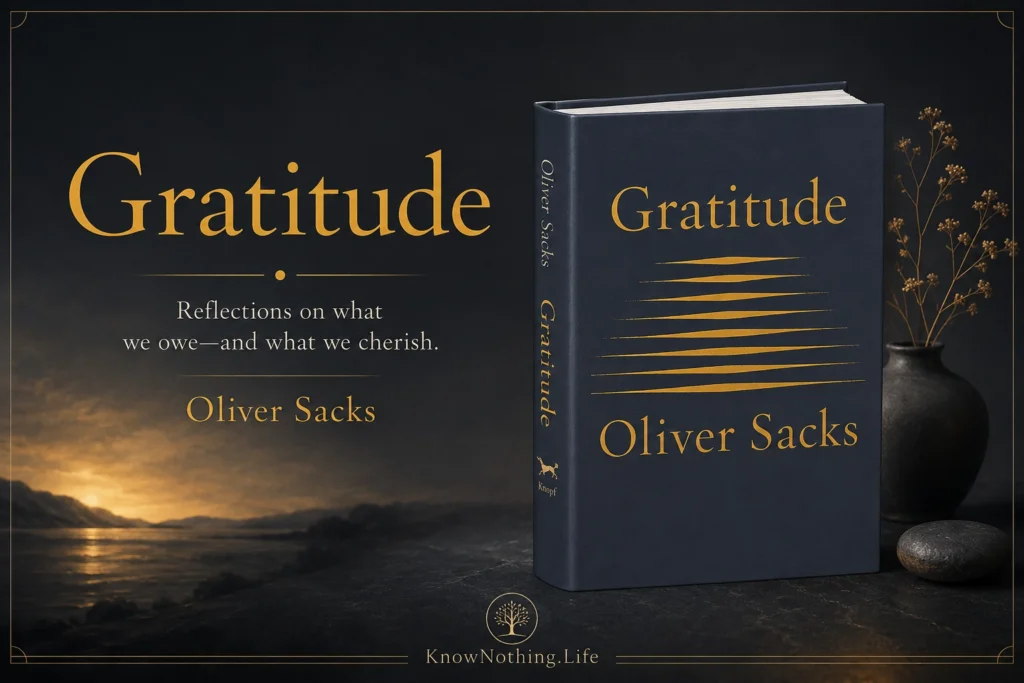
Oliver Sacks’ Gratitude is one of his shortest books and one of his most concentrated. Published posthumously in 2015, it gathers four autobiographical essays—“Mercury,” “My Own Life,” “My Periodic Table,” and “Sabbath”—written during the final years of Sacks’ life. The first grew from his reflections on turning eighty. The remaining pieces were shaped increasingly by the knowledge that metastatic cancer had left him little time. Rather than writing a conventional final memoir, Sacks compresses the concerns that had animated books such as Awakenings, Uncle Tungsten, Musicophilia, and On the Move into meditations on age, individuality, science, love, religion, mortality, and the extraordinary fact of having existed at all. The Oliver Sacks Foundation describes the collection as an exploration of “completing a life” and coming to terms with death, while remaining grateful for having lived one’s own unique life.
The title is important because Sacks does not approach gratitude as cheerful denial. He is not grateful instead of frightened, regretful, or sad. He recognizes unfinished work, lost possibilities, people he will miss, and aspects of life he wishes he had explored more fully. Gratitude becomes meaningful precisely because death is real. The essays resemble the ancient philosophical tradition in which awareness of mortality clarifies the value of life. Seneca’s On the Shortness of Life, Marcus Aurelius’ Meditations, Montaigne’s Essays, and later existential thinkers all ask what changes when human beings stop imagining time as unlimited. Sacks answers personally rather than systematically: mortality makes him want to withdraw from distractions, concentrate on what matters most, deepen his attention to friends and work, and experience the remaining world with greater intensity.
“Mercury” and the Unexpected Enlargement of Old Age
“Mercury” begins with Sacks turning eighty and linking his age to element 80 on the periodic table. This playful association is characteristic of him. Chemistry had structured his childhood imagination in Uncle Tungsten, and in old age the elements become markers of time: gold for seventy-nine, mercury for eighty, and other increasingly heavy elements waiting symbolically ahead. Yet the essay’s larger purpose is to challenge the idea that old age is merely a narrowing of life. The Oliver Sacks Foundation notes that Sacks described aging as bringing not a contraction but an enlargement of perspective. He has lost physical powers and friends, but he has gained something unavailable to his younger self: the ability to see decades of experience as a whole.
Modern lifespan psychology offers a striking parallel. Laura Carstensen’s socioemotional selectivity theory proposes that when people perceive their future time as limited, their priorities often shift away from goals centered on exploration and distant payoff toward experiences carrying immediate emotional meaning. The relevant variable is not simply chronological age; perceived endings—including serious illness or major life transitions—can produce similar changes. Experiments have even found that asking people to imagine a limited future can increase their relative attention to or recall of positive information regardless of age. Sacks’ reflections fit this pattern without reducing to it. His curiosity remains immense, but old age changes the economy of attention. Time becomes more precious because it is visibly finite.
“My Own Life” and Gratitude in the Face of Death
The emotional center of Gratitude is “My Own Life.” In January 2015 Sacks learned that a rare ocular melanoma previously treated in his eye had metastasized to his liver. His doctors told him that his remaining time would probably be measured in months. Within days, he began writing about the diagnosis. The resulting essay refuses both heroic defiance and despair. Sacks states plainly that he is afraid of dying, yet his dominant response is gratitude—for having loved and been loved, for work completed, for things given and received, and above all for the privilege of having been a conscious creature on Earth. Death does not make his life seem meaningless; the approaching end makes the specific shape of that life more visible.
Psychologist Erik Erikson called the central developmental task of later life ego integrity versus despair. Integrity involves looking back on one’s life with enough acceptance to experience it as one’s own, including its limitations and mistakes, rather than becoming consumed by the conviction that life should have been completely different. Longitudinal research on late adulthood has found associations between ego integrity, self-acceptance, and healthier adjustment, while despair is associated with greater difficulty reconciling oneself to the past. A later study of older adults found that ego integrity was positively associated with death acceptance and negatively associated with death anxiety, whereas despair showed the opposite pattern. Sacks’ essay reads almost like a literary illustration of integrity. He does not claim perfection. He claims ownership: this was his one life, incomplete and idiosyncratic, and he is grateful to have had it.
Gratitude as Attention Rather Than Forced Positivity
Sacks’ gratitude is considerably more sophisticated than the modern slogan to “think positive.” He does not transform cancer into a blessing or pretend that dying is desirable. Instead, gratitude changes what receives attention. When time becomes scarce, ordinary facts acquire greater significance: conversations, correspondence, scientific questions, music, the night sky, the presence of friends. Gratitude functions almost as a perceptual discipline. The world has not necessarily become better; Sacks has become more conscious of the fact that his opportunities to experience it are disappearing.
Psychological research suggests that deliberate gratitude can modestly improve well-being, although the effect should not be exaggerated. Robert Emmons and Michael McCullough’s influential 2003 experiments assigned participants to focus on things for which they were grateful, hassles, or comparison conditions. Gratitude groups showed improvements on several well-being measures, with positive affect among the more consistent findings. A 2023 meta-analysis of 25 randomized controlled trials involving 6,745 participants found a statistically significant but relatively small overall improvement in psychological well-being from expressed-gratitude interventions, with a Hedges’ g of 0.22. Sacks’s essays demonstrate why gratitude may matter without turning it into a cure-all: it does not erase suffering. It changes the relationship between suffering and everything else that remains valuable.
“My Periodic Table” and Finding Eternity in Matter
“My Periodic Table,” written only weeks before Sacks’ death, returns to the chemistry of his childhood. He surrounds himself with elements associated with his advancing age and thinks about metals, stars, minerals, and the immense timescale of the physical universe. The periodic table becomes more than scientific classification. It gives Sacks a form of continuity that does not depend upon personal immortality. Individual consciousness ends, but the elements do not belong to one lifetime. The hydrogen in stars, the metals in laboratories, and the atoms in the human body participate in processes incomparably older than any individual person. Sacks described the elements as small reminders of permanence amid biological transience.
This is a distinctly naturalistic response to mortality. Sacks does not need to imagine that the individual self survives forever in order to experience awe. His perspective recalls Carl Sagan’s cosmic humanism and, further back, the atomism of Epicurus and Lucretius. In On the Nature of Things, Lucretius argues that human beings are configurations of matter within a larger natural order and that understanding nature can free us from some forms of terror about death. Sacks’ response is warmer and more autobiographical, but the philosophical kinship is clear. His individual existence matters precisely because it is temporary, while science places that temporary existence inside a universe unimaginably larger than the self. The periodic table becomes a secular memento mori and, simultaneously, a source of consolation.
“Sabbath,” Religion, and the Question of a Worthwhile Life
The final essay, “Sabbath,” was published only weeks before Sacks died. It returns to his Orthodox Jewish childhood, the rituals of Friday evening and Saturday, family gatherings, prayer, food, and the feeling of sacred interruption created by the Sabbath. His adult relationship with religion was complicated. He had long since ceased to share the theology of his childhood, and his sexuality contributed painfully to his estrangement from parts of the religious world into which he was born. Yet near death he finds himself thinking again about the structure of Sabbath—not primarily as supernatural doctrine but as an image of completion, rest, reconciliation, and the possibility of having lived well. In the Foundation’s account, Sacks explicitly frames his final concern not around the supernatural but around what constitutes “a good and worthwhile life” and how one might reach peace with oneself.
This connects Gratitude to one of philosophy’s oldest questions. Aristotle’s Nicomachean Ethics asks what kind of complete life can be called flourishing; Epicurus asks how one can live without being dominated by fear of death; the Stoics insist that awareness of mortality should discipline our values; existential thinkers ask how finitude makes authentic choice possible. Sacks offers no universal formula. His answer is biographical: meaningful work, curiosity, love, friendship, contribution, attention to nature, and finally the ability to accept that a life cannot contain everything. The Sabbath metaphor suggests that completion does not mean perfection. It means reaching a point at which striving can stop without making the striving worthless.
Mortality Changes the Psychology of What Matters
Psychology complicates the romantic idea that contemplating death automatically produces wisdom. Terror management theory, developed from the work of Ernest Becker, proposes that awareness of mortality can also make people defensive, increasing attachment to worldviews and self-esteem systems that protect them from existential anxiety. Reviews of the literature emphasize that mortality awareness can lead to both defensive responses and, under some conditions, reflection on meaning, authenticity, and growth. Sacks’ response belongs to the more reflective side of that spectrum. He does not become more dogmatic as death approaches. He becomes more selective.
Socioemotional selectivity research helps explain this selectivity. When future time appears constrained, emotionally meaningful experiences become relatively more valuable than activities undertaken mainly for future benefit. One series of studies found that positive affect was more strongly related to a sense of meaning in life among people who perceived their remaining time as limited. Sacks’ final months contain exactly this altered scale of value. He continues writing and thinking, but career ambitions largely fall away. Friends, correspondence, scientific wonder, memories, and immediate encounters with the world become more important. Mortality functions as a ruthless editor.
Why Gratitude Still Matters
At barely a fraction of the length of Sacks’ major books, Gratitude might initially seem like a minor coda to a much larger body of work. In reality, it clarifies the moral philosophy implicit throughout his career. Sacks had always written about lives constrained by neurological disease without reducing those lives to disease. In Awakenings, severe disability did not eliminate personhood. In The Man Who Mistook His Wife for a Hat, neurological deficits revealed unexpected forms of adaptation. In Musicophilia, damaged memory could coexist with music and love. Gratitude applies the same principle to mortality itself. A terminal diagnosis radically constrains the future, but it does not make the remaining life meaningless. The appropriate question becomes what can still be experienced, created, given, understood, and loved.
The book’s deepest insight is therefore that gratitude and mortality are not opposites. Finitude may be one of the conditions that makes gratitude intelligible. If time were unlimited, an afternoon, a friendship, a scientific discovery, or an ordinary conversation could always be postponed. Sacks knows that they cannot be postponed forever. His gratitude does not come from believing that everything happened for a reason or that death is secretly good. It comes from recognizing contingency: he might never have existed at all, yet for more than eight decades he did. He observed, traveled, loved, made mistakes, treated patients, wrote books, listened to music, studied minds, collected elements, and looked at the stars. The closing achievement of Gratitude is to make this ordinary biological fact—having been alive—feel as extraordinary as Sacks believed it was.