Seneca the Elder occupies a distinctive place in Roman intellectual history as a preserver of rhetorical culture during a period of profound political and cultural transformation. Living through the final years of the Roman Republic and into the early Roman Empire under Augustus, he witnessed firsthand the shift from a political system defined by public debate to one increasingly dominated by imperial authority. In this environment, rhetoric—once the lifeblood of political life—evolved into a more academic and performative discipline, and Seneca the Elder became one of its most important chroniclers.
Unlike his more famous son, Seneca the Younger, who is remembered primarily for philosophical writings, Seneca the Elder devoted himself to the art of rhetoric. His work preserves not only the techniques of Roman oratory but also the personalities and styles of the declaimers who practiced it. Through his writings, we gain insight into how rhetorical education adapted to a world where political speech was no longer a primary means of influence, yet remained central to intellectual and cultural life.
His legacy lies not in original philosophical systems but in documentation, analysis, and critique. By recording speeches, exercises, and observations on rhetorical practice, Seneca the Elder ensured that the traditions of Roman eloquence would survive beyond their original political context. His work stands as both a historical record and a reflection on the changing nature of public discourse.
Early Life and Background
Seneca the Elder was born around 54 BCE in Corduba (modern Córdoba, Spain), a thriving provincial city within the expanding Roman world. As a member of the equestrian class, he belonged to a social group that valued education, discipline, and civic participation. Although far from Rome geographically, Corduba was deeply connected to Roman culture, and Seneca’s upbringing would have included exposure to Latin literature, rhetoric, and the ideals of Roman public life.
Little is known in detail about his early education, but his later writings reveal a deep familiarity with rhetorical traditions and an extensive knowledge of contemporary speakers. It is likely that he traveled to Rome at some point, as many ambitious young men from the provinces did, to further his education and immerse himself in the intellectual life of the capital. This exposure would have allowed him to observe firsthand the leading orators and teachers of his time.
Seneca the Elder did not pursue a political career in the same way as many of his contemporaries. Instead, he devoted himself to the study and preservation of rhetorical practice. This decision reflects both personal inclination and the broader historical context in which traditional avenues of political advancement were becoming more restricted under imperial rule. His focus on rhetoric as an intellectual discipline rather than a political tool would shape his contributions and define his legacy.
The World of Roman Rhetoric
To understand Seneca the Elder’s significance, it is essential to consider the role of rhetoric in Roman society. During the Republic, oratory was central to political life, with figures such as Cicero achieving fame and influence through their speeches. However, with the rise of the Empire, opportunities for political oratory diminished, and rhetoric increasingly shifted into the realm of education and performance.
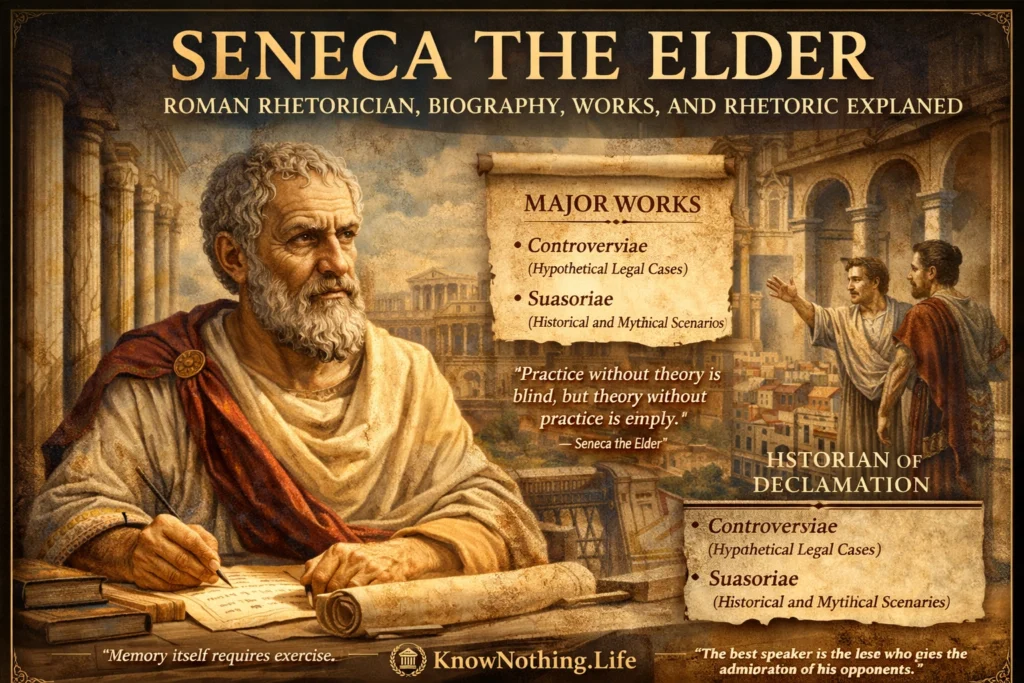
This shift gave rise to the practice of declamation, in which students and teachers engaged in structured rhetorical exercises. These exercises often took the form of fictional legal cases (controversiae) or imaginative scenarios (suasoriae) designed to develop persuasive skills. While some critics viewed declamation as artificial and detached from real-world concerns, it remained a central component of elite education.
Seneca the Elder positioned himself as both observer and critic of this evolving tradition. His writings reflect an awareness of the tension between rhetoric as a practical tool and as an intellectual exercise. He documented the techniques, styles, and personalities of prominent declaimers, offering both praise and critique. In doing so, he preserved a vivid picture of a cultural practice that might otherwise have been lost.
Works and Writings
Seneca the Elder’s most important contributions are his collections of rhetorical exercises and commentary, particularly Controversiae and Suasoriae. These works compile examples of declamatory arguments, along with his observations on the strengths and weaknesses of various speakers. They serve as both educational resources and historical records, capturing the diversity of rhetorical approaches in his time.
The Controversiae present a series of hypothetical legal cases, each accompanied by summaries of arguments made by different declaimers. Through these examples, Seneca illustrates how speakers constructed persuasive narratives, employed emotional appeals, and adapted their style to different scenarios. His commentary often highlights particularly effective phrases or techniques, demonstrating a keen ear for language and a deep appreciation for rhetorical skill.
The Suasoriae, on the other hand, focus on deliberative scenarios in which historical or mythical figures must decide on a course of action. These exercises emphasize ethical reasoning and imaginative engagement, encouraging speakers to explore complex dilemmas. Seneca’s treatment of these scenarios reveals his interest not only in technical proficiency but also in the intellectual and moral dimensions of rhetoric.
Although Seneca the Elder rarely provides direct philosophical statements, his works contain insights into the nature of persuasion and the importance of clarity, structure, and emotional resonance. One of his notable observations is: “Practice without theory is blind, but theory without practice is empty.” This reflects his belief in the necessity of balancing intellectual understanding with practical application.
Style and Approach
Seneca the Elder’s writing is characterized by its clarity, precision, and attention to detail. Rather than presenting lengthy speeches in full, he often provides concise summaries and extracts, focusing on key arguments and stylistic features. This approach allows him to cover a wide range of material while maintaining a critical perspective.
His commentary reveals a discerning and sometimes critical voice. He does not hesitate to point out excess, artificiality, or lack of substance in the speeches he records. At the same time, he demonstrates admiration for genuine eloquence and originality. This balance between critique and appreciation gives his work both analytical depth and practical value.
Another notable aspect of his style is his emphasis on memory. Seneca the Elder was renowned for his extraordinary ability to recall speeches and arguments in detail, even years after hearing them. This capacity enabled him to compile his works without relying heavily on written records, making his collections all the more remarkable. His reliance on memory also underscores the importance of internalizing knowledge in rhetorical training.
Relationship with Seneca the Younger
Seneca the Elder’s influence extended directly into the next generation through his son, Seneca the Younger. While the younger Seneca would become known primarily for his philosophical writings, his early education was shaped by his father’s emphasis on rhetoric and disciplined thinking. The skills of argumentation, clarity, and expression that Seneca the Younger displays in his works can be traced, in part, to this formative influence.
Despite their different intellectual focuses, there are notable parallels between their approaches. Both valued clarity of expression and the ability to communicate complex ideas effectively. Both also demonstrated an awareness of the moral dimensions of their respective disciplines—rhetoric for the father, philosophy for the son. This shared emphasis on ethical engagement suggests a continuity of intellectual values within the family.
At the same time, the contrast between their works highlights the changing priorities of Roman intellectual life. While Seneca the Elder documented rhetorical practice, his son used similar skills to explore questions of ethics, resilience, and the human condition. Together, they represent two complementary aspects of Roman thought: the art of persuasion and the pursuit of wisdom.
Legacy and Influence
Seneca the Elder’s legacy lies primarily in his role as a preserver of rhetorical culture. Without his works, much of what we know about Roman declamation and its practitioners would be lost. His collections provide invaluable insight into the techniques, styles, and educational practices of the time, making them essential resources for historians and scholars.
His influence extends beyond the ancient world. Renaissance humanists, who sought to revive classical learning, found in his works a rich source of rhetorical examples and principles. His emphasis on clarity, structure, and effective communication continues to inform modern approaches to writing and public speaking.
In a broader sense, Seneca the Elder’s work highlights the importance of preserving intellectual traditions. By documenting the practices of his contemporaries, he ensured that future generations would have access to a vital aspect of Roman culture. His efforts remind us that knowledge is not only created but also maintained through careful observation and recording.
Final Thoughts
Seneca the Elder may not have achieved the same level of fame as his son, but his contributions are no less significant. As a recorder and critic of rhetorical practice, he captured a moment of transition in Roman history, preserving the techniques and traditions of an art form that was adapting to new circumstances. His work provides a window into a world where language, persuasion, and intellectual discipline remained central to cultural life.
Through his writings, Seneca the Elder demonstrates that rhetoric is more than a technical skill—it is a means of shaping thought, influencing others, and engaging with complex ideas. His emphasis on practice, memory, and critical evaluation offers valuable lessons for anyone seeking to communicate effectively. In the end, his legacy is one of preservation and insight. By recording the voices of his time, he ensured that they would continue to be heard, allowing future generations to learn from the art of persuasion and the enduring power of language.