Seneca the Younger stands as one of the most compelling figures in Roman intellectual history—a philosopher, statesman, playwright, and moralist whose life embodied both the ideals and contradictions of Stoicism. Living during the height of the Roman Empire, Seneca navigated a world of immense political power, corruption, and instability, all while attempting to articulate a philosophy centered on virtue, reason, and inner freedom. His writings do not emerge from abstract speculation alone, but from lived experience within the dangerous inner circles of imperial Rome.
Unlike earlier Stoics such as Zeno of Citium, who developed the foundational structure of the philosophy, Seneca adapted Stoicism into a deeply personal and practical system suited to the complexities of Roman life. His work reflects a persistent tension between wealth and simplicity, power and detachment, engagement and withdrawal. This tension has made him one of the most relatable and debated Stoic thinkers, as he openly wrestled with the difficulty of living virtuously in an imperfect world.
Through essays, letters, and tragedies, Seneca offered guidance on how to confront suffering, manage anger, accept mortality, and maintain dignity under pressure. His influence extends far beyond antiquity, shaping ethical thought, early Christian philosophy, and modern psychological approaches to emotional resilience. His voice remains strikingly contemporary, addressing timeless human concerns with clarity and urgency.
Early Life and Education
Seneca was born around 4 BCE in Corduba (modern-day Córdoba, Spain), into a wealthy and educated Roman family. His father, Seneca the Elder, was a prominent rhetorician who ensured that his son received a rigorous education in grammar, rhetoric, and philosophy. From an early age, Seneca was exposed to intellectual traditions that would shape his thinking, including Stoicism, which would become the foundation of his philosophical outlook.
As a young man, Seneca traveled to Rome, where he studied under several philosophers, including the Stoic teacher Attalus. These early influences instilled in him a commitment to discipline, simplicity, and self-control. However, his philosophical development was not purely academic; it was also shaped by personal challenges, including periods of ill health that forced him to confront the fragility of life. These experiences deepened his focus on mortality and the importance of living deliberately.
Despite his philosophical inclinations, Seneca pursued a political career, rising through the ranks of Roman public life. His skill in rhetoric and sharp intellect earned him recognition, but also attracted jealousy and suspicion. This dual identity—as both philosopher and politician—would define much of his life, placing him at the center of power while simultaneously encouraging reflection on its dangers.
Political Career and Exile
Seneca’s political ascent brought him into close proximity with the Roman imperial court, a place where influence could quickly turn into peril. During the reign of Emperor Caligula, Seneca gained a reputation for his eloquence, but also drew the emperor’s hostility. Though he narrowly escaped execution, his fortunes shifted dramatically under Claudius, who exiled him to the island of Corsica in 41 CE on charges of adultery—likely politically motivated.
His exile, which lasted nearly eight years, became a period of intense philosophical reflection. Removed from the distractions and dangers of Rome, Seneca devoted himself to writing and contemplation. During this time, he developed many of the ideas that would later define his philosophical works, particularly his emphasis on resilience, acceptance, and the distinction between what can and cannot be controlled. His writings from exile reveal a man attempting to reconcile personal misfortune with Stoic principles.
Seneca’s return to Rome came through the intervention of Agrippina the Younger, who appointed him as tutor to her son, the future emperor Nero. This appointment would place Seneca at the heart of imperial power, offering both opportunity and danger. It also marked the beginning of one of the most controversial phases of his life.
Advisor to Nero
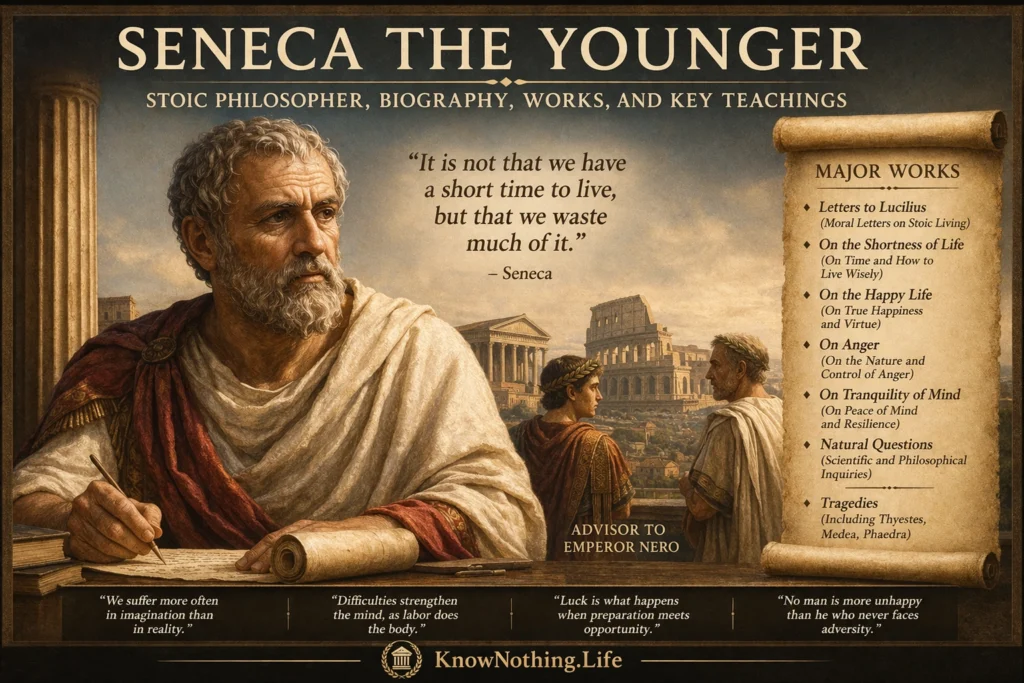
As tutor and later advisor to Nero, Seneca played a significant role in the early years of the young emperor’s reign. Alongside the praetorian prefect Sextus Afranius Burrus, he helped guide Nero toward a relatively stable and moderate rule during its initial period. Seneca’s influence was evident in policies that emphasized restraint and administrative order, reflecting Stoic ideals applied within a political context.
However, as Nero’s behavior became increasingly erratic and tyrannical, Seneca found himself in a difficult position. His wealth and status grew during this time, leading critics—both ancient and modern—to question whether he truly lived according to his philosophical principles. Seneca himself seemed aware of this tension, often addressing the challenges of balancing moral integrity with participation in public life.
Eventually, recognizing the dangers of remaining close to Nero, Seneca sought to withdraw from political affairs. His attempts to retire were only partially successful, and his association with the emperor would ultimately prove fatal. This period of his life illustrates the central Stoic dilemma he faced: how to engage with the world without being corrupted by it.
Philosophical Teachings and Core Ideas
Seneca’s philosophy is grounded in Stoicism but distinguished by its psychological depth and practical orientation. He emphasized that human suffering arises largely from misplaced values—particularly the belief that external conditions determine happiness. Like earlier Stoics, he argued that virtue is the only true good, and that peace of mind comes from aligning one’s judgments with reason.
One of his most important contributions is his exploration of emotions, particularly anger. In his work On Anger, Seneca describes anger as a form of temporary madness, a destructive force that clouds judgment and leads to irrational behavior. He advocates for awareness, delay, and reflection as tools for managing emotional impulses. This focus on emotional regulation anticipates modern psychological approaches, making his work especially relevant today.
Seneca’s writings are rich with memorable insights. Among his most famous quotes are: “We suffer more often in imagination than in reality,” highlighting the role of perception in shaping experience, and “It is not that we have a short time to live, but that we waste much of it,” emphasizing the importance of intentional living. These statements reflect a consistent theme in his philosophy—the need to reclaim control over one’s mind as the foundation of a meaningful life.
Works and Writings
Seneca was a prolific author, and unlike many earlier Stoics, a substantial portion of his work survives. His writings include philosophical essays, moral letters, and tragedies, each offering insight into his thought and literary skill. Among his most important works are Letters to Lucilius, On the Shortness of Life, On the Happy Life, On Anger, and On Tranquility of Mind.
The Letters to Lucilius are perhaps his most enduring contribution. Written in a personal and conversational style, these letters address a wide range of ethical topics, from the nature of friendship to the management of fear and desire. They reveal Seneca not as a distant authority, but as a reflective guide, grappling with the same challenges he seeks to help others overcome. The letters serve as a practical manual for Stoic living, emphasizing daily practice and continuous self-examination.
In addition to his philosophical works, Seneca wrote a series of tragedies, including Thyestes and Phaedra. These plays explore themes of power, revenge, and moral corruption, often depicting the destructive consequences of uncontrolled passions. While distinct from his philosophical writings, they reinforce his central concerns, illustrating through dramatic narrative the very emotions he sought to understand and regulate.
Death and Final Act
Seneca’s life came to a dramatic and symbolic end in 65 CE, when he was accused of involvement in the Pisonian conspiracy—a plot to assassinate Nero. Whether or not he was actually involved remains uncertain, but the accusation provided Nero with a pretext to eliminate him. Ordered to take his own life, Seneca accepted his fate with composure, embodying the Stoic principles he had long taught.
Accounts of his death, preserved by historians such as Tacitus, describe a scene of remarkable calm. Seneca is said to have opened his veins and continued to converse with friends, offering philosophical reflections even in his final moments. When the process proved slow, he reportedly took poison and eventually entered a warm bath to hasten the end. These details, whether fully accurate or somewhat embellished, reinforce the image of a man committed to facing death with dignity and rational acceptance.
His final act has often been interpreted as the ultimate test of his philosophy. In choosing to meet death without fear or resistance, Seneca demonstrated the Stoic ideal of freedom—freedom not from external circumstances, but from the internal turmoil they can provoke.
Legacy and Influence
Seneca’s influence has been profound and far-reaching. In the ancient world, his writings helped popularize Stoicism among Roman audiences, making it accessible beyond strictly philosophical circles. His emphasis on practical ethics and personal reflection resonated with readers seeking guidance in navigating the complexities of life.
In later centuries, his work influenced early Christian thinkers, who found parallels between Stoic ethics and their own moral teachings. During the Renaissance, his writings were rediscovered and widely studied, shaping European intellectual culture. In modern times, his insights continue to inform discussions of ethics, leadership, and mental health.
Perhaps the most enduring aspect of Seneca’s legacy is his ability to speak directly to the human condition. His reflections on time, suffering, anger, and mortality remain relevant because they address universal experiences. By focusing on the cultivation of inner resilience and rational clarity, Seneca offers a philosophy that transcends historical context, providing guidance for individuals across cultures and eras.
Final Thoughts
Seneca’s life is a study in complexity—a philosopher deeply committed to virtue, yet entangled in the realities of power and wealth. This tension does not diminish his significance; rather, it enhances it, making his work more human and accessible. He did not present Stoicism as an easy path, but as a demanding discipline requiring constant effort and reflection.
Through his writings, Seneca challenges readers to reconsider what truly matters. He reminds us that time is our most valuable resource, that emotional turmoil often arises from misguided beliefs, and that inner freedom is attainable through reason and self-control. His philosophy does not promise perfection, but progress—a continual movement toward greater clarity and integrity.
In a world still marked by uncertainty and distraction, Seneca’s voice remains a powerful guide. His call to live deliberately, to master one’s mind, and to align one’s life with enduring principles continues to resonate, offering a path toward resilience, wisdom, and peace.