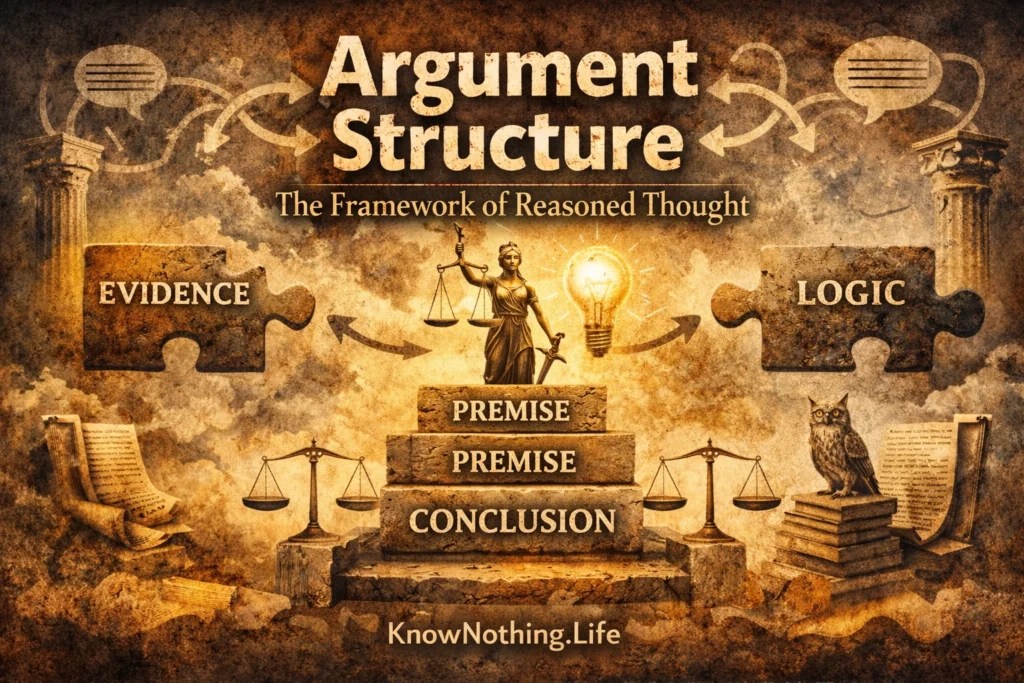
Argument structure refers to the underlying organization of reasoning—the way premises, inferences, and conclusions are arranged to form a coherent argument. It is the architecture that determines whether an argument is clear, persuasive, and logically sound. While formal logic examines abstract validity, the study of argument structure bridges both formal and informal approaches, focusing on how reasoning is actually constructed and communicated in language.
Understanding argument structure is essential for analyzing philosophical texts, evaluating public discourse, and constructing effective arguments of one’s own. From classical syllogisms to modern models of argumentation, thinkers have sought to uncover the patterns that govern reasoning. Figures such as Aristotle, Stephen Toulmin, and Chaïm Perelman have each contributed to this endeavor, offering frameworks that illuminate how arguments function across different contexts. Argument structure, in this sense, is not merely a technical concept but a fundamental aspect of rational communication.
The Basic Components of Arguments
At its most fundamental level, an argument consists of premises and a conclusion. Premises are statements offered in support of a conclusion, which is the claim the argument seeks to establish. This basic structure is deceptively simple, yet it forms the foundation of all reasoning, from everyday conversations to complex philosophical analyses.
The clarity of an argument depends on how well these components are articulated and connected. In many real-world arguments, premises are not explicitly stated but must be inferred by the reader or listener. This introduces a layer of interpretation, requiring critical engagement to reconstruct the argument’s full structure. Identifying hidden premises is often essential for evaluating whether an argument is strong or weak.
The systematic study of these components can be traced back to Aristotle, who developed the theory of syllogism in works such as Prior Analytics. Aristotle described arguments as structured relationships between propositions, where the conclusion follows necessarily from the premises. He wrote, “A syllogism is discourse in which, certain things being stated, something other than what is stated follows of necessity,” capturing the essence of structured reasoning.
Types of Argument Structures
Arguments can take many forms, each with its own structural characteristics. Deductive arguments aim for certainty, where the conclusion follows necessarily from the premises. Inductive arguments, by contrast, seek to establish probability, drawing general conclusions from specific instances. Abductive arguments infer the best explanation for a set of observations, often used in scientific and everyday reasoning.
These different types of arguments reflect the diversity of reasoning practices. Deductive structures, such as syllogisms, are highly formal and precise, while inductive and abductive structures are more flexible and context-dependent. Understanding these distinctions is crucial for evaluating arguments appropriately, as each type operates according to different standards of success.
Charles Sanders Peirce played a key role in articulating these distinctions, particularly in his analysis of abduction. Peirce described abduction as the process of forming hypotheses to explain observed phenomena, writing, “The surprising fact, C, is observed; but if A were true, C would be a matter of course; hence, there is reason to suspect that A is true.” This insight highlights how argument structure can vary depending on the goals and context of reasoning.
The Toulmin Model of Argument
One of the most influential modern approaches to argument structure is the model developed by Stephen Toulmin in The Uses of Argument. Toulmin criticized traditional logic for focusing too narrowly on formal validity, arguing that real-world arguments require a more nuanced framework. His model expands the basic structure of arguments to include additional components that reflect practical reasoning.
In Toulmin’s framework, an argument consists of a claim (the conclusion), data (the supporting evidence), and a warrant (the reasoning that connects the data to the claim). Additional elements include backing (support for the warrant), qualifiers (indicating the strength of the claim), and rebuttals (acknowledging potential counterarguments). This model captures the complexity of real-world reasoning, where arguments are rarely as straightforward as formal syllogisms.
Toulmin’s contribution lies in his recognition that argument structure is context-dependent. He wrote, “What features of an argument make it a good argument?”—a question that cannot be answered solely by formal criteria. By incorporating elements such as warrants and rebuttals, his model provides a more comprehensive account of how arguments function in practice, bridging the gap between logic and rhetoric.
Logical Relations and Inference
The strength of an argument depends on the relationships between its components, particularly the inferential connection between premises and conclusion. This connection can take various forms, including logical entailment, probabilistic support, or explanatory coherence. Understanding these relationships is key to evaluating whether an argument succeeds in its purpose.
In formal logic, these relationships are analyzed in terms of validity and soundness. A valid argument is one in which the conclusion follows necessarily from the premises, while a sound argument is both valid and based on true premises. However, in informal contexts, the criteria for evaluation are often more flexible, involving considerations such as relevance, sufficiency, and plausibility.
Alfred Tarski contributed to this understanding by clarifying the relationship between language and truth. His work on semantics provides a framework for interpreting logical statements, emphasizing the importance of meaning in evaluating arguments. As Tarski noted, “The concept of truth… is to be defined in terms of satisfaction,” highlighting the connection between formal structure and interpretation.
Argument Diagrams and Visualization
To better understand argument structure, logicians often use diagrams that visually represent the relationships between premises and conclusions. These diagrams map out the flow of reasoning, showing how different components support or interact with one another. They can reveal complex structures, such as convergent arguments (where multiple independent premises support a conclusion) and linked arguments (where premises work together as a unit).
Argument diagrams are particularly useful for analyzing complex texts, where multiple layers of reasoning may be present. By breaking down an argument into its constituent parts, diagrams make it easier to identify strengths, weaknesses, and potential fallacies. They also provide a tool for teaching and learning, helping students develop a clearer understanding of how arguments are constructed.
The use of diagrams reflects a broader effort to make reasoning more transparent and accessible. Douglas Walton emphasized the importance of such tools in his work on argumentation, arguing that visual representations can enhance critical thinking and facilitate dialogue. By making argument structure explicit, diagrams help bridge the gap between abstract theory and practical reasoning.
Argument Structure in Rhetoric and Discourse
Argument structure is not limited to formal analysis; it plays a central role in rhetoric and discourse. In persuasive contexts, the way an argument is structured can significantly influence its effectiveness. Elements such as the order of premises, the emphasis placed on certain points, and the inclusion of counterarguments all contribute to how an argument is received.
Rhetorical theorists such as Chaïm Perelman have emphasized the importance of audience in shaping argument structure. In The New Rhetoric, Perelman argued that arguments must be tailored to the beliefs and values of their audience in order to be persuasive. This perspective highlights the dynamic nature of argumentation, where structure is influenced by context and purpose.
The interplay between logic and rhetoric underscores the complexity of argument structure. While logical analysis provides criteria for evaluating arguments, rhetorical considerations determine how they are presented and perceived. Effective argumentation requires both rigor and adaptability, combining sound reasoning with an awareness of audience and context.
Conclusion
Argument structure is the foundation of reasoning, providing the framework through which ideas are organized, communicated, and evaluated. From the classical insights of Aristotle to the modern contributions of Stephen Toulmin and Douglas Walton, the study of argument structure has evolved into a rich and multifaceted field.
By understanding how arguments are constructed, we gain the tools needed to analyze reasoning critically and communicate effectively. We learn to identify premises, evaluate inferences, and consider alternative perspectives. This knowledge is essential not only for academic inquiry but for everyday decision-making, where arguments shape our beliefs and actions.
Ultimately, argument structure reveals the underlying patterns of thought that guide human reasoning. It shows that arguments are not merely collections of statements but organized systems of support and inference. In mastering this structure, we move closer to the ideal of clear, rational, and persuasive communication—an ideal that lies at the heart of philosophy and critical thinking.