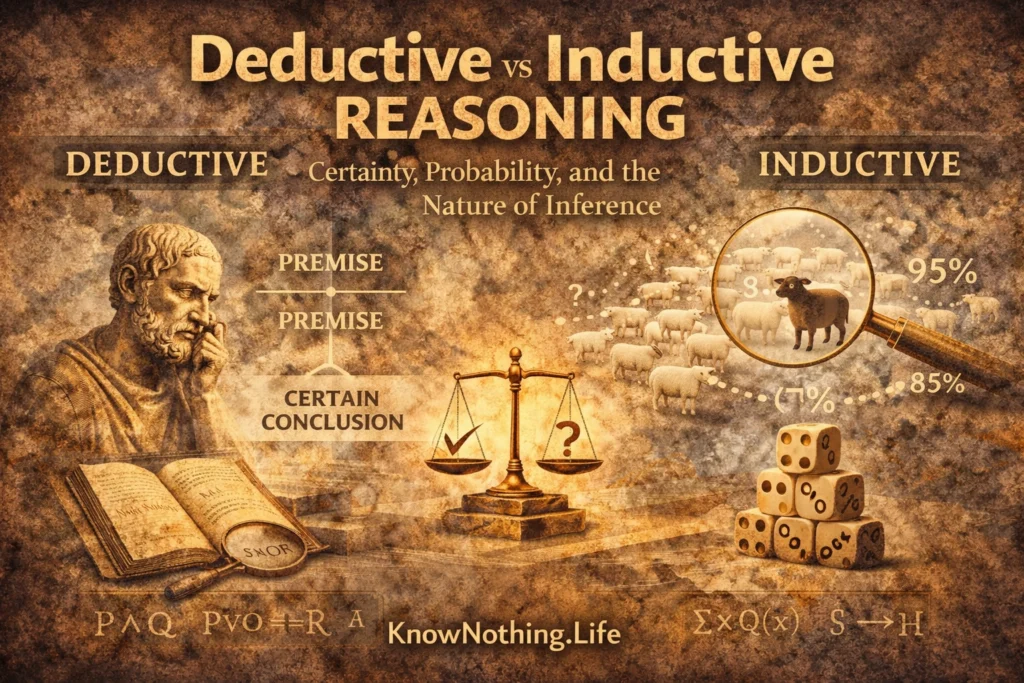
Deductive and inductive reasoning represent two foundational modes of inference that shape how humans understand the world. Deductive reasoning moves from general principles to specific conclusions, aiming at certainty, while inductive reasoning moves from specific observations to broader generalizations, aiming at probability. Together, they form the backbone of logic, science, and everyday thinking, offering complementary approaches to knowledge and justification.
The distinction between these forms of reasoning has been explored since antiquity, beginning with Aristotle, who developed formal systems of deduction while also recognizing the importance of inductive processes. In modern philosophy, thinkers such as David Hume and John Stuart Mill examined the limits and strengths of induction, while Karl Popper reinterpreted the role of inference in scientific reasoning. Understanding the relationship between deduction and induction is essential for grasping how knowledge is constructed, justified, and challenged.
Deductive Reasoning: The Pursuit of Certainty
Deductive reasoning is characterized by its commitment to certainty. In a valid deductive argument, if the premises are true, the conclusion must also be true. This form of reasoning is foundational to mathematics and formal logic, where conclusions are derived through strict rules of inference. Classic examples include syllogisms such as: “All humans are mortal; Socrates is human; therefore, Socrates is mortal.”
The strength of deduction lies in its reliability. It provides a guarantee of truth-preservation, ensuring that no new information is introduced in the conclusion beyond what is already contained in the premises. This makes it an ideal tool for analyzing arguments and constructing proofs. However, its certainty depends entirely on the truth of its premises; a deductive argument can be valid yet unsound if its premises are false.
Aristotle laid the groundwork for deductive reasoning in works such as Prior Analytics, where he defined the syllogism as a form of reasoning in which the conclusion follows necessarily from the premises. He wrote, “A syllogism is discourse in which… something other than what is stated follows of necessity,” capturing the essence of deductive inference. This emphasis on necessity continues to define deductive reasoning in modern logic.
Inductive Reasoning: The Logic of Probability
Inductive reasoning, by contrast, deals with probability rather than certainty. It involves drawing general conclusions from specific observations, such as inferring that the sun will rise tomorrow because it has done so consistently in the past. While inductive arguments can be strong or weak, they can never guarantee the truth of their conclusions, as future observations may contradict past patterns.
Despite this limitation, induction is indispensable for empirical inquiry. Science, in particular, relies heavily on inductive reasoning to formulate hypotheses and general laws based on observed data. Without induction, it would be impossible to move beyond isolated observations to broader understanding. Inductive reasoning thus reflects the inherently uncertain nature of knowledge about the world.
David Hume famously challenged the justification of induction, arguing that there is no rational basis for assuming that the future will resemble the past. In An Enquiry Concerning Human Understanding, he wrote, “All inferences from experience… are effects of custom, not of reasoning.” Hume’s skepticism highlights a fundamental problem: while induction is necessary for knowledge, it cannot be logically justified in the same way as deduction.
The Problem of Induction
The problem of induction remains one of the most significant issues in philosophy. If inductive reasoning cannot be justified through deduction, and if it relies on assumptions about the uniformity of nature, then its reliability is called into question. This raises profound concerns about the foundations of scientific knowledge and everyday reasoning.
David Hume argued that our reliance on induction is ultimately psychological rather than logical. We expect patterns to continue because we are accustomed to them, not because we have a rational justification. This insight challenges the notion that knowledge can be grounded entirely in reason, suggesting instead that it is shaped by habit and experience.
In response to Hume, philosophers have proposed various solutions to the problem of induction. Karl Popper rejected induction altogether, arguing that scientific reasoning is based on falsification rather than confirmation. According to Popper, hypotheses cannot be proven true through repeated observation but can be disproven by a single counterexample. He wrote, “No amount of experimentation can ever prove me right; a single experiment can prove me wrong,” emphasizing the asymmetry between verification and falsification.
Deduction and Induction in Science
The relationship between deduction and induction is particularly evident in scientific practice. Scientists often use induction to generate hypotheses based on observations, and deduction to test those hypotheses by deriving predictions. This interplay creates a dynamic process of inquiry, where general theories are refined through empirical testing.
John Stuart Mill contributed to the development of inductive methods in science, outlining systematic approaches for identifying causal relationships. In A System of Logic, Mill emphasized the importance of observation and experimentation in forming generalizations. His methods of agreement and difference remain influential in scientific reasoning.
At the same time, deductive reasoning plays a crucial role in ensuring the logical consistency of scientific theories. By deriving consequences from hypotheses, scientists can test whether those hypotheses align with observed data. This combination of induction and deduction reflects the complexity of scientific reasoning, where certainty and probability coexist.
Differences and Complementarity
While deductive and inductive reasoning differ in their goals and methods, they are not opposed but complementary. Deduction provides certainty and clarity, while induction offers flexibility and adaptability. Together, they enable a more comprehensive approach to understanding the world, balancing rigor with empirical insight.
The distinction between these forms of reasoning also highlights different standards of evaluation. Deductive arguments are judged by their validity and soundness, while inductive arguments are assessed in terms of strength and reliability. Recognizing these differences is essential for evaluating arguments appropriately, avoiding the mistake of applying deductive standards to inductive reasoning or vice versa.
Charles Sanders Peirce further expanded this framework by introducing abduction as a third form of reasoning, emphasizing the role of hypothesis formation. Peirce’s work underscores the idea that reasoning is multifaceted, involving different modes of inference that work together to generate and test knowledge.
Applications in Everyday Reasoning
Beyond philosophy and science, deductive and inductive reasoning play a central role in everyday decision-making. Deductive reasoning is used in situations requiring certainty, such as legal arguments or mathematical calculations, while inductive reasoning is employed in making predictions and generalizations based on experience.
For example, a person might use induction to infer that a restaurant is good based on positive reviews, and deduction to conclude that if all recommended dishes are vegetarian, then a specific dish is also vegetarian. These forms of reasoning are often intertwined, reflecting the complexity of real-world thinking.
Understanding the differences between deduction and induction can improve critical thinking skills, enabling individuals to evaluate arguments more effectively and avoid common errors. It also fosters a deeper appreciation of the limits of knowledge, recognizing that certainty is rare and that most reasoning involves degrees of probability.
Conclusion
Deductive and inductive reasoning represent two essential modes of inference, each with its own strengths and limitations. Deduction offers certainty and logical rigor, while induction provides the means to extend knowledge beyond immediate observations. Together, they form the foundation of rational inquiry, shaping how we understand and interact with the world.
From the early insights of Aristotle to the skeptical challenges of David Hume and the scientific philosophy of Karl Popper, the study of these forms of reasoning has revealed both the power and the limits of human thought.
Ultimately, the relationship between deduction and induction reflects a deeper tension between certainty and uncertainty, logic and experience. By understanding this relationship, we gain insight into the nature of knowledge itself—how it is constructed, justified, and continually revised. In this balance lies the enduring significance of deductive and inductive reasoning as cornerstones of philosophy and critical thinking.