Falsifiability is one of the most influential concepts in the philosophy of science, offering a criterion for distinguishing scientific theories from non-scientific ones. At its core, falsifiability is the idea that for a claim to be scientific, it must be testable in such a way that it could, in principle, be proven false. This principle shifts the focus of science away from verification—trying to confirm theories—to a more rigorous standard: exposing them to the possibility of refutation.
The concept was most famously developed by Karl Popper, who argued that scientific progress depends not on accumulating confirmations but on eliminating errors. By proposing bold hypotheses and subjecting them to stringent tests, science advances through a process of conjectures and refutations. Falsifiability thus serves not only as a demarcation criterion but also as a methodological principle guiding scientific inquiry.
The Problem of Verification
Before the introduction of falsifiability, many philosophers believed that scientific theories could be verified through observation and experiment. According to this view, a theory gains credibility by being repeatedly confirmed by empirical evidence. However, this approach faces a fundamental problem: no amount of positive evidence can conclusively prove a universal claim.
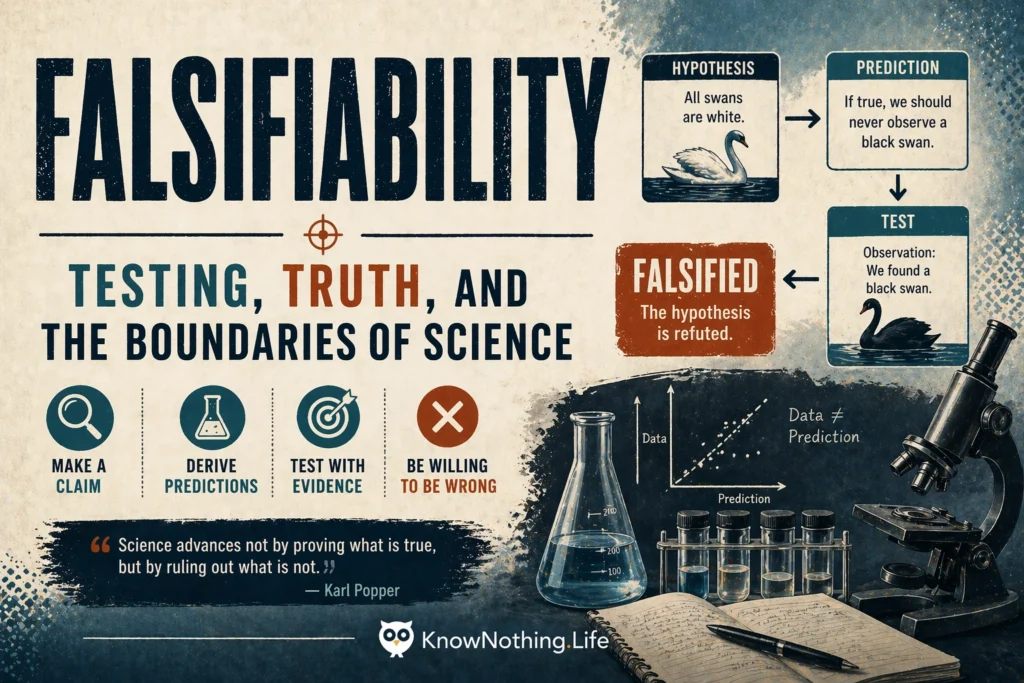
This issue is closely related to the problem of induction, famously articulated by David Hume. Inductive reasoning involves drawing general conclusions from specific observations, but there is no logical guarantee that future observations will conform to past patterns. For example, observing many white swans does not prove that all swans are white; a single black swan would refute the claim.
Popper’s response to this problem was to reject verification as the basis of scientific knowledge. Instead, he argued that scientific theories should be framed in ways that make them vulnerable to falsification. A theory that cannot, in principle, be proven false does not make meaningful claims about the world and therefore falls outside the domain of science.
Falsifiability as a Demarcation Criterion
One of the primary roles of falsifiability is to serve as a demarcation criterion, distinguishing science from non-science. According to Karl Popper, a theory is scientific if it makes predictions that could be tested and potentially refuted by empirical evidence. This criterion provides a clear standard for evaluating the scientific status of different claims.
For example, a statement like “All metals expand when heated” is falsifiable because it can be tested through experiment, and a single counterexample would disprove it. In contrast, a claim that is so vague or flexible that it cannot be tested—such as certain metaphysical or pseudoscientific assertions—fails to meet the criterion of falsifiability.
This approach has been particularly influential in debates about the status of disciplines such as psychoanalysis and astrology. Popper argued that these fields often rely on explanations that can accommodate any possible outcome, making them unfalsifiable and therefore unscientific. While this view has been contested, it highlights the importance of testability in scientific practice.
The Role of Testing and Refutation
Falsifiability emphasizes the importance of rigorous testing in science. A theory should not only be testable but should also be subjected to severe tests designed to challenge its predictions. The more a theory risks being proven wrong, the more informative it is. A theory that survives repeated attempts at falsification gains credibility, though it is never conclusively proven true.
This perspective transforms the nature of scientific inquiry. Instead of seeking confirmation, scientists are encouraged to actively look for evidence that could refute their hypotheses. This critical approach fosters a culture of skepticism and openness to revision, which is essential for scientific progress.
However, the process of refutation is not always straightforward. When a prediction fails, it is not always clear whether the fault lies with the theory itself or with auxiliary assumptions, experimental conditions, or measurement errors. This complexity has led philosophers to question whether falsification can serve as a simple and definitive criterion.
Critiques and Limitations
Despite its influence, falsifiability has faced significant criticism. One major challenge comes from the work of Thomas Kuhn, who argued that science does not operate through constant attempts to falsify theories. Instead, scientists typically work within established paradigms, focusing on solving puzzles rather than testing foundational assumptions.
Kuhn suggested that theories are not abandoned at the first sign of contradictory evidence. Instead, anomalies are often accommodated or explained within the existing framework. Only when anomalies accumulate and lead to a crisis does a paradigm shift occur, replacing one framework with another. This account challenges the idea that falsification is the primary driver of scientific change.
Another critique comes from the Duhem-Quine thesis, associated with Pierre Duhem and Willard Van Orman Quine. According to this view, scientific hypotheses are tested as part of a network of assumptions, making it difficult to isolate and falsify a single theory. When a prediction fails, multiple components of the system may be responsible, complicating the process of refutation.
Falsifiability and Scientific Practice
In practice, falsifiability remains an important guiding principle, even if it is not applied in a strict or absolute manner. Scientists design experiments to test predictions, seek out anomalies, and refine their theories in response to new evidence. While theories are rarely discarded immediately, the possibility of falsification plays a crucial role in maintaining the integrity of scientific inquiry.
Falsifiability also encourages clarity and precision in scientific theories. A theory must make specific, testable predictions in order to be falsifiable. This requirement helps distinguish meaningful scientific claims from vague or ambiguous ones, promoting rigor and accountability in research.
At the same time, the limitations of falsifiability have led to more nuanced approaches to understanding science. Rather than viewing it as a strict rule, many philosophers see it as one of several criteria that contribute to the evaluation of theories. Other factors, such as explanatory power, coherence, and simplicity, also play important roles.
Beyond Science: Broader Implications
The concept of falsifiability extends beyond the philosophy of science, influencing how we evaluate claims in everyday life. It encourages critical thinking by emphasizing the importance of evidence and the willingness to revise beliefs in light of new information. In this sense, falsifiability is not only a scientific principle but also a broader epistemological ideal.
In public discourse, the idea of falsifiability can help distinguish between evidence-based claims and those that rely on unfounded assertions. It provides a framework for assessing the credibility of information, particularly in an age of misinformation and rapid communication.
Philosophically, falsifiability raises questions about the nature of truth and knowledge. If scientific theories can never be conclusively proven, what does it mean to say that they are true? Popper himself suggested that we should think in terms of corroboration rather than proof, recognizing that knowledge is always provisional and subject to revision.
Conclusion
Falsifiability remains one of the most significant contributions to the philosophy of science, offering a powerful framework for understanding the nature of scientific inquiry. Developed by Karl Popper, it emphasizes the importance of testability, critical scrutiny, and the willingness to challenge established ideas.
While not without its limitations, falsifiability continues to shape how we think about science, knowledge, and rational inquiry. By highlighting the provisional nature of theories and the importance of empirical testing, it reinforces the dynamic and self-correcting character of science, ensuring its continued relevance in the pursuit of understanding.