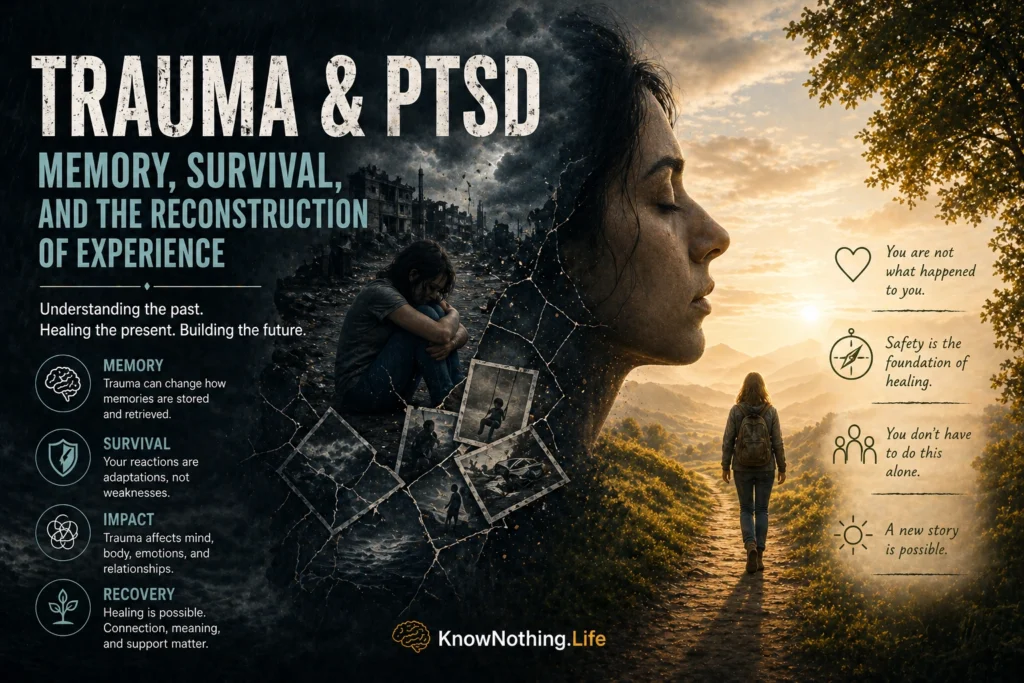
Trauma is not defined solely by the events that occur, but by how those events are experienced, processed, and remembered. It represents a rupture in the ordinary functioning of the mind—an overwhelming encounter with threat, loss, or helplessness that exceeds the individual’s capacity to integrate it into a coherent narrative. Post-Traumatic Stress Disorder (PTSD) is one of the most studied consequences of such experiences, characterized by intrusive memories, avoidance, negative alterations in mood and cognition, and heightened physiological arousal.
The modern understanding of trauma has evolved significantly over the past century. Early work on “shell shock” following World War I highlighted the psychological impact of extreme stress, while later research expanded the concept to include a wide range of experiences, from interpersonal violence to natural disasters. Psychiatrist Judith Herman, in her influential book Trauma and Recovery, argued that trauma must be understood within both psychological and social contexts, writing that “traumatic events overwhelm the ordinary systems of care that give people a sense of control, connection, and meaning.” This perspective emphasizes that trauma is not only an individual condition but also a relational and societal phenomenon.
Defining Trauma and PTSD
Trauma can take many forms, including acute incidents such as accidents or assaults, as well as chronic experiences like ongoing abuse or neglect. While not all traumatic experiences lead to PTSD, certain factors—such as severity, duration, and lack of support—can increase the likelihood of its development. PTSD is formally defined in the Diagnostic and Statistical Manual of Mental Disorders as a condition that arises following exposure to actual or threatened death, serious injury, or sexual violence.
The symptoms of PTSD are typically grouped into four clusters. Intrusion symptoms include flashbacks, nightmares, and distressing memories that feel as though the event is happening again. Avoidance involves efforts to evade reminders of the trauma, whether through physical withdrawal or emotional numbing. Negative alterations in cognition and mood may include persistent fear, guilt, or a diminished sense of self, while hyperarousal is marked by heightened vigilance, irritability, and difficulty sleeping.
Psychiatrist Bessel van der Kolk, in The Body Keeps the Score, highlights the embodied nature of trauma, noting that “the body keeps the score: if the memory of trauma is encoded in the viscera, in heartbreaking and gut-wrenching emotions, in autoimmune disorders and skeletal/muscular problems.” This insight underscores that trauma is not merely a cognitive phenomenon but one that is deeply embedded in the body’s physiological systems.
Neurobiology of Trauma
The neurobiology of trauma provides a framework for understanding how overwhelming experiences alter brain function. During a traumatic event, the brain’s threat detection system—centered in the amygdala—becomes highly activated, triggering the fight, flight, or freeze response. At the same time, the prefrontal cortex, responsible for rational thought and emotional regulation, may become less active, impairing the ability to process the experience in a coherent way.
The hippocampus, which plays a crucial role in memory consolidation, is also affected. In PTSD, traumatic memories are often stored in a fragmented and sensory-based form, lacking the temporal and contextual integration that characterizes ordinary memory. This helps explain why individuals may experience flashbacks that feel immediate and real, rather than as recollections of past events. The stress hormone cortisol and the neurotransmitter norepinephrine further influence how these memories are encoded and retrieved.
Neuroscientist Joseph LeDoux has contributed significantly to the understanding of fear and emotional memory. His research suggests that the brain’s fear circuits can operate independently of conscious awareness, meaning that individuals may react to trauma-related cues even when they do not consciously recognize them. This separation between emotional and cognitive processing is a hallmark of PTSD, complicating both diagnosis and treatment.
Psychological Experience and Meaning
The psychological impact of trauma extends beyond symptoms to affect the individual’s sense of self and worldview. Trauma can shatter fundamental assumptions about safety, trust, and control, leading to what some theorists describe as a “loss of innocence” or a disruption of basic beliefs about the world. Individuals may struggle with feelings of guilt, shame, or helplessness, particularly in cases where the trauma involved interpersonal harm.
Philosophical and phenomenological perspectives provide additional insight into the experience of trauma. Karl Jaspers emphasized that certain extreme experiences lie at the limits of understanding, challenging the capacity for empathy and explanation. Trauma often resists narrative integration, existing as a fragment rather than a story, which contributes to its persistence and recurrence.
Judith Herman describes trauma as a condition that isolates individuals from both themselves and others. Recovery, in her view, involves not only symptom reduction but the reconstruction of meaning and connection. This process requires acknowledging the reality of the trauma while also integrating it into a broader narrative that allows for continuity and growth. Without this integration, individuals may remain trapped in a cycle of re-experiencing and avoidance.
Treatment Approaches
Treatment for trauma and PTSD has advanced considerably, with several evidence-based approaches demonstrating effectiveness. Trauma-focused cognitive-behavioral therapy (TF-CBT) helps individuals process traumatic memories and challenge maladaptive beliefs, while prolonged exposure therapy involves repeated and controlled confrontation with trauma-related memories and cues. These approaches aim to reduce the intensity of emotional responses and facilitate the integration of traumatic experiences.
Eye Movement Desensitization and Reprocessing (EMDR), developed by Francine Shapiro, represents another widely used method. EMDR involves recalling traumatic memories while engaging in bilateral stimulation, such as guided eye movements. Although the precise mechanisms remain debated, research suggests that EMDR can help reprocess traumatic memories and reduce their emotional impact.
In addition to these methods, there is growing interest in body-based and mindfulness-oriented approaches. Techniques such as somatic experiencing and yoga-based interventions recognize the role of the body in trauma and aim to restore a sense of safety and regulation. As van der Kolk emphasizes, recovery often requires addressing not only thoughts but also physiological responses, highlighting the importance of an integrative approach.
Social Context and Cultural Dimensions
Trauma does not occur in a vacuum; it is shaped by social and cultural contexts that influence both its impact and its recognition. Factors such as poverty, discrimination, and systemic violence can increase exposure to trauma while also limiting access to resources for recovery. Collective traumas, such as war or natural disasters, affect entire communities, creating shared experiences of loss and disruption.
Cultural beliefs also play a role in how trauma is understood and expressed. In some contexts, psychological distress may be communicated through physical symptoms or spiritual frameworks, requiring culturally sensitive approaches to treatment. The concept of PTSD itself has been critiqued for its Western origins, with some scholars arguing that it may not fully capture the diversity of trauma experiences across cultures.
Sociologist Kai Erikson, in his work on collective trauma, described how disasters can damage the “tissue of social life,” affecting not only individuals but the bonds that connect them. This perspective highlights the importance of community and social support in recovery, suggesting that healing is not solely an individual process but a collective one.
Conclusion
Trauma and PTSD reveal the profound ways in which extreme experiences can reshape the mind, body, and sense of self. They challenge simple models of memory and emotion, demonstrating that the past can persist in the present in vivid and disruptive forms. At the same time, they also point to the capacity for resilience and recovery, as individuals work to integrate and transform their experiences.
Understanding trauma requires an interdisciplinary approach that bridges neuroscience, psychology, philosophy, and social theory. By recognizing the complexity of trauma and the diverse pathways to healing, clinicians and researchers can develop more effective and compassionate responses. Ultimately, the study of trauma not only informs clinical practice but deepens our understanding of human vulnerability and strength.