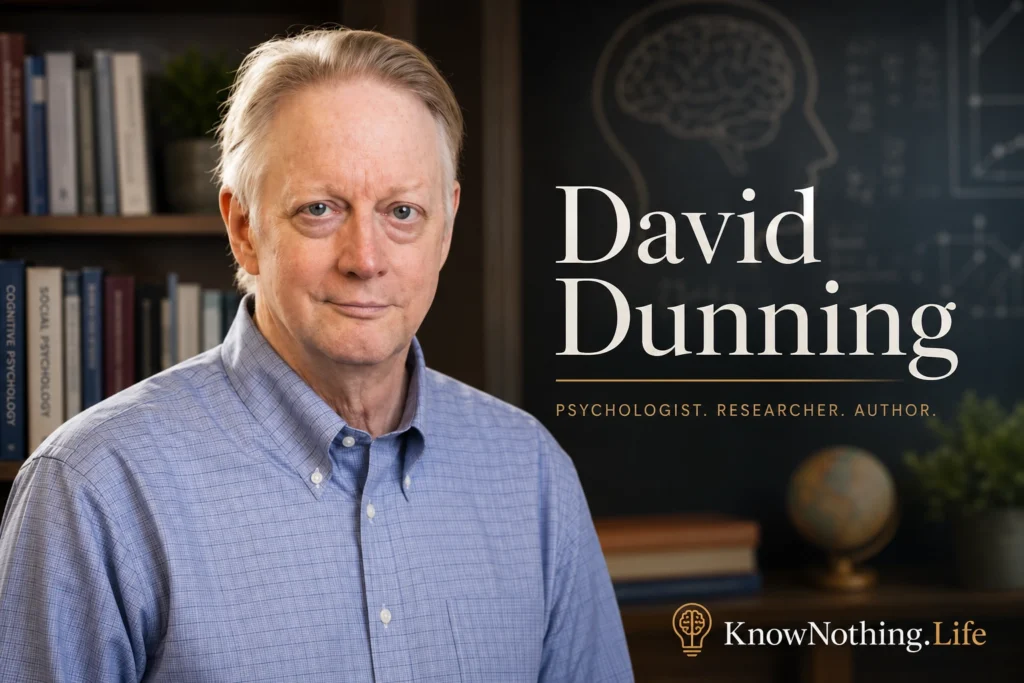
David Dunning is an American social psychologist whose research has transformed the study of self-knowledge, overconfidence, ignorance, and human judgment. He is best known for work conducted with Justin Kruger on what became known as the Dunning–Kruger effect: the tendency for people with limited competence in a particular area to overlook the extent of their shortcomings. Dunning’s broader contribution, however, reaches beyond one famous effect. His research asks how people form beliefs about their abilities, character, knowledge, and future—and why those beliefs so often diverge from objective evidence.
Dunning’s psychology is not simply a catalogue of foolish mistakes. It is an investigation of a difficult human predicament: people must make decisions using the same minds whose limitations they are trying to evaluate. Expertise helps people perform a task, but it may also be necessary to recognize whether the task was performed well. Ignorance can therefore conceal itself, leaving individuals confident in answers they lack the knowledge to question. As Dunning has observed, “Our ignorance is an everyday companion” that every person carries throughout life.
Education and Academic Career
Dunning earned his bachelor’s degree in psychology from Michigan State University in 1982 and completed his doctorate in psychology at Stanford University in 1986. His doctoral training focused on social judgment, including the ways people interpret situations and construct impressions of themselves and others. After graduating, he joined Cornell University as an assistant professor. He received tenure in 1992, became a full professor in 1999, and remained at Cornell for nearly three decades, building a major research program devoted to self-evaluation, decision-making, social cognition, and misbelief.
In 2015, Dunning moved to the University of Michigan as a professor of psychology and faculty associate in the Research Center for Group Dynamics. He later became associate chair for faculty development and, in 2024, was appointed Mary Ann and Charles R. Walgreen, Jr. Professor of the Study of Human Understanding. His honors include the Society for Self and Identity’s Distinguished Lifetime Career Award, the Society for Personality and Social Psychology’s Scientific Impact Award, and the 2023 Grawemeyer Award in Psychology, shared with Kruger.
The Origins of the Dunning–Kruger Effect
The work that made Dunning famous began with a question about whether poor performers could accurately recognize their own mistakes. With graduate student Justin Kruger, he designed studies involving humor, grammar, and logical reasoning. Participants completed tests and then estimated both their raw performance and their standing relative to others. Those who scored in the lowest quartile frequently believed they had performed substantially better, sometimes placing themselves above average despite objectively weak results.
Dunning and Kruger presented their findings in the 1999 paper “Unskilled and Unaware of It: How Difficulties in Recognizing One’s Own Incompetence Lead to Inflated Self-Assessments.” They argued that poor performers faced a “dual burden”: their lack of skill led them to make errors, while the same missing skill prevented them from recognizing those errors. When participants received training that improved their competence, their ability to evaluate their earlier performance also improved. Better knowledge did not merely produce better answers; it provided standards for recognizing what a good answer looked like.
What the Effect Actually Means
The popular version of the Dunning–Kruger effect is often misleading. It is commonly portrayed as proof that unintelligent people always believe they are brilliant, sometimes through a dramatic curve showing confidence soaring among beginners, collapsing among intermediate learners, and rising again among experts. That image did not appear in the original research. The effect is domain-specific: someone may possess excellent judgment in one field while misjudging their competence in another. It is not a permanent diagnosis or a synonym for stupidity.
Dunning has repeatedly emphasized that everyone is vulnerable because no person is knowledgeable in every domain. Experts may also make mistakes, particularly when they assume expertise in one subject transfers automatically to another. The deepest lesson is therefore not that other people are too ignorant to understand their ignorance. It is that each person has unknown weaknesses that cannot be detected through introspection alone. Dunning writes that “the scope of people’s ignorance is often invisible to them,” describing this condition as meta-ignorance—ignorance of one’s own ignorance.
Self-Insight and the Barriers to Knowing Oneself
Dunning developed his broader theory in Self-Insight: Roadblocks and Detours on the Path to Knowing Thyself. The book examines why people form inaccurate impressions of their competence, character, and emotional behavior. Self-evaluation is difficult partly because people observe their own intentions while others see their actions. Individuals also lack access to missed opportunities, unrecognized errors, and abilities they do not know they should possess. As a result, confidence may be built from information that feels persuasive internally but has little connection to actual skill.
The problem extends beyond intelligence. People often believe they are more ethical, fair, generous, and objective than their conduct supports. They may judge themselves according to admirable motives while judging others according to visible outcomes. Emotional states are similarly difficult to predict: people underestimate how hunger, anger, fear, temptation, or social pressure will influence later choices. Dunning’s work therefore complicates the ancient command to know oneself. In an interview, he remarked that “know thyself” turns out to be “an almost impossible task,” though not a reason to abandon the effort.
Overclaiming, Hypocognition, and Misbelief
Dunning’s later research explored overclaiming—the tendency to report knowledge of concepts that do not exist. In studies conducted with Stav Atir and Emily Rosenzweig, participants who considered themselves knowledgeable in a field were sometimes more likely to claim familiarity with fabricated terms. Confidence derived from genuine knowledge could spill beyond its proper boundaries, encouraging people to treat recognition, plausibility, or familiarity as evidence of understanding. Expertise can protect against error, but the identity of being an expert may also create pressure to appear informed.
Related work examined hypocognition, a condition in which people lack the concepts needed to recognize or interpret an experience. A person cannot search for information, identify a problem, or consider a solution that lies outside the available conceptual vocabulary. Dunning’s research on ignorance therefore concerns more than missing facts. People may possess false beliefs that disguise missing knowledge, rely on general impressions that appear sufficient, or fail to imagine the questions they should be asking. These “unknown unknowns” help explain why intelligence and sincere effort cannot guarantee sound judgment.
Trust, Groups, and Social Judgment
Dunning has also investigated why people trust strangers in situations where narrow economic reasoning would predict suspicion. In experimental games, participants frequently cooperate despite the possibility of exploitation, guided by emotions, expectations, and social norms rather than material calculation alone. This research places human error within a larger social context. The same openness that makes people vulnerable to deception also allows cooperation, commerce, friendship, and institutions to function. A society without trust would avoid some mistakes but would make ordinary collective life nearly impossible.
His research further examines how individual misjudgments become group errors. Groups can pool knowledge and correct personal blind spots, but they may also amplify confidence, suppress dissent, and mistake consensus for accuracy. Members often fail to share information that others do not already possess, while confidence and status can exert more influence than evidence. Dunning’s work therefore has implications for juries, medical teams, businesses, classrooms, public policy, and democratic debate—settings where decisions depend on whether people can identify both what they know and what they are missing.
Major Works, Debate, and Lasting Influence
Dunning’s major works include Self-Insight, the edited volume Social Motivation, and The Self in Social Judgment, edited with Mark Alicke and Joachim Krueger. His influential articles include “Unskilled and Unaware of It,” “Why People Fail to Recognize Their Own Incompetence,” “Faulty Self-Assessment,” “The Dunning–Kruger Effect: On Being Ignorant of One’s Own Ignorance,” and “Self-Perceived Expertise Predicts Claims of Impossible Knowledge.” Together, these works connect metacognition with education, morality, expertise, decision-making, and social behavior.
Researchers continue to debate how much of the classic Dunning–Kruger pattern reflects metacognitive deficits and how much may arise from statistical forces such as regression toward the mean, measurement error, and general better-than-average bias. Some analyses argue that the traditional effect is largely an artifact, while other scholars dispute that conclusion or defend narrower versions of the original explanation. These debates have refined the theory and discouraged reliance on the simplistic graph commonly circulated online.
Dunning’s enduring contribution is the recognition that confidence is not proof of knowledge and introspection is not an independent audit of the mind. Reliable self-understanding requires external evidence, meaningful feedback, comparison with clear standards, and enough expertise to interpret criticism. His work encourages humility without demanding paralysis: people cannot discover every hidden limitation, but they can build habits and institutions that make error easier to detect. In revealing how ignorance protects itself from recognition, David Dunning made uncertainty a central problem of psychological science—and intellectual humility a practical form of wisdom.