The Dunning–Kruger Effect describes a paradox at the heart of human cognition: those who lack skill or knowledge in a domain are often the least aware of their deficiencies, while those with greater competence tend to recognize the limits of their understanding. First identified by David Dunning and Justin Kruger in their seminal 1999 paper, “Unskilled and Unaware of It,” the effect has become one of the most widely cited phenomena in modern psychology. It captures a persistent truth about human judgment—our ability to evaluate ourselves is often constrained by the very knowledge we lack.
At its core, the Dunning–Kruger Effect is not simply about arrogance or overconfidence. It is about a deeper cognitive limitation: the skills required to perform well in a domain are often the same skills required to evaluate performance accurately. Without those skills, individuals may confidently believe they are competent when they are not. This creates a self-reinforcing loop in which ignorance sustains itself through misplaced certainty. As Dunning famously observed, “The knowledge and intelligence that are required to be good at a task are often the same qualities needed to recognize that one is not good at that task.”
The broader significance of the Dunning–Kruger Effect lies in its implications for decision-making, education, leadership, and social discourse. In a world increasingly shaped by complex information systems, the ability to recognize one’s own limitations has become a critical intellectual virtue. Yet the effect suggests that this recognition is not naturally distributed; rather, it must be cultivated through experience, feedback, and reflection.
Origins and Foundational Research
The modern articulation of the Dunning–Kruger Effect emerged from experimental work conducted by David Dunning and Justin Kruger at Cornell University. Their 1999 study examined participants’ performance in areas such as humor, grammar, and logical reasoning. After completing tasks, participants were asked to estimate how well they had performed relative to others. The results were striking: individuals in the lowest quartile consistently overestimated their abilities, often placing themselves well above average.
The researchers concluded that incompetence does not merely lead to poor performance—it also impairs the ability to recognize that poor performance. In other words, the least skilled participants were “doubly cursed”: they lacked both competence and the metacognitive insight needed to evaluate their competence. Conversely, high-performing individuals tended to underestimate their relative standing, assuming that tasks that came easily to them would also be easy for others.
This finding resonates with earlier philosophical insights. Socrates famously declared, “I know that I know nothing,” suggesting that wisdom begins with the recognition of ignorance. Similarly, Charles Darwin observed in The Descent of Man that “ignorance more frequently begets confidence than does knowledge.” These reflections, though not empirical, anticipated the psychological mechanisms later formalized by Dunning and Kruger.
Subsequent research has expanded and refined the original findings. Studies in fields ranging from medicine to finance have demonstrated similar patterns: novices tend to overestimate their abilities, while experts exhibit greater calibration between confidence and performance. The effect has also been linked to broader concepts such as metacognition—the capacity to think about one’s own thinking—and self-assessment accuracy, both of which are unevenly distributed across individuals.
Cognitive Mechanisms and Psychological Foundations
The Dunning–Kruger Effect is rooted in several interrelated cognitive processes, most notably metacognitive deficits. Metacognition refers to the ability to monitor and evaluate one’s own cognitive processes. When individuals lack the necessary knowledge or skills in a domain, they are also less capable of accurately judging their performance within that domain. This creates a blind spot: errors go unnoticed, and confidence remains unjustified.
Another contributing factor is the human tendency toward self-enhancement, a well-documented bias in which individuals maintain positive self-views even in the face of contradictory evidence. Psychologists such as Roy Baumeister have explored how self-esteem and self-perception shape behavior, often leading individuals to interpret ambiguous feedback in ways that preserve their sense of competence. In the context of the Dunning–Kruger Effect, this bias amplifies overconfidence among the least skilled.
Cognitive heuristics also play a role. As described by Daniel Kahneman and Amos Tversky in their work on judgment and decision-making, individuals rely on mental shortcuts to make sense of complex information. These heuristics can lead to systematic errors, particularly when individuals lack the expertise needed to evaluate evidence critically. In such cases, confidence may be based on superficial cues rather than deep understanding.
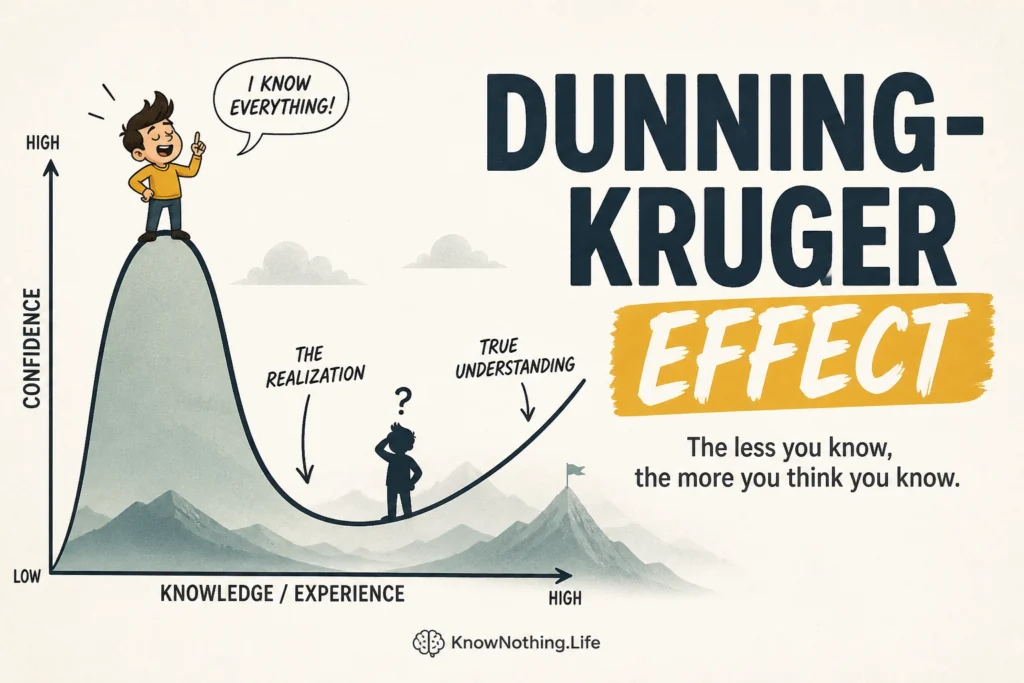
Importantly, the Dunning–Kruger Effect is not static. As individuals gain experience and knowledge, their self-assessments tend to become more accurate. This progression is sometimes depicted as a curve: initial confidence is high despite low competence, followed by a decline in confidence as individuals become aware of their limitations, and eventually a more calibrated level of confidence as expertise develops. This dynamic underscores the role of learning and feedback in mitigating the effect.
Real-World Implications
The implications of the Dunning–Kruger Effect extend far beyond laboratory settings. In education, for example, students who lack foundational knowledge may overestimate their understanding, leading them to underprepare for exams or resist feedback. Educators must therefore design systems that provide clear, objective measures of performance, helping students align their self-perceptions with reality.
In professional contexts, the effect can have significant consequences. In fields such as medicine, engineering, or finance, overconfidence among less skilled practitioners can lead to errors with serious repercussions. At the same time, highly competent individuals may underestimate their abilities, potentially limiting their willingness to take on leadership roles or advocate for their ideas. This asymmetry can distort organizational dynamics, privileging confidence over competence.
The Dunning–Kruger Effect also plays a visible role in public discourse, particularly in the age of social media. Complex topics—ranging from public health to climate science—are often debated by individuals with varying levels of expertise. Those with limited knowledge may express strong opinions with unwarranted certainty, while experts communicate with greater nuance and caution. This imbalance can create the illusion that all perspectives are equally informed, complicating efforts to establish consensus.
Political decision-making is another domain where the effect can be consequential. Leaders who lack expertise but possess high confidence may make decisions without sufficient consultation or reflection. Conversely, experts may hesitate to assert their views forcefully, aware of the uncertainties inherent in complex systems. The result can be a mismatch between authority and competence, with significant implications for governance and policy.
Critiques and Nuanced Perspectives
While the Dunning–Kruger Effect is widely accepted, it has not been without criticism. Some researchers argue that the observed patterns may be partly explained by statistical artifacts, such as regression to the mean. Others suggest that the effect may be overstated in popular discourse, where it is often used as a shorthand for dismissing opposing viewpoints rather than as a nuanced psychological concept.
Critics also emphasize that overconfidence is not limited to novices. Experts, too, can exhibit overconfidence, particularly in domains where uncertainty is high or feedback is limited. This phenomenon, sometimes referred to as the “expert overconfidence effect,” highlights the complexity of self-assessment across different levels of expertise. As Philip Tetlock demonstrated in Expert Political Judgment, even highly trained experts can struggle to make accurate predictions about complex systems.
Moreover, cultural factors may influence how the Dunning–Kruger Effect manifests. In some cultures, modesty and self-effacement are valued, potentially leading individuals to underestimate their abilities regardless of competence. In others, confidence and assertiveness are encouraged, which may amplify overestimation. These variations suggest that the effect is shaped not only by cognitive mechanisms but also by social norms and expectations.
Despite these critiques, the core insight of the Dunning–Kruger Effect remains robust: self-assessment is an imperfect process, and individuals often lack the tools needed to evaluate their own competence accurately. The challenge lies in understanding the conditions under which these inaccuracies arise and developing strategies to mitigate them.
Mitigation and the Path to Intellectual Humility
Addressing the Dunning–Kruger Effect requires a multifaceted approach centered on feedback, education, and intellectual humility. One of the most effective interventions is the provision of clear, objective feedback. When individuals receive accurate information about their performance, they are better able to calibrate their self-assessments. This is particularly important in educational and professional settings, where feedback can guide learning and development.
Training in metacognitive skills is another critical strategy. By teaching individuals how to reflect on their own thinking, educators can help them identify the limits of their knowledge and develop more accurate self-perceptions. This aligns with the broader goals of critical thinking education, which emphasizes the evaluation of evidence, the recognition of bias, and the willingness to revise one’s beliefs in light of new information.
The cultivation of intellectual humility is perhaps the most profound response to the Dunning–Kruger Effect. Philosophers and psychologists alike have emphasized the importance of recognizing the limits of one’s knowledge. Bertrand Russell captured this idea succinctly when he wrote, “The trouble with the world is that the stupid are cocksure and the intelligent are full of doubt.” While the phrasing is provocative, the underlying message is clear: doubt, when grounded in reflection and evidence, is a sign of intellectual maturity.
Ultimately, the Dunning–Kruger Effect is not merely a cognitive bias to be corrected but a reminder of the inherent limitations of human cognition. By acknowledging these limitations, individuals can adopt a more reflective and open-minded approach to knowledge. This does not eliminate error, but it creates the conditions under which learning and growth become possible.
Conclusion
The Dunning–Kruger Effect stands as one of the most compelling insights in modern psychology, illuminating the complex relationship between competence and self-awareness. From its origins in the work of David Dunning and Justin Kruger to its widespread application across disciplines, the concept has reshaped our understanding of how individuals perceive themselves and others.
Its enduring relevance lies in its universality. The effect is not confined to any one group or domain; it is a feature of human cognition itself. Whether in classrooms, workplaces, or public discourse, the tendency to misjudge one’s abilities shapes behavior in subtle and profound ways. Recognizing this tendency is the first step toward mitigating its impact.
In a broader philosophical sense, the Dunning–Kruger Effect invites a reevaluation of what it means to know. Knowledge is not merely the accumulation of facts but also the capacity to understand the limits of one’s understanding. In this respect, the effect echoes the insights of thinkers from Socrates to Bertrand Russell, reminding us that wisdom begins not with certainty, but with the recognition of uncertainty.