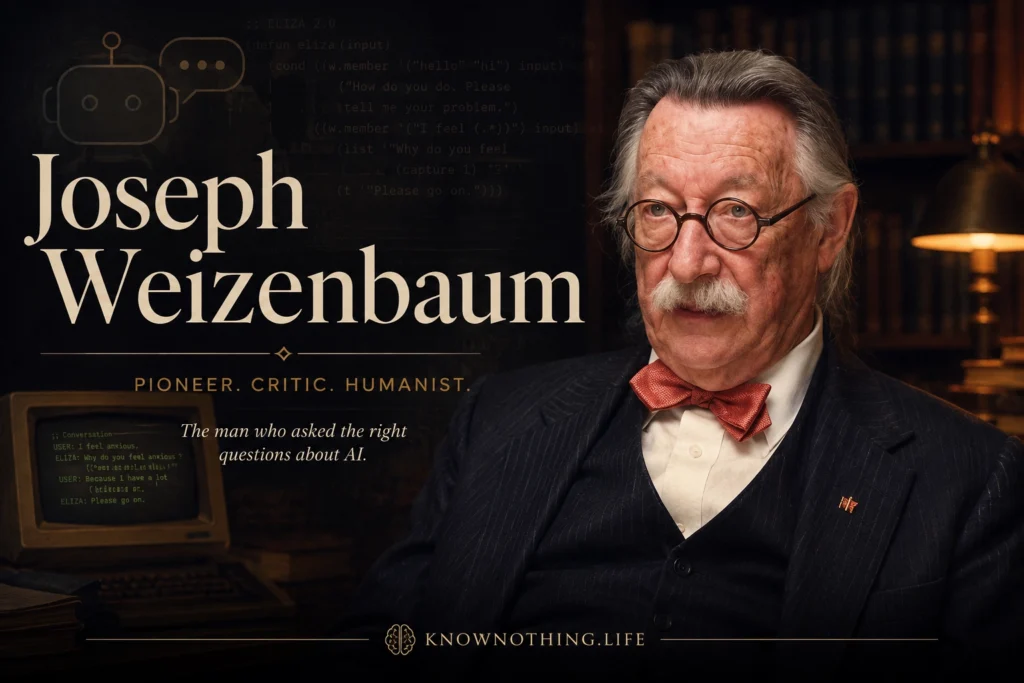
Joseph Weizenbaum was born on January 8, 1923, in Berlin, Germany, into a Jewish family whose life was transformed by the rise of Nazism. In 1936, when he was still a boy, his family fled Germany and immigrated to the United States. That experience of exile shaped the moral seriousness of his later work. Weizenbaum never treated technology as something separate from history, power, politics, and human responsibility. He had seen a modern society turn administrative efficiency, ideology, and obedience into instruments of cruelty, and this memory became part of his suspicion toward systems that remove judgment from human beings.
In the United States, Weizenbaum studied mathematics at Wayne University, later Wayne State University, in Detroit. His education was interrupted by the Second World War, during which he served in the U.S. Army Air Corps as a meteorologist. After the war, he returned to study and entered the emerging world of computing at a time when computers were still rare, room-sized machines understood by only a small technical elite. His early career placed him close to the birth of digital computation, but he would eventually become famous not merely for building programs, but for questioning what programs should be allowed to do.
Early Computing and Technical Work
Weizenbaum’s early technical career included work on analog computers and digital computer design at Wayne University. In the 1950s, he joined General Electric and contributed to one of the first computer systems designed for banking operations. This experience mattered because it showed him how computers entered institutions not as neutral gadgets, but as tools that reorganized work, authority, recordkeeping, and decision-making. Banking automation was not only a technical problem. It was a social transformation.
Before he became a public critic of artificial intelligence, Weizenbaum was a skilled computer scientist and programmer. He developed SLIP, a list-processing language that contributed to early artificial intelligence programming. He understood the attraction of computation from the inside. This is one reason his later criticism carried weight. He was not an outsider dismissing technology from ignorance. He knew the machine, the code, the culture of programming, and the excitement of making a system behave in surprising ways.
MIT and the Creation of ELIZA
In 1963, Weizenbaum joined the Massachusetts Institute of Technology as a visiting associate professor of computer science, later receiving tenure in the Department of Electrical Engineering. MIT placed him near the center of the emerging computer age. Artificial intelligence, time-sharing systems, programming languages, and human-computer interaction were all developing rapidly. Within this setting, Weizenbaum created the program that would define his public legacy: ELIZA.
ELIZA, published in 1966, was a natural-language processing program that simulated conversation by identifying patterns in user input and producing scripted replies. Its most famous script, DOCTOR, imitated the style of a Rogerian psychotherapist, often reflecting the user’s words back as questions. The program did not understand language in any human sense. It manipulated text according to rules. Yet many users responded to it as if it were listening. That gap between mechanical procedure and human projection became the center of Weizenbaum’s later thought.
The ELIZA Effect
What shocked Weizenbaum was not that ELIZA worked technically, but that people took it emotionally seriously. Users who knew they were interacting with a program still became drawn into the illusion of being understood. The now-famous “ELIZA effect” names this tendency to attribute intelligence, empathy, or inner life to a system that merely produces convincing conversational cues. ELIZA did not deceive because it was deeply intelligent. It revealed how easily human beings complete the illusion for the machine.
This discovery unsettled Weizenbaum. Many researchers saw ELIZA as a step toward intelligent machines. Weizenbaum saw something more disturbing: a demonstration of how shallow simulation could trigger deep trust. A program that had no compassion could be received as compassionate. A system with no understanding could be treated as a confidant. ELIZA therefore became both a milestone in chatbot history and a warning about artificial intimacy, especially in settings such as therapy, education, law, and care.
Computer Power and Human Reason
In 1976, Weizenbaum published his most important book, Computer Power and Human Reason: From Judgment to Calculation. The book was not an attack on computers as tools. It was an argument against confusing calculation with judgment and simulation with understanding. Weizenbaum accepted that computers could perform many tasks with extraordinary speed and precision. His question was whether every human task that can be formalized should therefore be delegated to machines.
The subtitle, “From Judgment to Calculation,” captures the central concern. Calculation follows rules; judgment involves responsibility, context, feeling, memory, moral imagination, and the courage to choose. Weizenbaum argued that certain decisions belong to human beings precisely because they involve human vulnerability. In one of his most powerful lines, he wrote that “no computer” can face “genuine human problems in human terms.” That sentence became a summary of his humanistic criticism of artificial intelligence.
The Programmer as Creator
Weizenbaum also understood the strange power of programming. In Computer Power and Human Reason, he described the programmer as “a creator of universes,” a phrase that captures both the exhilaration and danger of software. A programmer builds a world of rules, operations, permissions, exclusions, and consequences. Inside that world, the machine obeys perfectly. This can make programming feel like pure rational mastery, but it can also tempt the programmer to mistake a formal world for the real world.
That warning remains important. Models simplify reality, and programs act only within the terms given to them. The danger begins when people forget the simplification and treat the model as reality itself. A credit-scoring system, military targeting system, hiring algorithm, chatbot, or diagnostic tool may appear objective because it is computational. Weizenbaum’s point was that computation can hide human assumptions behind mechanical authority. The programmer’s universe is never innocent. It carries choices, values, omissions, and power.
Critic of Artificial Intelligence
Weizenbaum became one of the most famous internal critics of artificial intelligence. He did not deny that machines could be useful, impressive, or even surprising. He denied that usefulness should be confused with wisdom. He believed that the AI community often moved too quickly from “can we do this?” to “therefore we should do this.” His criticism was ethical before it was technical. He worried about what happens when human beings surrender responsibility to systems they built but no longer fully question.
This stance made him controversial among computer scientists who believed he underestimated the future of AI. Yet Weizenbaum’s criticism was not simple pessimism. He was asking for moral boundaries. Some uses of computers, he argued, may be inappropriate even if technically possible. A society that automates decisions about punishment, warfare, therapy, welfare, education, or care must ask whether it is preserving human dignity or escaping from the burden of human choice.
Technology, Society, and Human Responsibility
As his career developed, Weizenbaum’s critique widened beyond artificial intelligence. He became skeptical of what he saw as technological ideology: the belief that every problem is best understood as an information problem and every solution as a technical solution. He objected to the phrase “computer literacy” when it became a commercial slogan, arguing that the deeper need was literacy, judgment, and civic understanding. Knowing how to operate machines was not the same as knowing how to live responsibly with them.
In a 1985 interview, he described dependence on computers as a way of avoiding the burden of being “an independent agent.” This was one of his deepest themes. Technology can extend human power, but it can also become a refuge from responsibility. People may prefer a machine’s output because it feels impersonal, efficient, and authoritative. Weizenbaum wanted people to resist that temptation. Human beings must not hide behind systems when moral judgment is required.
Later Life and Recognition
Weizenbaum remained associated with MIT for decades and later held appointments at institutions including Harvard, Stanford, the Technical University of Berlin, and the University of Hamburg. He became a fellow of major scientific organizations and a major voice in debates about computers and society. In later life, he spent more time in Germany and became a public intellectual whose warnings about technology reached well beyond computer science.
He died on March 5, 2008, in Berlin, at the age of eighty-five. By then, ELIZA had become part of the origin story of chatbots, natural-language processing, and human-computer interaction. But Weizenbaum’s deeper legacy was not the chatbot itself. It was the moral shock that followed it. He saw that people could be moved by a machine that did not understand them, and he spent the rest of his life asking what that vulnerability meant.
Legacy and Lasting Importance
Joseph Weizenbaum’s major works include ELIZA, SLIP, Computer Power and Human Reason, Computer Power and Society, and later essays and lectures on technology, ethics, and human responsibility. He belongs to the history of artificial intelligence, but also to the history of computer ethics. He helped build the world he later criticized, which makes his criticism especially valuable. He knew that computers were powerful; that was exactly why he thought they required limits.
Weizenbaum remains essential because his questions have become more urgent, not less. In an age of chatbots, algorithmic decision-making, automated warfare, predictive policing, AI therapy tools, and machine-generated language, ELIZA no longer looks like a curiosity from the 1960s. It looks like the beginning of a problem we still have not solved. Joseph Weizenbaum’s central warning was not that computers are useless or evil. It was that human beings are tempted to give machines authority where only human judgment, responsibility, and compassion belong.