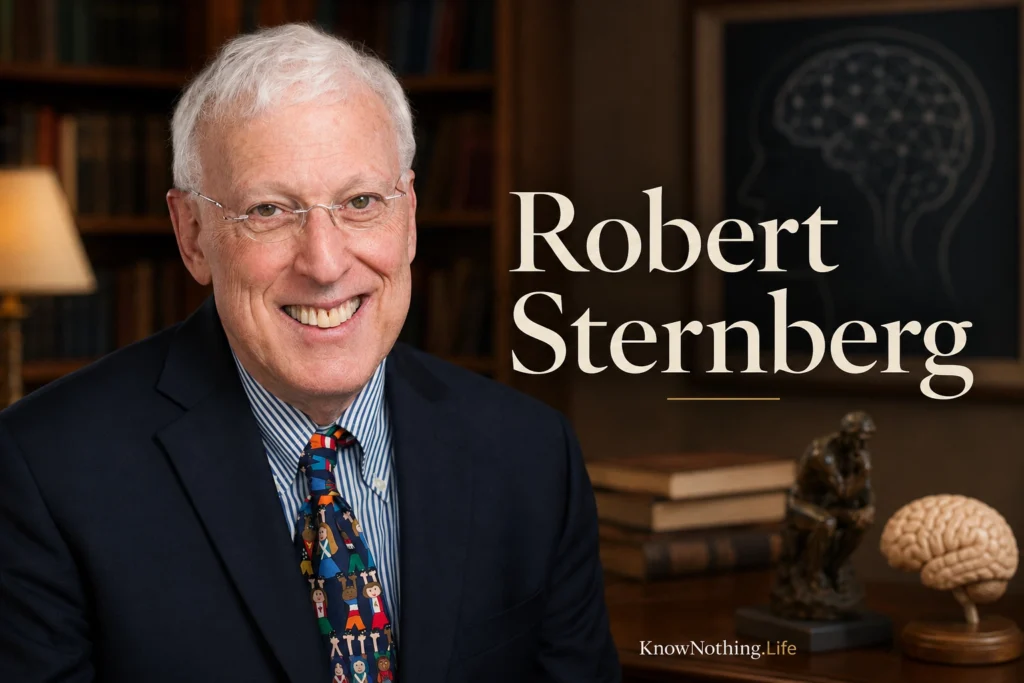
Robert J. Sternberg is an American psychologist whose work transformed modern thinking about intelligence, creativity, wisdom, leadership, and love. Throughout a career spanning more than five decades, Sternberg has challenged narrow definitions of human ability, arguing that intelligence cannot be understood through IQ scores alone. Success in life, he contends, depends on a combination of analytical reasoning, creative thinking, practical judgment, ethical wisdom, and the capacity to adapt to changing environments. His theories have influenced psychology, education, business, leadership studies, and relationship research, offering broader models for understanding human potential.
Sternberg is widely known for developing the Triarchic Theory of Intelligence and the Triangular Theory of Love, two of the most influential psychological frameworks of the late twentieth century. His publications, including Beyond IQ, Successful Intelligence, Wisdom, Intelligence, and Creativity Synthesized, The Nature of Hate, Adaptive Intelligence, and The New Psychology of Love, explore how people think, solve problems, build relationships, and make moral decisions. Rather than separating intellectual ability from everyday life, Sternberg has consistently argued that psychology should explain how people navigate real-world challenges while contributing positively to society.
Early Life and Education
Robert Jeffrey Sternberg was born on December 8, 1949, in Newark, New Jersey. Ironically, someone who would later become one of the world’s leading intelligence researchers struggled with test anxiety as a child. Standardized examinations often underestimated his abilities, leaving him frustrated with educational systems that treated test performance as the primary measure of intelligence. Those experiences profoundly shaped his later research, convincing him that conventional testing captured only part of what makes people intellectually capable.
Sternberg attended Yale University, where he earned his bachelor’s degree in psychology in 1972 before completing his doctorate at Stanford University in 1975 under the supervision of Gordon Bower. After joining Yale’s faculty, he quickly established himself as an innovative cognitive psychologist whose interests extended beyond laboratory experiments. Throughout his career, he held major academic leadership positions, including appointments at Tufts University, Oklahoma State University, the University of Wyoming, Cornell University, and several visiting professorships worldwide. His work consistently crossed disciplinary boundaries, connecting cognitive psychology with education, leadership, ethics, and public policy.
Understanding Intelligence Beyond IQ
Early intelligence research often focused on whether intelligence could be represented by a single general ability. Sternberg argued that this perspective overlooked many of the skills people rely upon every day. Exceptional students sometimes struggled outside classrooms, while individuals with average academic records frequently demonstrated remarkable judgment, creativity, entrepreneurship, or leadership. These observations convinced Sternberg that intelligence must involve more than solving abstract problems under timed testing conditions.
His Triarchic Theory of Intelligence, introduced during the 1980s and expanded in Beyond IQ and later works, proposed three interacting forms of intelligence. Analytical intelligence involves evaluating information, solving logical problems, comparing alternatives, and reaching reasoned conclusions. Creative intelligence allows individuals to generate original ideas, adapt to novel situations, and discover innovative solutions. Practical intelligence concerns applying knowledge effectively within real environments, understanding social situations, and accomplishing meaningful goals. According to Sternberg, genuine success usually requires all three abilities working together rather than any single dimension alone.
Successful Intelligence and Adaptive Thinking
Sternberg later expanded his framework into the concept of successful intelligence. Rather than defining intelligence as academic achievement, he argued that intelligent individuals identify personally meaningful goals, capitalize on their strengths, compensate for weaknesses, and adapt to changing environments. Sometimes success requires adapting to existing conditions; at other times it requires shaping those environments or selecting entirely new ones better suited to personal strengths and values.
One of Sternberg’s most frequently quoted observations summarizes this philosophy: “Intelligence is not merely what is measured by intelligence tests.” He believed educational systems often reward memorization while neglecting imagination, judgment, collaboration, and ethical decision-making. Schools should therefore encourage students to analyze, create, and apply knowledge instead of mastering isolated facts. His research inspired educational programs emphasizing critical thinking, problem solving, creativity, and practical application alongside traditional academic instruction.
The Triangular Theory of Love
Outside intelligence research, Sternberg became equally well known for his Triangular Theory of Love, first introduced in the mid-1980s. The theory proposes that love consists of three interacting components: intimacy, passion, and commitment. Intimacy refers to emotional closeness, trust, understanding, and mutual support. Passion encompasses physical attraction, excitement, romance, and desire. Commitment involves the decision to maintain a relationship over time despite changing circumstances.
Different combinations of these elements produce different kinds of relationships. Liking contains intimacy without passion or commitment. Infatuation consists largely of passion. Empty love relies primarily upon commitment. Romantic love combines intimacy and passion, while companionate love emphasizes intimacy and commitment. Fatuous love joins passion and commitment without deep intimacy. According to Sternberg, consummate love integrates all three components, although maintaining this balance requires continuous effort. He famously observed that “Love is a story,” emphasizing that individuals develop personal narratives about relationships that influence expectations, satisfaction, and long-term compatibility.
Creativity, Wisdom, and Leadership
Creativity became another major focus of Sternberg’s scholarship. He argued that creative achievement involves more than originality; valuable ideas must also prove useful and meaningful within particular cultural contexts. His investment theory of creativity, developed with Todd Lubart, suggested that creative individuals often “buy low and sell high” in the marketplace of ideas. They pursue unpopular or unconventional concepts before broader society recognizes their value, demonstrating persistence despite criticism and uncertainty.
Sternberg later integrated creativity with wisdom in Wisdom, Intelligence, and Creativity Synthesized. Wisdom, he argued, differs fundamentally from intelligence because it requires balancing personal interests with those of others while considering both immediate and long-term consequences. Wise individuals pursue the common good rather than narrow personal advantage. This perspective became increasingly important in his later work, where he argued that highly intelligent societies can nevertheless make destructive decisions if intelligence becomes separated from ethical judgment and compassion.
Adaptive Intelligence and Global Challenges
During the later stages of his career, Sternberg introduced the concept of adaptive intelligence. While traditional intelligence often measures success within existing systems, adaptive intelligence concerns humanity’s ability to solve collective problems threatening long-term survival. Climate change, political polarization, misinformation, public health crises, and technological disruption all require forms of intelligence extending beyond individual achievement.
In Adaptive Intelligence, Sternberg argued that societies frequently reward people for advancing their own careers rather than improving collective well-being. Educational systems should therefore cultivate ethical reasoning, cooperation, long-range thinking, and responsible leadership. His work reflects a growing concern that intelligence without wisdom can produce remarkable technological progress while simultaneously increasing social inequality, environmental degradation, and political instability. The purpose of intelligence, he argues, should ultimately be adaptation that benefits both individuals and the larger communities in which they live.
Major Works and Lasting Legacy
Robert Sternberg has authored or edited more than 1,500 scholarly publications and dozens of influential books. Among his most significant works are Beyond IQ, Successful Intelligence, Thinking Styles, The Triarchic Mind, The Nature of Hate, Wisdom, Intelligence, and Creativity Synthesized, Adaptive Intelligence, The New Psychology of Love, and The Psychology of Hate. His research has received numerous honors, including the American Psychological Association’s Distinguished Scientific Contribution Award, the James McKeen Cattell Award, and election as president of several major psychological organizations.
Sternberg’s influence extends across psychology, education, organizational leadership, relationship science, and public policy. His theories continue to shape intelligence testing, educational assessment, creativity research, leadership development, and counseling. Perhaps his greatest contribution is demonstrating that human excellence cannot be reduced to a single score or trait. Intelligence, creativity, wisdom, and love are interconnected capacities that enable people not merely to solve problems, but to build meaningful lives and contribute responsibly to society. By expanding psychology’s understanding of what it means to think well, choose wisely, and love deeply, Robert Sternberg has helped redefine the study of human potential for generations of researchers, educators, and students.