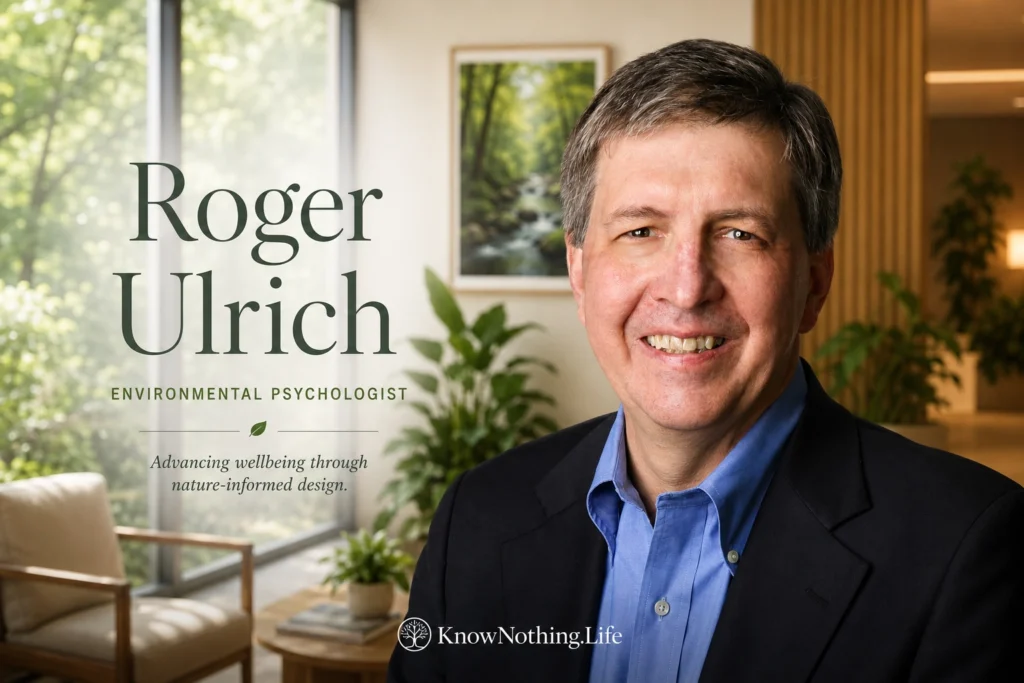
Roger S. Ulrich is an American environmental psychologist whose research transformed how hospitals, clinics, and other healthcare facilities are designed. Before his work gained attention, medical buildings were commonly evaluated according to technical efficiency, sanitation, equipment needs, and construction costs. These concerns remain essential, but Ulrich demonstrated that the physical environment can also affect stress, pain, emotion, sleep, staff fatigue, and aspects of patient recovery. A window, garden, sound level, room configuration, or piece of artwork is not merely decorative when it changes how vulnerable people experience illness and treatment.
Ulrich is best known for his landmark 1984 study “View Through a Window May Influence Recovery from Surgery,” which compared patients whose hospital rooms overlooked trees with patients whose rooms faced a brick wall. He later developed supportive design theory and helped establish evidence-based healthcare design, an approach that uses credible research to guide architectural decisions. His influential works include “Natural Versus Urban Scenes,” “Stress Recovery During Exposure to Natural and Urban Environments,” “Effects of Interior Design on Wellness,” “A Theory of Supportive Design for Healthcare Facilities,” and “A Review of the Research Literature on Evidence-Based Healthcare Design.” Together, these publications helped make the built environment a legitimate subject of health research.
Environmental Psychology and the Study of Nature
Ulrich developed his career within environmental psychology, an interdisciplinary field examining the relationships between human beings and physical surroundings. During his early academic work at the University of Delaware, he investigated whether natural and urban scenes produced measurably different psychological and physiological responses. This research moved beyond asking whether people simply preferred attractive landscapes. Ulrich wanted to know whether environmental experiences could influence emotional states, attention, stress, and bodily arousal in ways relevant to health. His work combined landscape research with methods drawn from psychology, geography, medicine, and psychophysiology.
In “Natural Versus Urban Scenes: Some Psychophysiological Effects,” published in 1981, participants viewed images of vegetation, water, or urban environments lacking prominent natural elements. Measurements included heart rate, brain-wave activity, and reported emotional states. Natural scenes—particularly those involving water—generally produced more positive responses than the urban images. Ulrich extended this investigation in the book chapter “Aesthetic and Affective Response to Natural Environment,” published in Behavior and the Natural Environment. These early works established the foundation for what became known as stress recovery theory: the proposal that certain natural settings can rapidly engage attention, reduce negative emotion, and help physiological arousal return toward a less stressful condition.
The Hospital Window Study
Ulrich’s most famous research began with a simple architectural circumstance. At a Pennsylvania hospital, some rooms used for gallbladder-surgery recovery looked toward a small stand of deciduous trees, while comparable rooms faced a brown brick wall. Ulrich reviewed records for 46 patients treated between 1972 and 1981, matching the two groups on factors such as age, sex, weight, smoking status, and year of surgery. Because the rooms were otherwise similar, their different window views offered an unusual opportunity to investigate whether exposure to nature corresponded with measurable medical outcomes.
The results, published in Science in 1984, became one of environmental psychology’s most widely discussed findings. Patients with tree views had shorter postoperative stays, received fewer negative comments in nurses’ notes, and used fewer potent pain medications than comparable patients who faced the wall. The study was small and retrospective, so it did not establish that every natural view will produce the same result in every medical setting. Its importance came from demonstrating that environmental design could be examined through clinical outcomes rather than preference surveys alone. Ulrich later recalled recognizing that natural beauty’s effects were “much more than skin deep.”
Stress Recovery and the Effects of Nature
Ulrich expanded his account of nature and recovery in the 1991 paper “Stress Recovery During Exposure to Natural and Urban Environments,” written with Robert Simons, Barbara Losito, Evelyn Fiorito, Mark Miles, and Michael Zelson. After participants watched a stressful film, they were exposed to videos of natural or urban settings while researchers measured emotional and physiological changes. Recovery tended to be quicker and more complete during exposure to natural environments, supporting the argument that environmental content could affect the body’s response after stress rather than merely producing aesthetic preference.
Ulrich’s explanation emphasized rapid emotional and physiological reactions. Natural environments containing vegetation, open space, moderate visual complexity, and calm water may communicate safety and invite attention without demanding intense mental effort. In healthcare, this matters because patients and relatives often experience fear, pain, uncertainty, and loss of control. Nature does not cure disease by itself, and a garden cannot replace effective medicine. It can, however, become part of a setting that reduces unnecessary stress and supports the psychological conditions surrounding treatment. As Ulrich stated in discussing hospital gardens, “Nature is generally healing,” especially when accessible to people facing unusually intense emotional strain.
Supportive Design Theory
Ulrich formalized many of his ideas in “Effects of Interior Design on Wellness: Theory and Recent Scientific Research” and “A Theory of Supportive Design for Healthcare Facilities.” Supportive design theory begins with the recognition that illness and hospitalization are often stressful. An environment should therefore help people cope rather than add avoidable confusion, helplessness, noise, isolation, or fear. The theory identifies three broad resources: a sense of control, access to social support, and positive distraction. These principles provided designers with an organized framework for translating psychological evidence into physical features.
A sense of control can be supported by understandable wayfinding, adjustable lighting, privacy options, accessible bathrooms, and opportunities to regulate sound or social contact. Social support can be strengthened through rooms and waiting areas that allow relatives to remain nearby without obstructing care. Positive distractions may include windows, gardens, natural light, representational art, music, or other features that attract attention without creating fear or confusion. Ulrich did not propose one universal appearance for every hospital. His central claim was that healthcare environments should “support patients in coping with stress” and should be judged partly by their consequences for the people using them.
Evidence-Based Healthcare Design
Ulrich became one of the central figures in evidence-based healthcare design, which applies a logic resembling evidence-based medicine to buildings. Architects and healthcare leaders identify goals, consult relevant research, make design decisions transparently, and evaluate completed facilities to determine whether they achieve intended outcomes. Evidence may concern infection transmission, falls, medication errors, noise, staff walking distances, patient privacy, family participation, stress, or recovery. Design is no longer treated solely as artistic expression or technical problem-solving; it becomes an intervention that can be tested and improved.
At Texas A&M University, Ulrich was a professor of architecture and co-founding director of the Center for Health Systems and Design, an interdisciplinary center connected with architecture and medicine. His collaborations widened the field beyond nature views to include single-patient rooms, acoustics, lighting, wayfinding, workspace organization, staff support, and patient safety. The large 2008 review “A Review of the Research Literature on Evidence-Based Healthcare Design,” written with Craig Zimring and colleagues, assessed hundreds of studies and identified both useful findings and major gaps in knowledge. A later conceptual paper stated that “physical facilities…play an important role in the healing process,” while emphasizing outcomes for patients, families, clinicians, staff, and healthcare organizations.
Healthcare Architecture and International Influence
Ulrich later became associated with the Centre for Healthcare Architecture at Chalmers University of Technology in Sweden and held an adjunct appointment at Aalborg University in Denmark. His European work continued the interdisciplinary approach that characterized his career, joining psychologists, architects, clinicians, and healthcare administrators. His publications examined hospital gardens, staff recovery, residential care, psychiatric facilities, patient transport, and the broader conceptual boundaries of evidence-based design.
His research has influenced hospitals internationally by strengthening the case for patient rooms with daylight and exterior views, convenient access to gardens, family-friendly spaces, reduced noise, and environments designed around human needs as well as medical technology. Ulrich has also stressed accessibility. A beautiful courtyard provides limited benefit when sick patients, relatives, or exhausted nurses must travel several floors to reach it. Restorative spaces should be close enough to become part of daily hospital life rather than symbolic features used mainly in architectural photographs.
Psychiatric Design, Staff Well-Being, and Later Research
Ulrich’s later work expanded beyond surgical recovery to psychiatric care and healthcare employees. In studies of psychiatric wards, he and his colleagues investigated whether design features associated with stress reduction could influence aggressive behavior. Their findings supported a model in which private space, reduced crowding, lower noise, access to nature, and other stress-reducing features may contribute to safer and less coercive care environments. This research was significant because psychiatric architecture has historically prioritized containment and surveillance, sometimes at the expense of dignity and emotional regulation.
He also examined gardens as recovery spaces for nurses and relatives of intensive-care patients. Medical personnel regularly experience emotional exhaustion, interruptions, sensory overload, and responsibility for life-or-death decisions. A healthcare building that drains staff attention can indirectly affect patient care, even when its clinical technology is excellent. Ulrich therefore broadened the meaning of a healing environment: it should support patients, but it should also provide families and workers with places to recover from the demands imposed by illness and caregiving.
Major Works and Lasting Legacy
Roger Ulrich’s major works created a progression from environmental perception to healthcare application. “Natural Versus Urban Scenes” examined psychophysiological differences between settings. “View Through a Window May Influence Recovery from Surgery” connected nature views with clinical records. “Stress Recovery During Exposure to Natural and Urban Environments” developed stronger experimental support for restoration. “Effects of Interior Design on Wellness” and “A Theory of Supportive Design for Healthcare Facilities” translated research into design principles. “The Role of the Physical Environment in the Hospital of the 21st Century” and “A Review of the Research Literature on Evidence-Based Healthcare Design” helped define the evidence base for an international professional movement.
Ulrich’s lasting contribution is the demonstration that buildings participate in human experience. Architecture does not determine recovery, but it can increase stress or reduce it, isolate people or support connection, create confusion or restore a measure of control. His work gave designers and healthcare leaders a scientific reason to take these consequences seriously. By showing that a view, sound, garden, or room arrangement can influence measurable outcomes, Roger Ulrich helped replace the idea of the hospital as a neutral container with a more humane understanding of place as part of care.