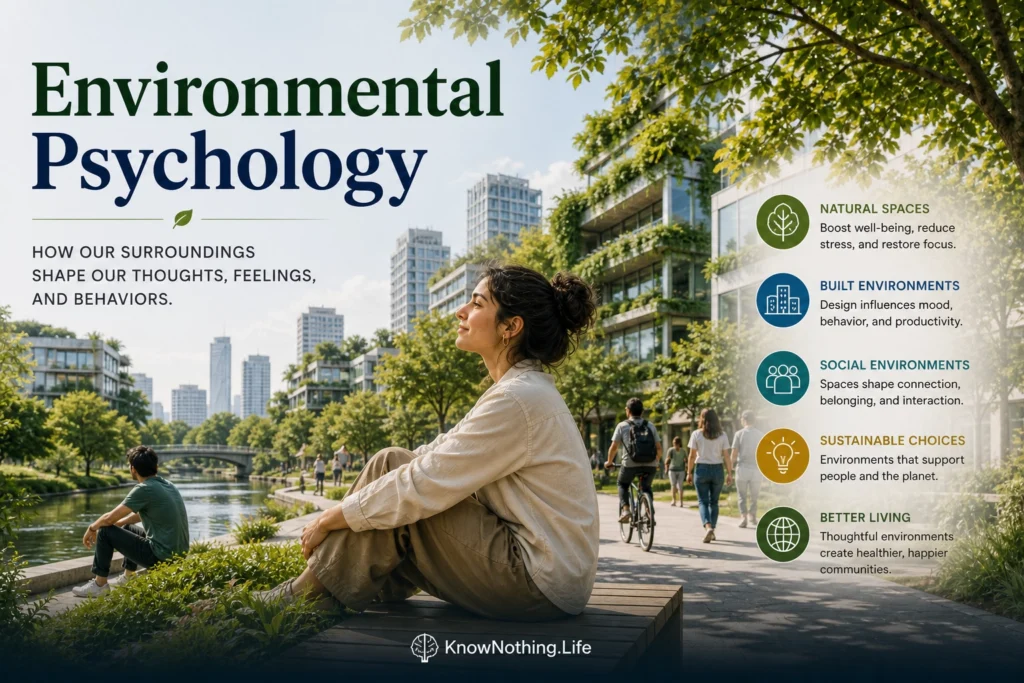
Environmental psychology explores the dynamic relationship between human behavior and the physical environments in which it unfolds. It asks how built spaces, natural landscapes, urban density, architecture, climate, and sensory conditions shape perception, emotion, cognition, and social interaction. At its core, the field rejects the idea that behavior occurs in a vacuum. Instead, it emphasizes that environments are active participants in psychological life, influencing not only what people do but how they think, feel, and relate to others. From the design of a room to the layout of a city, environments structure experience in subtle yet powerful ways.
The field emerged in the mid-20th century as psychologists, architects, and planners began to recognize that physical settings affect human well-being. Scholars such as Kurt Lewin, Roger G. Barker, James J. Gibson, and Robert Gifford helped establish the foundations of the discipline. Lewin’s famous formula—“behavior is a function of the person and the environment”—captured the field’s central premise, later formalized in his work Field Theory in Social Science. Environmental psychology extends this insight by examining how specific environmental features—from noise and crowding to green space and lighting—shape human experience across diverse contexts.
Person–Environment Interaction
At the heart of environmental psychology is the concept of person–environment interaction. Rather than treating individuals and environments as separate entities, the field studies how they influence one another in continuous feedback loops. People shape environments through design, use, and modification, while environments shape people by constraining and enabling behavior. This reciprocal relationship means that psychological outcomes cannot be fully understood without considering the context in which they occur.
Kurt Lewin’s field theory provides a foundational framework for this perspective. His equation B = f(P, E)—behavior as a function of person and environment—highlights that behavior emerges from the interaction between individual characteristics and situational factors. Roger G. Barker expanded on this idea through his concept of “behavior settings,” described in Ecological Psychology. Barker argued that recurring patterns of behavior are tied to specific environmental contexts, such as classrooms, offices, or public spaces, each with its own norms and expectations. These settings guide behavior in predictable ways, often without conscious awareness, illustrating how environments structure social life.
Perception and Environmental Experience
Environmental psychology also examines how individuals perceive and interpret their surroundings. Perception is not merely a passive reception of sensory input but an active process shaped by experience, expectations, and cultural context. James J. Gibson’s ecological approach to perception emphasized that environments offer “affordances”—opportunities for action that are directly perceived by individuals. In The Ecological Approach to Visual Perception, Gibson argued that perception is inherently functional, oriented toward what the environment allows or invites a person to do.
This perspective has important implications for understanding how design influences behavior. A well-designed space communicates its purpose intuitively, guiding movement and interaction without explicit instruction. For example, the layout of a park may encourage social gathering, relaxation, or physical activity depending on its features. Poor design, by contrast, can create confusion, stress, or disengagement. Environmental perception is therefore central to how people experience spaces, affecting everything from navigation and safety to comfort and aesthetic appreciation.
Urban Environments and Behavior
Urban environments present unique challenges and opportunities for environmental psychology. Cities concentrate large populations within limited spaces, creating conditions of density, noise, and social complexity. These factors can influence stress levels, social behavior, and mental health. Research has shown that high levels of crowding and noise can lead to increased stress, reduced concentration, and social withdrawal. At the same time, urban environments offer access to resources, cultural experiences, and social networks that can enhance well-being.
Stanley Milgram explored the psychological effects of urban life in his work on “stimulus overload” suggesting that individuals in cities develop coping strategies to manage the constant flow of information and social interaction. These strategies may include ignoring strangers, limiting social engagement, or filtering sensory input. While such adaptations help individuals function in complex environments, they can also contribute to feelings of isolation or detachment. Environmental psychology seeks to understand these dynamics and inform urban design practices that promote well-being, such as incorporating green spaces, reducing noise pollution, and improving accessibility.
Nature, Restoration, and Well-Being
One of the most significant findings in environmental psychology is the positive impact of natural environments on psychological well-being. Exposure to nature has been linked to reduced stress, improved mood, enhanced cognitive functioning, and greater overall life satisfaction. Rachel Kaplan and Stephen Kaplan developed Attention Restoration Theory (ART), which suggests that natural environments help restore depleted cognitive resources. In The Experience of Nature, they argued that nature provides “soft fascination,” allowing the mind to recover from the demands of directed attention.
Similarly, Roger Ulrich demonstrated that exposure to natural scenes can reduce physiological stress. His research showed that patients recovering from surgery experienced better outcomes when they had views of nature compared to those with views of built environments. These findings highlight the importance of integrating natural elements into urban design, healthcare settings, and everyday environments. Nature is not merely an aesthetic addition but a vital component of psychological health.
Environmental Stress and Adaptation
Environmental stressors such as noise, pollution, crowding, and extreme temperatures can have significant psychological effects. These stressors can impair cognitive performance, increase irritability, and contribute to long-term health problems. Environmental psychology examines how individuals respond to these challenges and develop coping strategies. Adaptation may involve behavioral changes, such as avoiding noisy areas, or psychological adjustments, such as habituation to certain conditions.
However, adaptation has limits. Chronic exposure to environmental stressors can lead to fatigue, burnout, and decreased well-being. Robert Gifford, in Environmental Psychology: Principles and Practice, emphasized that understanding environmental stress requires considering both objective conditions and subjective perceptions. What matters is not only the presence of a stressor but how it is experienced and interpreted. This insight underscores the importance of designing environments that minimize stress and support psychological resilience.
Sustainability and Environmental Behavior
Environmental psychology also plays a crucial role in addressing global challenges such as climate change and sustainability. Understanding why people engage in environmentally responsible behavior—or fail to do so—is essential for promoting sustainable practices. Factors such as values, social norms, perceived control, and environmental awareness all influence behavior. Psychologists study how these factors interact to shape actions such as recycling, energy conservation, and support for environmental policies.
Paul Stern contributed significantly to this area through his work on environmentally significant behavior. He emphasized that behavior is influenced by a combination of personal motivations, social influences, and structural constraints. Encouraging sustainable behavior therefore requires more than providing information; it involves creating environments that make sustainable choices accessible and socially supported. Environmental psychology bridges the gap between individual behavior and global outcomes, highlighting the role of human action in shaping the future of the planet.
Conclusion
Environmental psychology offers a comprehensive framework for understanding the interplay between people and their surroundings. It reveals that environments are not passive backdrops but active forces that shape perception, behavior, and well-being. From urban design to natural landscapes, from stressors to restorative settings, the physical world plays a central role in psychological life.
As global challenges such as urbanization, climate change, and environmental degradation intensify, the insights of environmental psychology become increasingly important. By integrating knowledge from psychology, architecture, and environmental science, the field provides tools for designing spaces that promote health, sustainability, and quality of life. Ultimately, environmental psychology reminds us that to understand human behavior, we must also understand the environments in which it takes place—and to improve human well-being, we must create environments that support it.