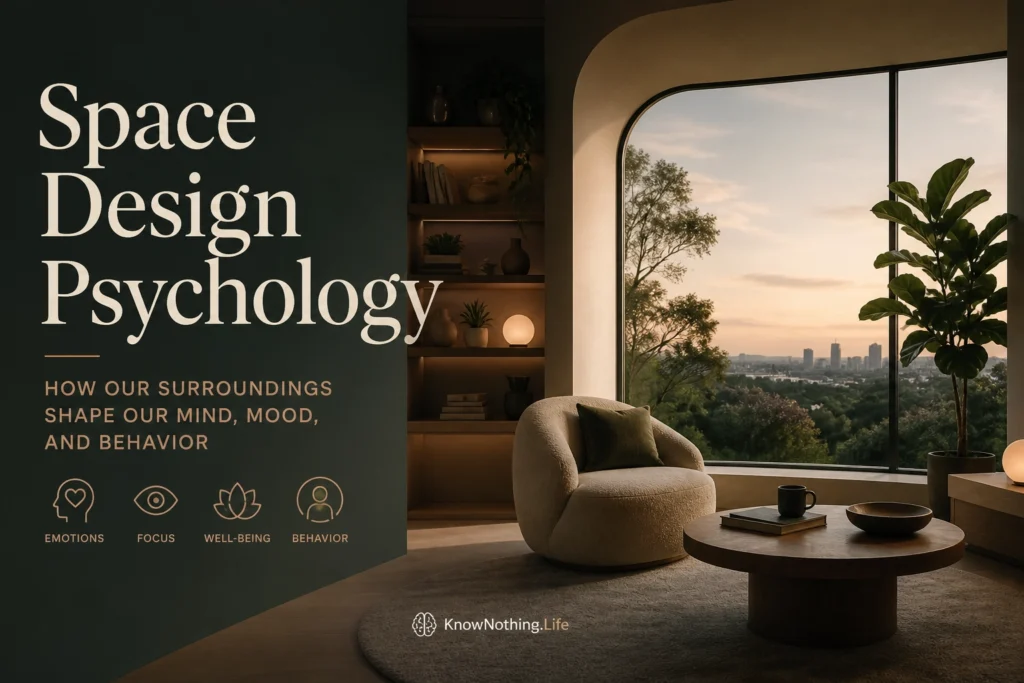
Space design psychology examines how the physical arrangement of environments influences human thought, emotion, and behavior. It operates at the intersection of psychology, architecture, interior design, and environmental science, asking a deceptively simple question: how do spaces shape the people who inhabit them? From the layout of a room to the scale of a building, from lighting and color to acoustics and spatial flow, every design decision carries psychological consequences. These effects are often subtle, operating below conscious awareness, yet they can profoundly influence comfort, productivity, social interaction, and well-being.
The field builds on foundational insights from Kurt Lewin, whose principle that behavior is a function of both the person and the environment laid the groundwork for understanding spatial influence. Later contributions from James J. Gibson, Roger G. Barker, and Robert Gifford expanded this perspective, showing that environments provide cues for action, structure behavior through recurring patterns, and shape psychological outcomes in systematic ways. Space design psychology applies these insights to the intentional creation of environments that support human needs, bridging scientific understanding with practical design.
The Psychology of Spatial Perception
Human interaction with space begins with perception. Individuals do not experience environments as neutral physical structures but as meaningful, interpreted spaces. James J. Gibson introduced the concept of affordances in The Ecological Approach to Visual Perception, arguing that environments offer possibilities for action that are directly perceived. A chair affords sitting, a corridor affords movement, and an open area may afford social gathering. These affordances guide behavior intuitively, often without conscious deliberation.
Spatial perception is also influenced by factors such as scale, proportion, and layout. Large, open spaces may evoke feelings of freedom or insignificance, while smaller, enclosed spaces can feel either comforting or restrictive depending on context. Cultural and individual differences further shape perception, as people bring expectations and prior experiences to their interpretation of space. Designers must therefore consider not only the physical properties of environments but also how those properties are likely to be perceived and experienced by users.
Layout, Flow, and Behavior
The organization of space plays a critical role in shaping behavior. Layout determines how people move through environments, where they gather, and how they interact with others. Roger G. Barker introduced the concept of behavior settings, emphasizing that specific environments are associated with recurring patterns of activity. In Ecological Psychology, Barker demonstrated that the structure of a setting can guide behavior independently of individual differences, highlighting the importance of design in shaping social life.
Flow, or the ease with which individuals can navigate a space, is a key aspect of layout. Poorly designed spaces can create confusion, frustration, and inefficiency, while well-designed environments facilitate movement and interaction. Kevin Lynch explored this idea in The Image of the City, introducing the concept of legibility—the clarity with which a space can be understood. Although Lynch focused on urban environments, his insights apply equally to interior spaces, where clear pathways, visual cues, and coherent organization enhance usability and comfort.
Lighting, Color, and Sensory Experience
Sensory elements such as lighting and color have significant psychological effects. Lighting influences mood, alertness, and perception, with natural light generally associated with improved well-being and productivity. Poor lighting can contribute to fatigue, eye strain, and decreased performance. Designers must balance functional requirements with psychological considerations, ensuring that spaces are both usable and supportive of mental health.
Color also plays a powerful role in shaping emotional responses. Different colors can evoke different moods, although these effects are influenced by cultural and contextual factors. Warm colors may create a sense of energy or intimacy, while cool colors can promote calmness and focus. Robert Gifford emphasized that environmental factors must be understood in relation to human perception, noting in Environmental Psychology: Principles and Practice that subjective experience is as important as objective conditions. Sensory design is therefore not merely decorative but integral to the psychological impact of space.
Privacy, Personal Space, and Territoriality
Space design psychology also addresses the need for privacy and personal space. Humans require a balance between social interaction and solitude, and environments must accommodate both. Irwin Altman developed a theory of privacy as a dynamic process, described in The Environment and Social Behavior. Altman argued that individuals regulate their level of interaction with others, seeking to achieve an optimal balance between openness and seclusion.
Personal space and territoriality are closely related concepts. Personal space refers to the immediate area surrounding an individual, while territoriality involves the control and use of larger spaces. Design can influence these experiences by providing areas for retreat, clear boundaries, and opportunities for personalization. Environments that fail to meet these needs can lead to discomfort, stress, and conflict, particularly in settings such as workplaces, schools, and residential buildings.
Social Interaction and Collaboration
The design of space significantly affects social behavior. Open layouts may encourage interaction and collaboration, while more segmented spaces can support focused work and privacy. The challenge lies in creating environments that balance these needs, recognizing that different activities require different spatial conditions. Edward T. Hall explored the role of spatial relationships in communication through his concept of proxemics, described in The Hidden Dimension. Hall demonstrated that cultural norms influence how people use space, including preferred distances and patterns of interaction.
In organizational settings, space design can influence teamwork, creativity, and productivity. Collaborative spaces that encourage informal interaction can foster innovation, while quiet areas support concentration. The effectiveness of these designs depends on how well they align with the needs and expectations of users. Space design psychology emphasizes that environments should be flexible, allowing individuals to choose spaces that match their activities and preferences.
Nature and Biophilic Design
The integration of natural elements into built environments has become a central focus in space design psychology. Biophilic design, inspired by the work of Edward O. Wilson, seeks to incorporate features such as natural light, vegetation, water, and organic materials into architectural spaces. This approach is based on the idea that humans have an inherent affinity for nature, which can be leveraged to enhance well-being.
Research by Rachel Kaplan and Stephen Kaplan supports the benefits of natural elements, showing that they can reduce stress, improve mood, and enhance cognitive functioning. Even small interventions, such as adding plants or providing views of nature, can have positive effects. Biophilic design demonstrates how insights from environmental psychology can be applied to create spaces that support both physical and mental health.
Designing for Well-Being
Space design psychology ultimately aims to create environments that support human well-being. This involves considering a wide range of factors, including functionality, aesthetics, comfort, and psychological impact. Human-centered design approaches prioritize the needs and experiences of users, ensuring that spaces are not only efficient but also enjoyable and meaningful.
Designing for well-being requires an interdisciplinary approach, integrating knowledge from psychology, architecture, and other fields. It also requires sensitivity to cultural differences, as perceptions of space and design preferences vary across contexts. By grounding design decisions in psychological principles, it is possible to create environments that enhance quality of life, promote positive behavior, and support diverse needs.
Conclusion
Space design psychology reveals that environments are not passive settings but active influences on human experience. The arrangement of space, the quality of sensory elements, and the integration of natural features all contribute to how individuals think, feel, and behave. By understanding these relationships, designers can create spaces that support well-being, productivity, and social interaction.
As the built environment continues to evolve, the importance of psychologically informed design will only increase. Whether in homes, workplaces, schools, or public spaces, the environments we create shape the lives we lead. Space design psychology provides the tools to make these environments more responsive to human needs, ensuring that the spaces we inhabit enhance rather than hinder our well-being.