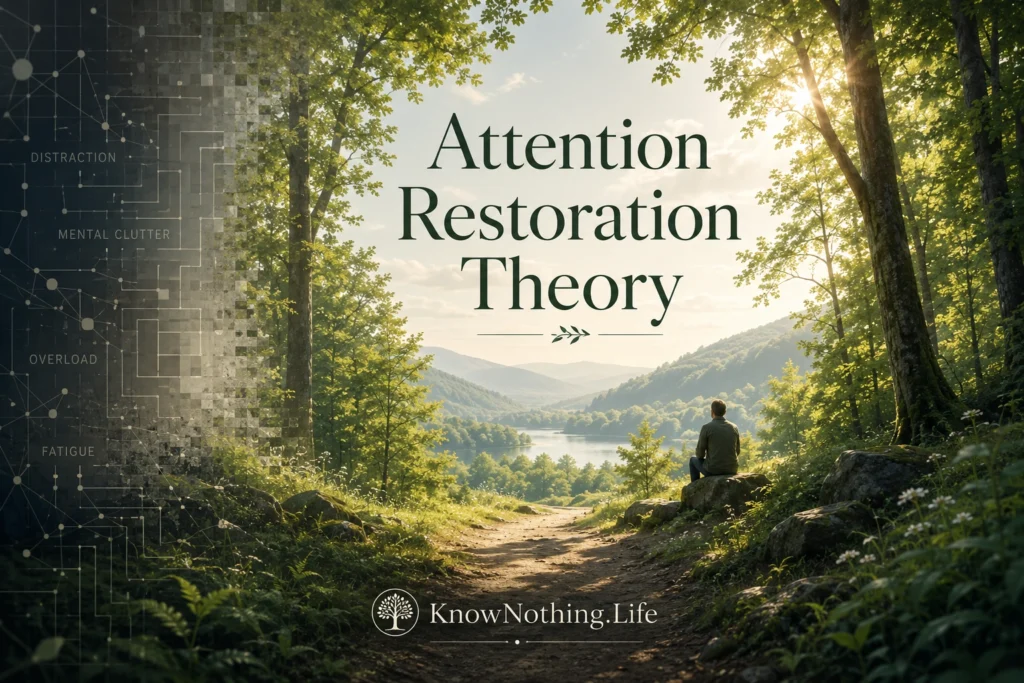
Attention Restoration Theory is a psychological theory that explains why certain environments, especially natural settings, help the mind recover from mental fatigue. The theory was developed by environmental psychologists Rachel Kaplan and Stephen Kaplan, whose work showed that attention is not an unlimited resource. Human beings can concentrate, plan, study, solve problems, control impulses, and ignore distractions, but these abilities require effort. After long periods of directed attention, the mind becomes tired. People may feel irritable, unfocused, impatient, mentally foggy, or less capable of self-control. Attention Restoration Theory argues that some environments allow this exhausted attentional system to recover.
The theory is especially important today because modern life constantly demands directed attention. Work screens, phones, notifications, traffic, dense schedules, digital messages, advertising, noise, and multitasking all compete for mental energy. Even leisure often happens through devices that keep the mind alert, reactive, and fragmented. Attention Restoration Theory offers a different idea: recovery does not always come from doing nothing. It can come from entering an environment that gently holds attention without forcing it. Natural settings such as forests, gardens, parks, rivers, lakes, beaches, trails, and even window views of trees can give the mind a form of effortless engagement that restores psychological balance.
The Origins of Attention Restoration Theory
Rachel and Stephen Kaplan developed Attention Restoration Theory through decades of research in environmental psychology. Their influential book The Experience of Nature: A Psychological Perspective argued that nature has powerful effects on mental functioning because it supports a different kind of attention than demanding urban or work environments. The Kaplans were not simply saying that nature is beautiful or pleasant. Their deeper claim was that natural environments help restore the cognitive capacity people use for effortful concentration.
Stephen Kaplan later refined the theory in his article “The Restorative Benefits of Nature: Toward an Integrative Framework.” He described directed attention as a limited capacity that allows people to focus voluntarily while inhibiting competing distractions. This kind of attention is essential for civilized life, but it is vulnerable to fatigue. Kaplan argued that restorative environments help because they engage the mind through “soft fascination,” a gentle form of interest that does not require effortful control. In this sense, the theory connects attention, environment, and well-being. It suggests that where people spend time affects not only mood, but the basic mental resources required for thinking clearly.
Directed Attention and Mental Fatigue
The central idea in Attention Restoration Theory is directed attention. Directed attention is the ability to intentionally focus on something while resisting distractions. Reading a difficult book, writing an article, driving in traffic, listening carefully in a meeting, solving a math problem, studying for an exam, or staying calm during conflict all require directed attention. This capacity is powerful because it allows people to act according to goals rather than impulses. It helps the mind say, “Stay with this,” even when something easier, louder, or more tempting appears.
The problem is that directed attention becomes depleted. When people spend too long in demanding environments, their ability to regulate attention weakens. They may become distractible, emotionally reactive, impatient, forgetful, or unable to think deeply. William James, in The Principles of Psychology, wrote that attention is the taking possession by the mind of one object “out of what seem several simultaneously possible objects.” His description captures the selective nature of attention. To attend to one thing, the mind must suppress others. Attention Restoration Theory adds that this suppression has a cost. The more the mind must filter distractions, the more it needs recovery.
Soft Fascination
Soft fascination is one of the most important concepts in Attention Restoration Theory. It refers to forms of attention that are naturally interesting but not mentally demanding. Watching leaves move in the wind, listening to water, observing clouds, sitting near a fire, following birdsong, walking through a garden, or looking across a landscape can hold attention gently. These experiences are engaging enough to prevent boredom, but not so intense that they require effortful control. The mind is occupied without being strained.
This is different from hard fascination. Hard fascination captures attention strongly and can be exciting, but it may not be restorative in the same way. A loud action movie, a fast video game, a chaotic city street, or a constantly refreshing social media feed can seize attention, but they may keep the nervous system stimulated rather than allowing recovery. Soft fascination gives attention a place to rest while still remaining awake. The Kaplans recognized that nature is especially rich in soft fascination because it contains movement, pattern, variety, depth, and mystery without usually demanding immediate response.
The Four Features of Restorative Environments
Attention Restoration Theory identifies four major features of restorative environments: being away, fascination, extent, and compatibility. “Being away” means psychological distance from ordinary demands. This does not always require traveling far. A garden, quiet park, wooded path, or peaceful room with natural elements may create a sense of separation from work, obligation, screens, and routine. The key is that the person feels temporarily released from the mental environment that caused fatigue.
“Fascination” refers to the effortless attention already described as soft fascination. “Extent” means the environment feels rich enough to enter mentally. A restorative place should have scope, coherence, and a sense that there is more to explore. A forest trail, coastline, mountain view, or even a well-designed garden can create this feeling. “Compatibility” means the environment fits what the person wants or needs to do. A peaceful trail supports walking and reflection; a quiet bench supports contemplation; a park supports unstructured play. When these four qualities come together, the environment gives the mind both relief and gentle engagement.
Nature and Cognitive Recovery
Research inspired by Attention Restoration Theory has found that natural environments can improve attention, working memory, mood, and self-regulation. Marc Berman, John Jonides, and Stephen Kaplan conducted influential research showing that walking in nature improved performance on cognitive tasks more than walking in urban environments. Their work supported the idea that nature can restore directed attention rather than merely improve mood. The important point is that nature does not have to be spectacular to matter. Everyday green spaces can provide measurable benefits.
Even small doses of nature may help. Views of trees from a window, indoor plants, photographs of natural scenes, neighborhood parks, and short outdoor walks can provide partial restoration. Roger Ulrich’s classic healthcare design research also showed that patients recovering from surgery had better outcomes when their hospital windows looked onto trees rather than a brick wall. While Ulrich’s work is often associated with stress recovery theory rather than Attention Restoration Theory specifically, both traditions support the larger idea that natural environments influence mental and physical recovery. The built environment is not psychologically neutral. It can drain the mind or help restore it.
Attention Restoration and Stress Reduction
Attention Restoration Theory is closely related to, but distinct from, stress reduction theory. Stress reduction theory, associated with Roger Ulrich, argues that humans have evolved to respond positively to certain natural environments because they signal safety, resources, and survival advantage. Natural scenes may reduce physiological stress, lower arousal, and promote emotional calm. Attention Restoration Theory focuses more specifically on cognitive recovery from directed attention fatigue. One theory emphasizes stress and emotion; the other emphasizes attention and cognition.
In real life, these processes often work together. A person who walks through a quiet park after a difficult day may feel calmer, less tense, and more mentally clear. Their stress response may settle while their attentional capacity recovers. This is one reason natural environments can feel so powerfully renewing. They do not merely entertain the mind; they change its operating conditions. They reduce pressure, soften attention, widen perception, and allow thought to reorganize itself. A person may enter nature overwhelmed and leave with a clearer sense of priorities.
Urban Life and Attention Fatigue
Urban environments can be exciting, creative, and socially rich, but they often place heavy demands on directed attention. Traffic, signage, sirens, crowds, advertisements, construction noise, social vigilance, and fast movement require continuous filtering. The mind must constantly decide what matters and what can be ignored. This does not mean cities are bad for mental life, but it does mean that urban design matters. A city without restorative spaces can become cognitively exhausting.
Attention Restoration Theory has influenced urban planning, architecture, landscape design, and public health because it suggests that green space is not a luxury. Parks, street trees, gardens, courtyards, trails, and quiet public spaces support mental functioning. They are part of psychological infrastructure. A well-designed city should not only move cars and people efficiently; it should help human beings recover attention, regulate emotion, and experience moments of quiet fascination. The theory therefore connects individual mental health to environmental justice. People in neighborhoods with fewer trees, parks, and safe outdoor spaces may have fewer opportunities for everyday restoration.
Digital Life and the Need for Restoration
Digital life makes Attention Restoration Theory more relevant than ever. Phones, apps, email, news feeds, video platforms, and social media constantly demand micro-bursts of attention. Unlike a forest path, a digital feed often uses hard fascination: novelty, outrage, beauty, humor, comparison, alerts, and social reward. It captures attention, but may leave the mind more scattered afterward. The result is a paradox. People turn to screens to relax, yet often finish feeling more tired, restless, or unfocused.
Nicholas Carr, in The Shallows, argued that digital environments can train the mind toward skimming, scanning, and interruption rather than deep concentration. His concern fits well with Attention Restoration Theory. If directed attention is already depleted, then constant digital stimulation may prevent real recovery. Restoration requires environments that do not keep pulling the mind into reaction. Natural settings provide a counter-pattern. They invite slower perception, broader awareness, and less defensive filtering. For a screen-saturated culture, nature may function as a necessary attentional reset.
Practical Applications of Attention Restoration Theory
Attention Restoration Theory can be applied in everyday life through small, realistic changes. A person does not need to live near a wilderness area to benefit. A short walk under trees, lunch outside, time in a garden, a view of the sky, a quiet park bench, indoor plants, natural light, or a screen break near a window can support recovery. The goal is not simply to add nature as decoration, but to create regular moments when attention is gently held rather than forcefully demanded.
Schools, workplaces, hospitals, and homes can all benefit from this insight. Students need access to outdoor breaks and green schoolyards. Workers need spaces that allow mental recovery rather than only productivity. Hospitals should consider views, gardens, daylight, and quiet spaces as part of healing environments. Homes can be arranged to include natural textures, plants, sunlight, and calm visual complexity. These design choices may seem small, but Attention Restoration Theory suggests that the mind is constantly shaped by environmental cues. A restorative environment supports better thinking by reducing unnecessary attentional strain.
Criticism and Limits of the Theory
Attention Restoration Theory is influential, but it should not be treated as a complete explanation of all nature benefits. Some researchers argue that restoration depends on many factors, including personal preference, safety, culture, physical activity, social context, biodiversity, weather, and prior experience. A forest may restore one person but frighten another. A city park may feel peaceful during the day and unsafe at night. A beach may be calming when quiet and overstimulating when crowded. Restorative value is not located only in the landscape; it emerges between person and environment.
There is also debate over how best to measure attention restoration. Cognitive tests, mood ratings, physiological measures, and self-reports do not always capture the same effects. Some benefits may come from exercise, sunlight, fresh air, reduced noise, beauty, or escape from work rather than nature alone. These criticisms do not erase the theory’s value. They refine it. Attention Restoration Theory is strongest when understood as part of a broader environmental psychology of human well-being. Nature often restores attention, but the degree of restoration depends on context, design, meaning, and individual need.
Final Thoughts on Attention Restoration Theory
Attention Restoration Theory matters because it reveals that the mind needs environments that respect its limits. Human beings are not built for endless concentration, constant interruption, and permanent cognitive demand. Directed attention is essential, but it is also fragile. When it becomes fatigued, people lose clarity, patience, emotional control, and the capacity for thoughtful action. Restorative environments help because they offer the mind a different relationship to the world: one based on soft fascination, spaciousness, compatibility, and temporary release from demand.
Rachel and Stephen Kaplan gave psychology a powerful language for understanding why nature feels mentally renewing. William James helps explain the selective effort of attention; the Kaplans show why that effort must be restored; Roger Ulrich shows how natural views can reduce stress and support healing; Marc Berman and colleagues provide cognitive evidence for the benefits of nature exposure; Nicholas Carr helps explain why digital life makes restoration more urgent. Attention Restoration Theory is not only a theory about parks, forests, or gardens. It is a theory about the kind of world the human mind needs in order to think clearly, feel balanced, and return to itself.