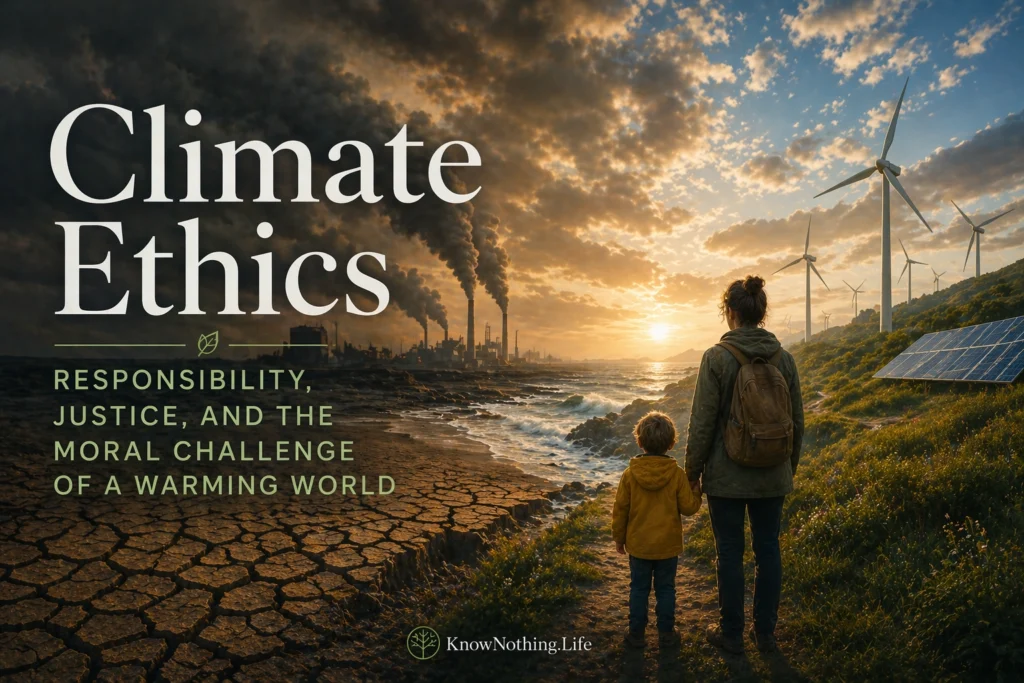
Climate change is not only a scientific and political issue but a profound moral challenge. It raises questions about responsibility, fairness, and the obligations individuals and societies have toward one another and toward future generations. Unlike many ethical problems, climate change operates on a global scale, with causes and consequences distributed unevenly across time and space. Those who contribute least to the problem are often those who suffer the most from its effects, while future generations bear risks they did not choose.
Climate ethics seeks to address these complexities by examining how moral principles apply to environmental change. It asks who is responsible for reducing emissions, how the burdens of mitigation and adaptation should be shared, and what duties exist toward future people and non-human life. In doing so, it extends traditional ethical frameworks to account for the unique challenges posed by climate change, including uncertainty, scale, and interdependence.
Historical Foundations of Climate Ethics
The ethical dimensions of climate change build on earlier philosophical discussions about justice, responsibility, and the environment. In classical philosophy, thinkers such as Aristotle emphasized the importance of balance and moderation, suggesting that excess can lead to instability. While not directly addressing environmental issues, this idea resonates with modern concerns about overconsumption and ecological limits.
In the modern period, philosophers such as John Locke explored the concept of property and resource use, arguing that individuals have rights to natural resources as long as they leave “enough and as good” for others. This principle introduces an early form of environmental responsibility, highlighting the need to consider the impact of resource use on others.
Contemporary climate ethics draws on these traditions while addressing new challenges. The global nature of climate change and its long-term consequences require an expansion of ethical thinking, incorporating considerations of collective action, global justice, and intergenerational responsibility. These developments reflect the evolving scope of moral philosophy in response to environmental issues.
Responsibility and Causation
One of the central questions in climate ethics is who is responsible for climate change. Greenhouse gas emissions are produced by individuals, corporations, and governments, making it difficult to assign responsibility to any single agent. This complexity raises questions about how responsibility should be distributed and what obligations arise from it.
Philosophers distinguish between different types of responsibility, including causal responsibility and moral responsibility. Causal responsibility refers to the role an agent plays in producing an outcome, while moral responsibility involves accountability and obligation. In the context of climate change, these concepts often overlap but do not align perfectly. For example, individuals may contribute to emissions through everyday activities, but their individual impact may seem negligible compared to larger systemic forces.
The challenge lies in determining how collective responsibility should be understood. Some argue that responsibility should be proportional to contribution, meaning that those who emit more should bear greater burdens. Others emphasize the role of capacity, suggesting that those with greater resources and technological capabilities have a stronger obligation to act. These approaches highlight the complexity of assigning responsibility in a global and interconnected system.
Justice and Equity
Climate change raises significant issues of justice and equity, as its impacts are distributed unevenly across populations. Vulnerable communities, particularly in developing regions, often face the most severe consequences despite contributing least to the problem. This disparity challenges traditional notions of fairness, requiring a broader understanding of justice that accounts for global inequalities.
Philosophers such as John Rawls have influenced discussions of climate justice through theories of fairness and distribution. Rawls’s emphasis on equality and the protection of the least advantaged provides a framework for evaluating climate policies, suggesting that efforts should prioritize those most affected by environmental harm.
Climate ethics also addresses the concept of distributive justice, which concerns how resources and burdens are allocated. This includes questions about how to share the costs of reducing emissions, adapting to climate impacts, and supporting affected communities. Achieving equitable solutions requires balancing competing interests while ensuring that vulnerable populations are not disproportionately burdened.
Intergenerational Ethics
A distinctive feature of climate change is its impact on future generations. Actions taken today will influence environmental conditions for decades or even centuries, affecting people who have no voice in current decision-making. This raises questions about the obligations present generations have toward those who will live in the future.
Intergenerational ethics explores how these obligations can be understood and justified. Philosophers argue that future people have moral claims on the present, even though they do not yet exist. This challenges traditional ethical frameworks, which often focus on relationships between contemporaries. It requires extending moral consideration across time, recognizing that future well-being is affected by present actions.
The concept of sustainability is closely linked to intergenerational ethics, emphasizing the need to preserve resources and environmental conditions for future use. This perspective encourages long-term thinking and highlights the importance of precaution in decision-making. By considering the interests of future generations, climate ethics expands the scope of moral responsibility.
Uncertainty and Risk
Climate change involves significant uncertainty, both in terms of its precise impacts and the effectiveness of potential solutions. This uncertainty complicates ethical decision-making, as individuals and policymakers must act without complete information. The presence of risk raises questions about how to balance caution and action.
Philosophers examine how ethical principles apply under conditions of uncertainty. The precautionary principle, for example, suggests that actions should be taken to prevent harm even when scientific certainty is lacking. This approach emphasizes the importance of avoiding potentially catastrophic outcomes, prioritizing safety and risk reduction.
At the same time, uncertainty can be used as a reason for inaction, as individuals may delay decisions until more information is available. Climate ethics challenges this tendency, arguing that the potential consequences of inaction are too significant to ignore. It emphasizes the need for responsible decision-making that accounts for both known and unknown risks.
Climate Ethics and Non-Human Life
Climate change affects not only human populations but also non-human life, including animals, plants, and ecosystems. This raises questions about the moral status of these entities and the extent to which they should be considered in ethical decision-making. Environmental philosophers argue that climate ethics must account for the broader ecological context.
The inclusion of non-human life expands the scope of moral concern, highlighting the interconnectedness of all living systems. It suggests that ethical responsibility extends beyond human interests, encompassing the preservation of biodiversity and ecological integrity. This perspective aligns with broader environmental ethics, emphasizing the value of nature as a whole.
Balancing human and non-human interests can be challenging, particularly when they conflict. However, climate ethics encourages a holistic approach that considers the long-term health of ecosystems as essential to overall well-being. By integrating these considerations, it provides a more comprehensive framework for addressing environmental issues.
Climate Ethics in Practice
Applying the principles of climate ethics to real-world situations involves translating abstract ideas into concrete actions. This includes developing policies that reduce emissions, promote renewable energy, and support adaptation efforts. It also involves individual choices, such as consumption patterns and lifestyle changes, that contribute to broader outcomes.
The role of institutions is particularly important, as governments and organizations have the capacity to implement large-scale changes. International cooperation is essential, given the global nature of climate change. Agreements and policies must balance national interests with collective responsibility, ensuring that efforts are coordinated and effective.
At the individual level, climate ethics encourages reflection on personal responsibility and the impact of everyday actions. While individual contributions may seem small, collective action can lead to significant change. This highlights the importance of both personal and systemic approaches in addressing climate challenges.
Conclusion
Climate ethics provides a framework for understanding the moral dimensions of climate change, addressing questions of responsibility, justice, and the future. It highlights the complexity of environmental issues, emphasizing the need for thoughtful and informed decision-making. By integrating ethical principles with scientific knowledge, it offers guidance for navigating one of the most pressing challenges of our time.
The study of climate ethics reveals that addressing climate change requires more than technical solutions; it demands a rethinking of values and priorities. It calls for a commitment to fairness, responsibility, and long-term thinking, recognizing the interconnectedness of human and natural systems.
Ultimately, climate ethics invites individuals and societies to consider their role in shaping the future. It challenges us to act not only for ourselves but for others, including those who will inherit the world we leave behind. In doing so, it offers a vision of a more just and sustainable future, grounded in ethical reflection and collective action.