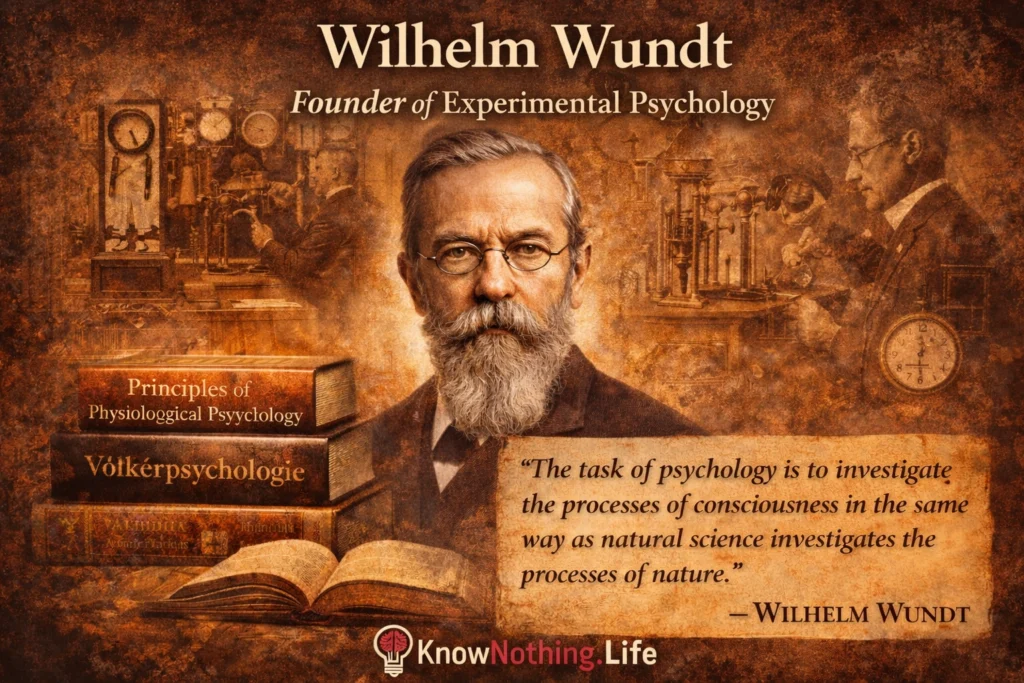
Wilhelm Wundt is widely regarded as the father of modern psychology, a figure who transformed the study of the human mind from a branch of philosophy into a rigorous scientific discipline. In the late 19th century, Wundt established the first laboratory dedicated specifically to psychological research, marking a decisive break from speculative approaches to understanding consciousness. His work laid the foundation for experimental psychology, influencing generations of researchers and shaping the development of the field as an independent science.
Wundt’s ambition was not merely to study the mind but to do so systematically, using controlled observation and measurement. He believed that mental processes could be analyzed in much the same way as physical phenomena, provided the right methods were applied. By combining philosophical insight with scientific methodology, he created a new framework for exploring perception, attention, and consciousness, setting the stage for psychology’s emergence as a modern discipline.
Early Life and Academic Formation
Wilhelm Wundt was born on August 16, 1832, in Neckarau, Germany. The son of a Lutheran pastor, Wundt grew up in an environment shaped by discipline, education, and intellectual curiosity. His early academic interests were diverse, encompassing medicine, physiology, and philosophy, fields that would later converge in his psychological work.
Wundt studied medicine at the universities of Tübingen and Heidelberg, where he developed a strong interest in physiology—the scientific study of bodily functions. This training proved crucial, as it provided him with the tools and perspective needed to approach mental phenomena in a scientific manner. He later worked as an assistant to the renowned physiologist Hermann von Helmholtz, whose influence further reinforced Wundt’s commitment to experimental methods.
During this period, Wundt began to explore questions about the relationship between the mind and the body. He was particularly interested in how sensory experiences are processed and how they give rise to conscious awareness. These early investigations laid the groundwork for his later efforts to establish psychology as a distinct scientific field.
Founding Experimental Psychology
Wundt’s most significant achievement came in 1879, when he established the first experimental psychology laboratory at the University of Leipzig. This event is often considered the official beginning of psychology as an independent scientific discipline. In this laboratory, Wundt and his students conducted systematic experiments on perception, reaction time, and attention, using carefully controlled conditions to ensure reliable results.
The Leipzig laboratory quickly became a center for psychological research, attracting students from around the world. Wundt’s approach emphasized the importance of experimentation and measurement, distinguishing psychology from philosophy and aligning it more closely with the natural sciences. His methods focused on analyzing immediate conscious experience, rather than abstract speculation.
One of Wundt’s key techniques was introspection, a method in which trained observers reported their own conscious experiences in response to specific stimuli. Unlike casual self-reflection, Wundt’s introspection was highly structured and conducted under controlled conditions. This allowed researchers to break down complex mental processes into simpler components, providing insight into the structure of consciousness.
Major Works and Theoretical Contributions
Wundt’s intellectual output was vast, encompassing numerous books and articles that shaped the direction of psychological research. Among his most important works is Principles of Physiological Psychology, published in 1874. In this text, Wundt outlined his vision for a scientific psychology grounded in physiological processes, arguing that mental phenomena could be studied through their physical correlates.
Another significant contribution is his multi-volume work Völkerpsychologie, which explores the role of culture, language, and social practices in shaping human thought. While his experimental work focused on individual consciousness, Wundt recognized that higher mental processes—such as language and reasoning—could not be fully understood through laboratory experiments alone. Völkerpsychologie represents his attempt to address these broader aspects of human psychology.
Wundt’s theoretical framework is often associated with structuralism, the idea that consciousness can be analyzed into basic elements, much like chemical compounds can be broken down into simpler substances. Although later psychologists would challenge and refine this approach, it provided an essential starting point for the systematic study of the mind.
Consciousness, Perception, and Apperception
Central to Wundt’s psychology is the study of consciousness, which he defined as the sum of immediate experiences. He believed that understanding consciousness required careful analysis of its components, including sensations, feelings, and perceptions. By examining these elements, Wundt aimed to uncover the fundamental structure of mental life.
A key concept in his theory is apperception, the process by which the mind actively organizes and interprets sensory information. Unlike passive perception, apperception involves attention and will, reflecting the dynamic nature of consciousness. Wundt saw this process as central to human cognition, emphasizing that the mind is not merely a passive receiver of stimuli but an active participant in shaping experience.
Wundt’s work also highlighted the importance of temporal processes in consciousness. He studied reaction times to understand how quickly individuals could respond to stimuli, providing insight into the speed and efficiency of mental operations. These experiments demonstrated that psychological processes could be measured and quantified, reinforcing his vision of psychology as a scientific discipline.
Influence and Legacy
Wilhelm Wundt’s influence on psychology is profound and far-reaching. His laboratory at Leipzig trained many of the early pioneers of the field, including figures who would go on to establish psychology in other countries. Through his teaching and mentorship, Wundt helped spread experimental methods and scientific rigor across the emerging discipline.
Although some of his methods, particularly introspection, would later be criticized and replaced by new approaches, his emphasis on experimentation remains a cornerstone of psychological research. Fields such as cognitive psychology, neuroscience, and behavioral science all trace their roots to the foundations laid by Wundt.
Beyond psychology, Wundt’s work has had an impact on philosophy, linguistics, and cultural studies. His recognition of the interplay between individual consciousness and social context anticipated later developments in these fields. By bridging the gap between science and philosophy, Wundt created a framework that continues to inform our understanding of the human mind.
Conclusion
Wilhelm Wundt’s legacy lies in his pioneering effort to transform the study of the mind into a scientific endeavor. Through his establishment of the first psychology laboratory, his development of experimental methods, and his extensive theoretical contributions, he laid the groundwork for modern psychology.
His vision of psychology as a discipline grounded in observation, measurement, and analysis remains as relevant today as it was in the 19th century. While the field has evolved in many ways, the fundamental principles he introduced continue to guide research and inquiry.
As Wundt himself observed, “The task of psychology is to investigate the processes of consciousness in the same way as natural science investigates the processes of nature.” This statement encapsulates his enduring contribution: a commitment to understanding the human mind through systematic and scientific exploration.