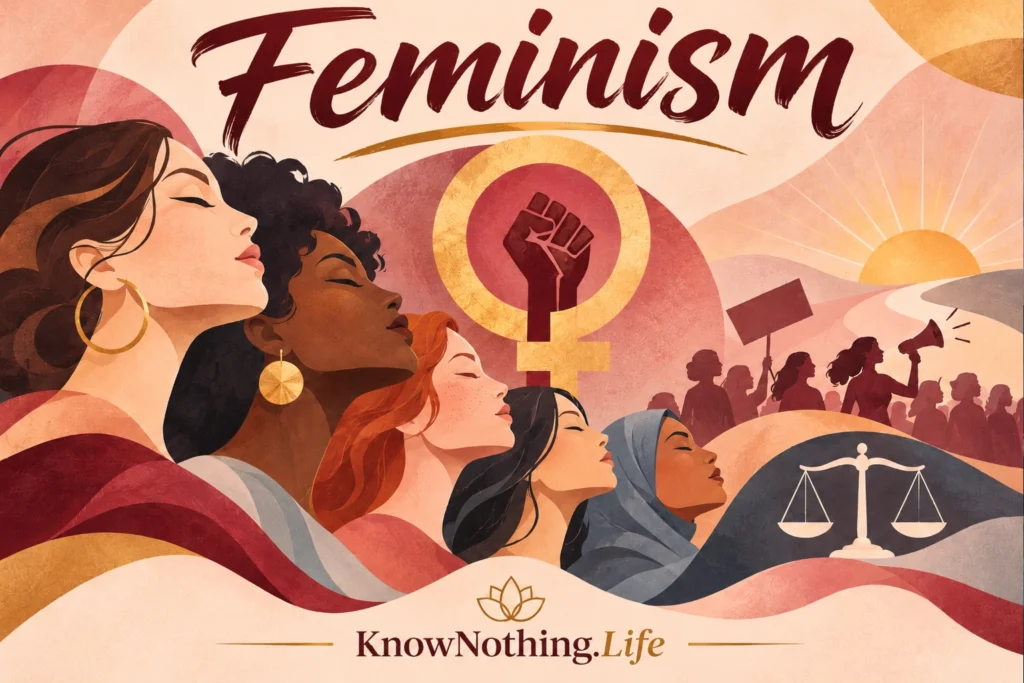
Feminism is one of the most influential social, political, and philosophical movements in modern history, fundamentally transforming how societies understand equality, individual rights, gender, and human freedom. At its core, feminism challenges forms of discrimination, exclusion, and unequal power associated with sex and gender. Yet the movement encompasses a wide range of intellectual traditions, from liberal arguments for equal legal rights to more radical examinations of social institutions, economic structures, and cultural expectations.
Throughout its history, feminism has raised questions extending far beyond women’s political participation. What does genuine equality require? How do biological differences interact with social expectations? Can individuals make truly independent choices when their opportunities are shaped by inherited cultural norms? Philosophers and writers including Mary Wollstonecraft, John Stuart Mill, Simone de Beauvoir, bell hooks, and Judith Butler have approached these questions from different perspectives. Their work reveals that feminism is not a single, unchanging ideology but an evolving debate about justice, identity, autonomy, and the relationship between individuals and society.
What Is Feminism?
Feminism is broadly understood as a collection of movements and theories seeking to challenge gender-based discrimination and promote equality in social, political, economic, and personal life. The term encompasses both practical activism and philosophical inquiry. Feminist movements have pursued voting rights, educational opportunities, legal independence, workplace protections, and freedom from violence, while feminist philosophers have questioned the assumptions through which societies define gender roles, authority, and human capabilities.
American scholar bell hooks offered an influential definition in Feminism Is for Everybody (2000), describing feminism as “a movement to end sexism, sexist exploitation, and oppression.” Her formulation emphasizes systems of inequality rather than hostility toward men. However, feminists disagree over which inequalities deserve priority and how they should be addressed. Some emphasize individual rights and equal opportunity, while others argue that meaningful equality requires transforming economic institutions, family structures, or cultural expectations. These disagreements are central to feminism’s intellectual history rather than evidence that the movement lacks philosophical substance.
The Philosophical Origins of Feminism
Although the modern feminist movement emerged primarily during the eighteenth and nineteenth centuries, arguments challenging women’s subordination appeared much earlier. Christine de Pizan’s The Book of the City of Ladies (1405) criticized influential assumptions about women’s intellectual and moral inferiority. During the Enlightenment, the language of universal rights created further opportunities to question political systems that proclaimed human equality while excluding women. Olympe de Gouges challenged this contradiction in her Declaration of the Rights of Woman and of the Female Citizen (1791), arguing that revolutionary principles should apply to women as well as men.
Mary Wollstonecraft provided one of the movement’s most important philosophical foundations in A Vindication of the Rights of Woman (1792). She argued that women’s apparent intellectual limitations were often consequences of restricted education rather than evidence of natural inferiority. Her central concern was autonomy: women should develop their rational capacities instead of being trained primarily to satisfy social expectations. In the nineteenth century, Harriet Taylor Mill’s The Enfranchisement of Women (1851) and John Stuart Mill’s The Subjection of Women (1869) further challenged legal and cultural inequalities. These works connected women’s emancipation with broader liberal principles of individuality, liberty, and equal moral standing.
The First Wave of Feminism and Women’s Suffrage
The first wave of feminism is commonly associated with nineteenth- and early twentieth-century campaigns for women’s legal rights, particularly political representation and suffrage. The Seneca Falls Convention of 1848 became a landmark event in the American women’s rights movement. Organized by activists including Elizabeth Cady Stanton and Lucretia Mott, the convention produced the Declaration of Sentiments, which challenged restrictions on women’s political participation, property ownership, and educational opportunities. Suffrage campaigns subsequently developed across multiple countries, employing petitions, public demonstrations, legislative advocacy, and civil disobedience.
New Zealand granted women the parliamentary vote in 1893, while the United States ratified the Nineteenth Amendment in 1920, prohibiting denial of voting rights on account of sex. However, these achievements did not immediately establish equal political access for all women. Racial discrimination, citizenship restrictions, and other barriers continued to exclude many women from effective participation. Black activists including Ida B. Wells-Barnett and Mary Church Terrell challenged these inequalities while confronting racism within parts of the suffrage movement. The history of first-wave feminism therefore demonstrates both significant advances in political equality and unresolved tensions concerning whose rights were prioritized.
The Second Wave and the Transformation of Everyday Life
The second wave of feminism, associated particularly with the 1960s through the 1980s, expanded feminist inquiry beyond formal political equality. Activists and theorists examined workplace discrimination, reproductive autonomy, domestic labor, sexual harassment, and expectations surrounding marriage and motherhood. Betty Friedan’s The Feminine Mystique (1963) criticized the assumption that domestic fulfillment should provide the exclusive foundation of women’s identities. Although Friedan’s account centered largely on the experiences of white, middle-class American women, it helped stimulate broader public discussion about educational ambitions, economic independence, and social expectations.
The slogan “the personal is political,” associated with feminist organizing and Carol Hanisch’s influential 1969 essay, expressed an important philosophical transformation. Experiences traditionally treated as private concerns could also reflect larger institutional arrangements and cultural expectations. Kate Millett’s Sexual Politics (1970) examined relationships between sexuality and power, while Shulamith Firestone’s The Dialectic of Sex (1970) proposed a more radical transformation of gender relations. These thinkers disagreed about the origins of inequality, but they shared an interest in examining how authority could operate through ordinary relationships rather than exclusively through laws and governments.
Liberal, Radical, and Socialist Feminism
Feminist philosophy developed several distinct schools of thought, each emphasizing different explanations of inequality. Liberal feminism focuses primarily on individual rights, equal opportunities, legal protections, and autonomy. Its arguments commonly defend access to education, employment, political participation, and freedom from discrimination. Radical feminism investigates whether gender hierarchies are deeply embedded within institutions, social expectations, and intimate relationships. Some radical feminists argue that legal reforms alone cannot eliminate inequalities reproduced through everyday cultural practices.
Socialist and Marxist feminism place greater emphasis on economic relationships, labor, and the distribution of resources. These perspectives examine how unpaid domestic work, caregiving responsibilities, and employment structures influence women’s economic independence. Friedrich Engels’ The Origin of the Family, Private Property and the State (1884) provided an early materialist interpretation of women’s subordination, while Silvia Federici’s Caliban and the Witch (2004) investigated relationships among capitalism, reproductive labor, and historical transformations in women’s social position. These traditions frequently overlap, but they differ over whether legal reform, economic restructuring, or more extensive cultural transformation offers the most effective route toward equality.
Simone de Beauvoir and the Construction of Gender
Simone de Beauvoir fundamentally transformed feminist philosophy through The Second Sex (1949), one of the twentieth century’s most influential examinations of women’s social and existential circumstances. Her famous statement, “One is not born, but rather becomes, a woman,” challenges the assumption that social expectations associated with femininity arise inevitably from biology. Beauvoir did not deny the physical realities of human bodies. Instead, she investigated how societies interpret bodily differences and transform them into expectations governing identity, behavior, and opportunity.
Drawing upon existentialism and phenomenology, Beauvoir argued that human beings possess possibilities extending beyond the social categories assigned to them. She examined how women were frequently positioned as the “Other” in relation to men, whose experiences were treated as the supposedly universal human standard. Her analysis influenced later distinctions between biological sex and socially constructed gender roles. Judith Butler subsequently challenged stable understandings of gender identity in Gender Trouble (1990), developing the concept of gender performativity. Butler’s arguments sparked influential debates about whether gender categories should be reformed, expanded, or fundamentally reconsidered.
Black Feminism and Intersectionality
One of the most important developments in feminist thought emerged from criticism that mainstream movements frequently overlooked differences among women. Black feminist thinkers argued that gender inequality could not always be understood independently of race, class, sexuality, and historical circumstances. In Ain’t I a Woman: Black Women and Feminism (1981), bell hooks examined how racism and sexism interacted within American society and within movements that claimed to represent women’s interests. Patricia Hill Collins extended these arguments in Black Feminist Thought (1990), emphasizing the importance of lived experience and the relationship between knowledge and social power.
The Combahee River Collective’s 1977 statement argued that multiple systems of oppression could operate together rather than functioning as isolated forces. Legal scholar Kimberlé Crenshaw developed the concept of intersectionality in Demarginalizing the Intersection of Race and Sex (1989), examining situations in which conventional approaches to discrimination failed to capture overlapping disadvantages. Intersectionality subsequently became an important framework for understanding how gender interacts with other social characteristics. Its central insight is that women do not constitute a uniform population with identical experiences, priorities, or opportunities.
Feminism, Psychology, and Gender Socialization
Feminist thought has influenced psychology by challenging assumptions about innate differences between men and women and examining how social environments shape human development. Psychologist Sandra Bem introduced gender schema theory in 1981, proposing that individuals learn culturally available categories through which they interpret gender-related information. These schemas can influence expectations, behavior, and self-perception. Albert Bandura’s broader social learning framework also provides insight into how observation, reinforcement, and social modeling contribute to the development of behavioral patterns.
Research suggests that many psychological characteristics show substantial overlap between men and women. In The Gender Similarities Hypothesis (2005), psychologist Janet Shibley Hyde reviewed 46 meta-analyses and concluded that males and females are similar on most, though not all, measured psychological variables. This does not mean that every observed difference is negligible or that biological influences are irrelevant. Instead, the findings challenge sweeping claims that men and women possess fundamentally incompatible psychological capacities. Feminist psychology consequently examines how biology, social expectations, opportunity, and individual experience interact rather than assuming that gender alone determines personality or ability.
Feminism and Research on Economic Inequality
Economic research provides important evidence for understanding persistent differences in employment and earnings. Economist Claudia Goldin examined the historical evolution of women’s labor market participation in A Grand Gender Convergence: Its Last Chapter (2014). She argued that remaining earnings differences are influenced partly by workplace structures that disproportionately reward long hours, inflexible schedules, and continuous availability. Because women continue to perform substantial caregiving responsibilities in many societies, these employment arrangements can produce unequal economic outcomes even when educational attainment and professional qualifications become increasingly similar.
Experimental research has also investigated gender-based evaluation. In Getting a Job: Is There a Motherhood Penalty? (2007), Shelley Correll, Stephen Benard, and In Paik found evidence that mothers could face disadvantages in hiring evaluations compared with otherwise similar applicants without children. A 2012 study by Corinne Moss-Racusin and colleagues, Science Faculty’s Subtle Gender Biases Favor Male Students, found that faculty participants evaluated identical laboratory-manager applications differently depending upon whether the applicant was assigned a male or female name. These studies identify particular mechanisms of disadvantage, although their findings should not be interpreted as proving that every employment difference results from discrimination. Economic inequality can emerge through multiple interacting influences, including occupational choices, family responsibilities, institutional practices, and social expectations.
Feminism, Criticism, and Internal Disagreements
Feminism has generated substantial philosophical criticism, both from external opponents and from thinkers working within feminist traditions. One recurring debate concerns whether policies intended to promote equality should emphasize equal treatment, equal opportunity, or greater equality of outcomes. Critics argue that some approaches risk assigning too much explanatory importance to gender or overlooking individual preferences and differences. Others question whether political movements organized around collective identities can unintentionally reinforce the categories they seek to challenge. These objections raise legitimate philosophical questions about autonomy, fairness, and the appropriate relationship between social reform and individual freedom.
Feminists themselves disagree about pornography, sex work, reproductive ethics, gender identity, religious practices, and the appropriate balance between collective protection and personal choice. Philosophers such as Martha Nussbaum and Susan Moller Okin have examined how freedom, cultural traditions, and gender equality can come into conflict. Nussbaum’s Women and Human Development (2000) proposes a capabilities approach focused on the substantive opportunities individuals possess to pursue flourishing lives. These debates demonstrate that feminism cannot be reduced to agreement upon a single political program. Its competing traditions continually reconsider the meaning of freedom and the conditions necessary for individuals to exercise it.
Feminism in the Modern World
Contemporary feminism operates across diverse cultural, political, and economic environments. Its concerns include educational access, workplace discrimination, political representation, reproductive healthcare, gender-based violence, family responsibilities, and the effects of emerging technologies. Digital communication has expanded opportunities for activism, allowing personal experiences to become part of international public discussions. The #MeToo movement, for example, drew widespread attention to sexual harassment, institutional accountability, and the difficulties individuals may face when reporting misconduct. However, differences in national laws, economic conditions, religious traditions, and cultural expectations mean that feminist priorities vary considerably across societies.
Global feminist thought has also challenged the assumption that Western experiences provide a universal model of women’s liberation. Chandra Talpade Mohanty’s influential essay Under Western Eyes (1984) criticized representations of women in developing countries as an undifferentiated population lacking agency. Her work emphasized the importance of historical context, local political conditions, and the perspectives of women themselves. This approach encourages a more complex understanding of feminism as a collection of movements responding to distinct circumstances. It also raises questions about how universal human rights can coexist with respect for cultural diversity and individual self-determination.
Why Feminism Still Matters
The philosophical significance of feminism extends beyond particular policies or historical achievements. Feminist inquiry challenges societies to reconsider assumptions that may appear natural simply because they have existed for generations. Expectations concerning leadership, caregiving, emotional expression, ambition, and personal identity influence men as well as women. Examining these expectations can reveal how social institutions shape the opportunities available to individuals and how apparently ordinary practices may carry broader ethical consequences.
Feminism also raises fundamental questions about the relationship between freedom and social conditions. Possessing a legal right does not necessarily guarantee the practical ability to exercise it, while eliminating formal restrictions does not automatically remove cultural pressures. At the same time, respecting autonomy requires acknowledging that individuals may pursue different values and life arrangements. A philosophical defense of equality must therefore remain attentive to both shared human dignity and the diversity of personal choices. These tensions explain why feminism continues to evolve rather than arriving at a single final interpretation of justice.
Final Thoughts on Feminism
Feminism has transformed political institutions, philosophical debates, educational opportunities, and cultural understandings of gender. From Mary Wollstonecraft’s defense of rational independence to Simone de Beauvoir’s examination of socially constructed identity and contemporary research into discrimination and economic inequality, feminist thought has consistently questioned whether inherited arrangements adequately respect individual dignity and freedom.
Its enduring intellectual significance lies not in universal agreement among feminists but in the questions the movement continues to raise. What does equality mean when individuals begin life under different circumstances? How should societies distinguish personal choice from social expectation? And how can political institutions protect freedom without reducing people to predetermined identities? Ultimately, feminism invites reflection upon a fundamental philosophical principle: Human potential should not be limited by assumptions about what individuals are expected to become simply because of their sex or gender.