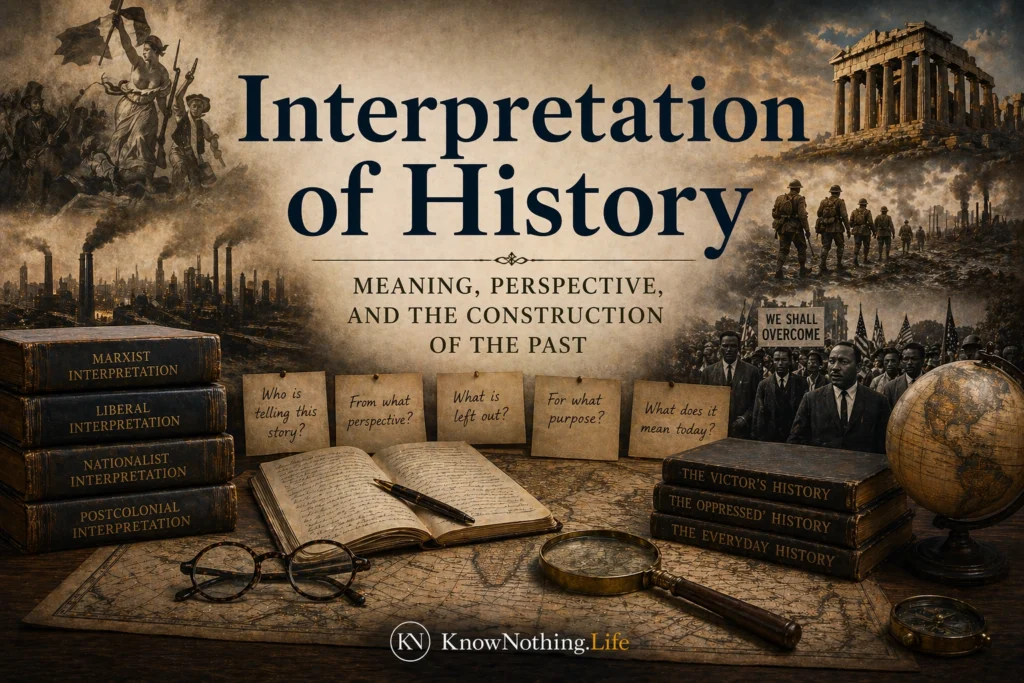
The interpretation of history concerns how the past is understood, explained, and given meaning. While historical events themselves are fixed, the way those events are interpreted is constantly evolving. Historians do not simply uncover facts; they organize, analyze, and present them within frameworks that shape how those facts are understood. This process raises fundamental questions about objectivity, perspective, and the role of interpretation in historical knowledge.
Interpretation is unavoidable because the past does not present itself as a complete or coherent narrative. It must be reconstructed from fragments—documents, artifacts, testimonies—that require context and explanation. Different historians may interpret the same evidence in different ways, leading to diverse and sometimes conflicting accounts. The philosophy of historical interpretation explores these differences, seeking to understand how meaning is created and how interpretations can be evaluated.
The Nature of Historical Interpretation
Historical interpretation involves transforming raw data into meaningful accounts of the past. Facts alone do not constitute history; they become historical knowledge only when they are connected, explained, and situated within a broader context. This process requires selecting which events are significant, determining relationships between them, and constructing narratives that make sense of their implications.
Philosophers such as R. G. Collingwood emphasized that historical understanding involves reconstructing the thoughts and intentions of historical actors. According to this view, interpretation is not merely about external events but about the meanings those events held for the people involved. This perspective highlights the active role of the historian in shaping historical knowledge, as interpretation bridges the gap between past actions and present understanding.
Objectivity and Subjectivity
One of the central debates in the interpretation of history concerns the possibility of objectivity. Traditional approaches often aimed to present history as an objective account of what actually happened, minimizing the influence of personal or cultural bias. The ideal of objectivity remains important, as it underpins the credibility of historical scholarship and the pursuit of truth.
However, many philosophers argue that complete objectivity is unattainable. Historians inevitably bring their own perspectives, assumptions, and values to their work, influencing how they interpret evidence and construct narratives. Recognizing this subjectivity does not necessarily undermine historical knowledge but encourages greater awareness of the factors that shape interpretation. By critically examining their own assumptions and engaging with multiple perspectives, historians can strive for a more balanced and nuanced understanding of the past.
The Role of Evidence
Evidence plays a central role in historical interpretation, providing the foundation for constructing and evaluating accounts of the past. Sources such as documents, artifacts, and oral histories offer insights into historical events, but they do not speak for themselves. Interpreting evidence requires assessing its reliability, context, and significance, as well as considering how it fits within a broader framework.
The process of interpretation often involves weighing conflicting sources and resolving ambiguities. Historians must decide which evidence is most credible and how different pieces of information relate to one another. This interpretive work is guided by methodological principles, including critical analysis and corroboration, which help ensure that interpretations are grounded in evidence rather than speculation. At the same time, the limitations of available sources mean that historical interpretations are always provisional and open to revision.
Narrative and Storytelling
Historical interpretation is closely tied to narrative, as historians organize events into stories that provide coherence and meaning. Narratives connect causes and effects, highlight significant developments, and create a sense of continuity over time. Without narrative, historical accounts would remain fragmented and difficult to understand.
The philosopher Hayden White argued that historical narratives are shaped by literary structures, such as plot and genre, which influence how events are presented. This perspective suggests that interpretation involves not only selecting facts but also choosing how to tell the story. While narrative enhances understanding, it also introduces the possibility of distortion, as different narrative choices can lead to different interpretations of the same events.
Competing Interpretations
Historical interpretation often involves competing perspectives, as different historians offer alternative explanations for the same events. These differences may arise from varying theoretical frameworks, cultural backgrounds, or research priorities. For example, an event might be interpreted in terms of economic forces, political, or cultural change, depending on the perspective adopted.
The existence of competing interpretations does not necessarily imply that truth is unattainable. Instead, it reflects the complexity of historical reality and the diversity of approaches used to understand it. Evaluating interpretations involves assessing their coherence, evidence, and explanatory power, as well as considering how well they account for alternative viewpoints. This process of debate and revision is central to the development of historical knowledge.
Context and Perspective
Context is essential for interpreting history, as events cannot be fully understood in isolation. Cultural, social, and political contexts shape both the actions of historical actors and the interpretations of historians. Understanding the context in which events occurred helps to clarify their significance and avoid anachronistic judgments.
Perspective also plays a crucial role, as different groups may interpret the same events in different ways. Including diverse perspectives, particularly those that have been marginalized or overlooked, enriches historical understanding and provides a more comprehensive view of the past. This emphasis on multiple perspectives reflects a broader shift toward inclusivity and critical reflection in historical scholarship.
Interpretation and Power
The interpretation of history is not only an intellectual activity but also a site of power. Historical narratives can influence collective memory, national identity, and political discourse. Those who control the dominant interpretations of history can shape how societies understand themselves and their past.
This connection between interpretation and power has been explored by thinkers such as Michel Foucault, who examined how knowledge and power are intertwined. Historical interpretations can reinforce existing power structures or challenge them by bringing alternative perspectives to light. Recognizing this dynamic underscores the importance of critical engagement with historical narratives and the need for openness to diverse viewpoints.
Limits of Interpretation
Despite its central role, historical interpretation has limits. The available evidence may be incomplete or ambiguous, and certain aspects of the past may remain inaccessible. These limitations mean that historical interpretations can never achieve complete certainty or finality.
Acknowledging these limits does not diminish the value of historical inquiry but highlights its ongoing and dynamic nature. Interpretations evolve as new evidence is discovered, methodologies are refined, and perspectives shift. The study of history is thus a continuous process of reinterpretation, reflecting both the complexity of the past and the changing concerns of the present.
Conclusion
The interpretation of history is a fundamental aspect of understanding the past, involving the transformation of evidence into meaningful narratives. It requires balancing objectivity and subjectivity, analyzing evidence critically, and engaging with multiple perspectives. Through this process, historians construct accounts that provide insight into human experience and the forces that shape it.
Ultimately, historical interpretation is not about discovering a single, definitive account but about exploring the range of possible meanings and explanations. By examining how interpretations are formed and evaluated, the philosophy of history deepens our understanding of both the past and the methods used to study it. This ongoing engagement with interpretation ensures that history remains a vibrant and evolving field of inquiry.