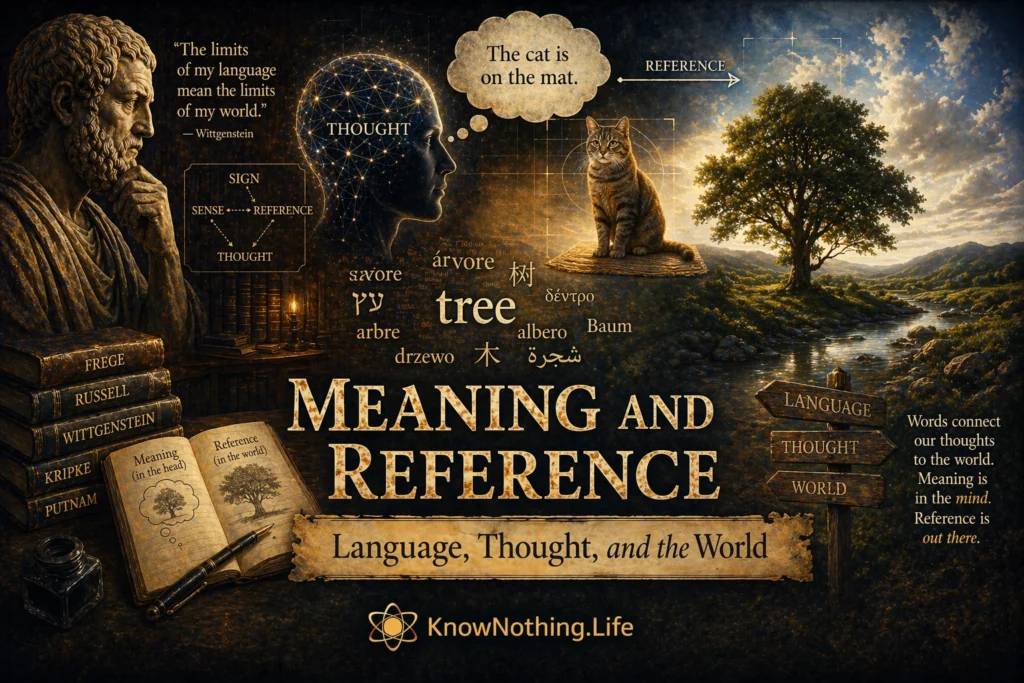
The concepts of meaning and reference lie at the core of the philosophy of language. When we use words, we typically intend them to convey meaning and to refer to objects, properties, or states of affairs in the world. Yet the relationship between meaning and reference is far from straightforward. How do words connect to the things they describe? Can two expressions have the same reference but different meanings? And how does language succeed in representing reality at all?
These questions have shaped philosophical inquiry for over a century, particularly within the analytic tradition. Thinkers such as Gottlob Frege and Bertrand Russell laid the groundwork for modern debates, introducing distinctions and theories that continue to influence contemporary discussions. By examining meaning and reference, philosophers seek to understand not only how language works, but also how thought relates to the world.
The Distinction Between Sense and Reference
One of the most influential contributions to this topic comes from Gottlob Frege, who introduced the distinction between sense (Sinn) and reference (Bedeutung). According to Frege, the reference of a term is the object it stands for, while its sense is the way in which that object is presented. This distinction helps explain how different expressions can refer to the same object while conveying different information.
A classic example involves the phrases “the morning star” and “the evening star,” both of which refer to the planet Venus. Despite sharing the same reference, these expressions have different senses, as they present the object in different ways. This insight shows that meaning cannot be reduced to reference alone; it also involves the cognitive significance of an expression.
Frege’s distinction has had a profound impact on the philosophy of language, providing a framework for analyzing how language conveys information. It highlights the importance of perspective and context in understanding meaning, suggesting that language is not merely a system of labels attached to objects but a complex medium for representing thought.
Reference and Description
Building on Frege’s work, Bertrand Russell developed a theory of descriptions to address problems related to reference. Russell was particularly concerned with how language handles expressions that do not correspond to existing objects, such as “the current king of France.” While such phrases appear meaningful, they seem to refer to something that does not exist.
Russell argued that these expressions can be analyzed in terms of their logical structure. Instead of treating “the current king of France” as a name, he proposed that it functions as a quantified statement involving existence and uniqueness. This analysis allows us to understand how such sentences can be meaningful and either true or false, even in the absence of a corresponding object.
This approach demonstrates that reference is not always a simple matter of pointing to an object. It often involves more complex logical relationships that determine how expressions function within a sentence. Russell’s work thus extends the study of reference beyond simple naming, revealing the intricate ways in which language relates to reality.
Direct Reference and Naming
In contrast to descriptive theories, some philosophers have argued for a more direct connection between language and the world. Saul Kripke introduced the idea of rigid designation, according to which proper names refer directly to objects without relying on descriptive content. On this view, the name “Aristotle” refers to a particular individual regardless of the descriptions associated with him.
Kripke’s theory challenges the idea that meaning is tied to descriptive information. He argued that even if our beliefs about Aristotle are mistaken, the name still refers to the same person. This suggests that reference is fixed by causal-historical chains rather than by the content of descriptions in our minds.
The concept of direct reference has significant implications for understanding necessity and identity. It supports the idea that some statements, such as “Water is H2O,” are necessarily true, even if they were discovered empirically. By emphasizing the stability of reference across possible worlds, Kripke reshaped debates about language, meaning, and metaphysics.
Meaning, Use, and Context
While earlier theories focused on the relationship between language and objects, later philosophers shifted attention to the role of use and context in determining meaning. Ludwig Wittgenstein argued that meaning is not a fixed property of words but arises from their use within specific practices. According to this view, understanding a word involves knowing how it functions in various contexts.
This perspective challenges the search for universal definitions and emphasizes the diversity of linguistic practices. Words can have multiple meanings depending on how they are used, and their significance is shaped by social and cultural factors. This approach highlights the dynamic and flexible nature of language, contrasting with more rigid theories of meaning.
Context also plays a crucial role in reference. Expressions such as “I,” “here,” and “now” derive their meaning from the situation in which they are used. Philosophers like David Kaplan have developed frameworks to account for this, distinguishing between the general rules governing an expression and its specific content in a given context. This work underscores the importance of situational factors in understanding meaning and reference.
Challenges and Paradoxes
The study of meaning and reference is fraught with challenges, including paradoxes and puzzles that test our intuitions. One such issue is the problem of empty names—how can we meaningfully talk about fictional or non-existent entities? Another is the paradox of identity statements, which appear informative even when they involve two names for the same object.
Philosophers have proposed various solutions to these problems, often drawing on insights from logic, semantics, and metaphysics. However, no single theory has resolved all the difficulties, and debates continue about the best way to understand the relationship between language and the world.
These challenges reveal the complexity of meaning and reference, showing that they cannot be fully captured by simple models. Instead, they require a nuanced approach that takes into account multiple factors, including logic, context, and human cognition.
Meaning, Thought, and Reality
The connection between meaning and reference extends beyond language to the nature of thought itself. If our thoughts are expressed in language, then understanding how language relates to the world can shed light on how we think about it. This raises questions about whether meaning is fundamentally linguistic or whether it exists independently of language.
Some philosophers argue that thought has its own structure, which language merely expresses. Others suggest that language plays a constitutive role in shaping thought, influencing how we perceive and categorize the world. These debates highlight the deep connections between language, cognition, and reality.
Ultimately, the study of meaning and reference reveals that language is not a passive mirror of the world but an active tool for shaping our understanding of it. By examining how words connect to objects and ideas, philosophers gain insight into the nature of knowledge and the limits of representation.
Conclusion
Meaning and reference are central to understanding how language functions and how it relates to the world. From the sense-reference distinction of Gottlob Frege to the direct reference theory of Saul Kripke, philosophers have developed a range of approaches to explain how words convey meaning and refer to objects.
Despite significant progress, many questions remain unresolved. The complexity of language, the role of context, and the challenges posed by paradoxes ensure that the study of meaning and reference remains an active and evolving field. By continuing to explore these issues, philosophy deepens our understanding of language, thought, and the world itself.