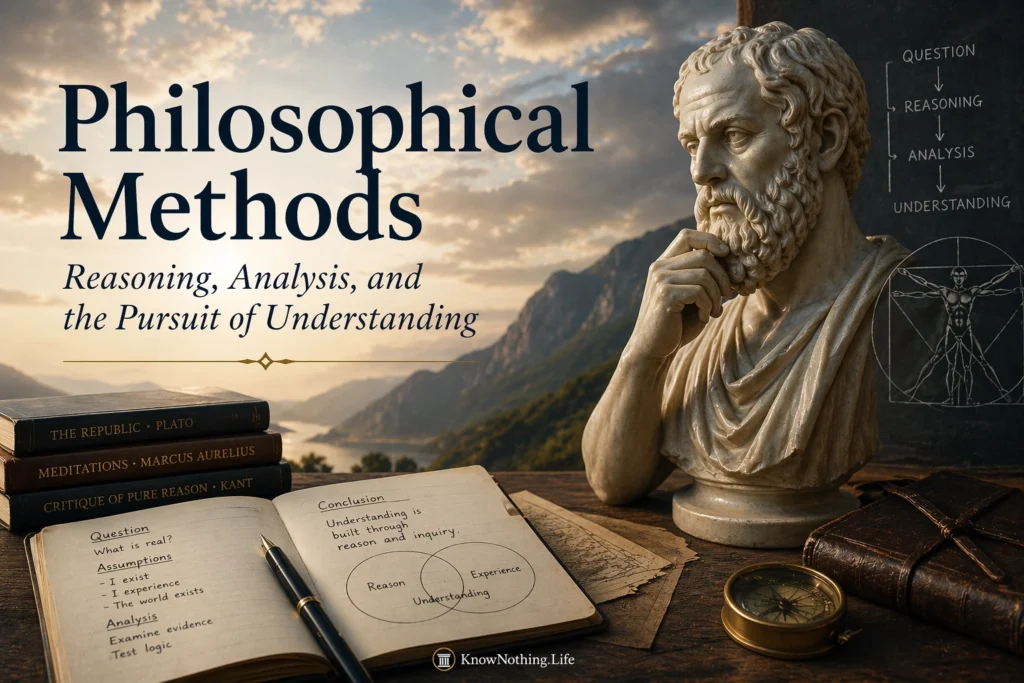
Philosophy is not defined solely by the questions it asks, but by the methods it employs to explore them. From inquiries into knowledge and reality to ethics and meaning, philosophical investigation relies on structured approaches to reasoning, analysis, and critique. These methods distinguish philosophy from other disciplines, emphasizing clarity, rigor, and the careful examination of assumptions. While philosophers may disagree on conclusions, they often share a commitment to systematic thinking and argumentative precision.
The study of philosophical methods reveals that there is no single way to do philosophy. Instead, a variety of approaches have developed across traditions and time periods, each offering distinct tools for understanding complex problems. Some methods focus on logical analysis, others on conceptual clarification, and still others on lived experience or linguistic usage. Together, these approaches form a diverse intellectual toolkit that enables philosophers to engage with fundamental questions in a disciplined and reflective manner.
Logical Analysis
Logical analysis is one of the most central methods in philosophy, involving the examination of arguments to determine their validity and soundness. Philosophers use formal and informal logic to assess whether conclusions follow from premises and whether those premises are themselves justified. This method emphasizes precision in language and structure, aiming to eliminate ambiguity and uncover hidden assumptions.
The development of modern logic owes much to thinkers like Gottlob Frege, whose work laid the foundation for symbolic logic. Logical analysis allows philosophers to break down complex arguments into simpler components, making it easier to evaluate their coherence and consistency. While logic alone cannot determine the truth of premises, it provides a crucial framework for assessing the strength of reasoning.
Conceptual Analysis
Conceptual analysis involves clarifying the meanings of key terms and ideas, seeking to understand how concepts are structured and how they relate to one another. Philosophers often begin by examining the language used to describe a problem, identifying ambiguities or inconsistencies that may hinder understanding. By refining concepts, they aim to achieve greater clarity and precision in philosophical discussions.
This method has been particularly influential in analytic philosophy, where the focus on language and meaning is central. Philosophers such as Ludwig Wittgenstein explored how the meanings of words are shaped by their use in specific contexts. Conceptual analysis does not merely define terms but investigates the underlying assumptions and implications of those terms, revealing how they shape our understanding of the world.
The Socratic Method
The Socratic method is one of the oldest and most recognizable philosophical approaches, characterized by dialogue and questioning. Associated with Socrates, this method involves asking a series of probing questions to expose contradictions, test assumptions, and guide participants toward deeper insight. Rather than providing answers, the Socratic method encourages critical reflection and self-examination.
Through this process, individuals are led to recognize gaps in their understanding and refine their beliefs. The method is not merely a teaching tool but a way of engaging with philosophical problems, emphasizing inquiry over certainty. By fostering dialogue and critical thinking, the Socratic method highlights the importance of questioning as a path to knowledge.
Phenomenology
Phenomenology is a method that focuses on the study of conscious experience, seeking to describe phenomena as they appear to the mind. Rather than analyzing external objects or abstract concepts, phenomenology examines the structures of perception, thought, and emotion from a first-person perspective. This approach aims to uncover the essential features of experience without imposing theoretical assumptions.
The work of Edmund Husserl is central to the development of phenomenology, emphasizing the importance of “bracketing” or setting aside preconceived beliefs to focus on pure experience. This method has been extended by later thinkers to explore issues such as embodiment, temporality, and intersubjectivity. Phenomenology offers a distinctive approach to philosophy, grounding inquiry in lived experience rather than abstract reasoning alone.
Dialectical Reasoning
Dialectical reasoning involves the exploration of opposing viewpoints to arrive at a deeper understanding. This method is often associated with the work of G. W. F. Hegel, who described a process in which a thesis encounters its antithesis, leading to a synthesis that resolves the tension between them. Dialectics emphasizes the dynamic nature of thought, where ideas evolve through conflict and reconciliation.
This method is particularly useful for addressing complex problems that resist simple solutions. By engaging with contradictions and opposing perspectives, dialectical reasoning reveals the limitations of one-sided approaches. It encourages a holistic understanding, recognizing that truth may emerge from the interaction of different viewpoints rather than from a single perspective.
Pragmatism
Pragmatism is a philosophical method that evaluates ideas based on their practical consequences. Rather than focusing solely on abstract truth, pragmatists consider how beliefs function in real-world contexts and whether they lead to successful outcomes. This approach emphasizes experimentation, adaptability, and the ongoing revision of ideas in response to experience.
Thinkers like William James and John Dewey developed pragmatism as a way of connecting philosophy with everyday life. By focusing on practical effects, pragmatism bridges the gap between theory and application, offering a flexible and context-sensitive approach to philosophical inquiry.
Thought Experiments
Thought experiments are a widely used method in philosophy, involving hypothetical scenarios designed to test intuitions and explore conceptual possibilities. By imagining situations that may not occur in reality, philosophers can isolate specific variables and examine their implications. Thought experiments often reveal hidden assumptions or highlight tensions within existing theories.
Classic examples include scenarios that challenge our understanding of knowledge, identity, or morality. While thought experiments rely on imagination, they are grounded in logical reasoning and aim to clarify philosophical concepts. This method demonstrates that philosophical inquiry is not limited to empirical observation but can also involve creative exploration of possibilities.
Comparative and Cross-Cultural Methods
Philosophical methods are not confined to a single tradition; they vary across cultures and intellectual histories. Comparative philosophy examines different traditions, such as Western, Eastern, and Indigenous philosophies, to identify similarities, differences, and potential points of dialogue. This approach broadens the scope of philosophical inquiry, challenging assumptions that may be taken for granted within a particular tradition.
Cross-cultural methods emphasize the importance of context, recognizing that philosophical ideas are shaped by cultural, historical, and linguistic factors. By engaging with diverse perspectives, philosophers can develop more inclusive and comprehensive approaches to fundamental questions. This method highlights the global nature of philosophical inquiry and the value of intellectual diversity.
Critique and Reflection
Critical analysis is a unifying feature of many philosophical methods, involving the evaluation of arguments, assumptions, and implications. Philosophers engage in critique not merely to refute ideas but to refine and improve them. This process requires careful attention to detail, openness to alternative perspectives, and a willingness to revise one’s own views.
Reflection is equally important, as philosophical inquiry often turns inward, examining the foundations of belief and knowledge. By questioning assumptions and exploring their origins, philosophers seek to achieve a deeper understanding of both the subject matter and the methods themselves. This reflective dimension ensures that philosophical methods remain dynamic and self-correcting.
Conclusion
Philosophical methods provide the tools through which complex questions about reality, knowledge, and value are explored. From logical and conceptual analysis to phenomenology and pragmatism, these methods offer diverse approaches to understanding the world and our place within it. Each method has its strengths and limitations, and their combined use allows for a richer and more nuanced form of inquiry.
Ultimately, the study of philosophical methods reveals that philosophy is not a static body of knowledge but an ongoing process of questioning, reasoning, and reflection. By examining how philosophers think as well as what they think about, we gain insight into the nature of inquiry itself. This understanding underscores the enduring relevance of philosophy as a discipline that seeks clarity, coherence, and meaning in the face of complexity.