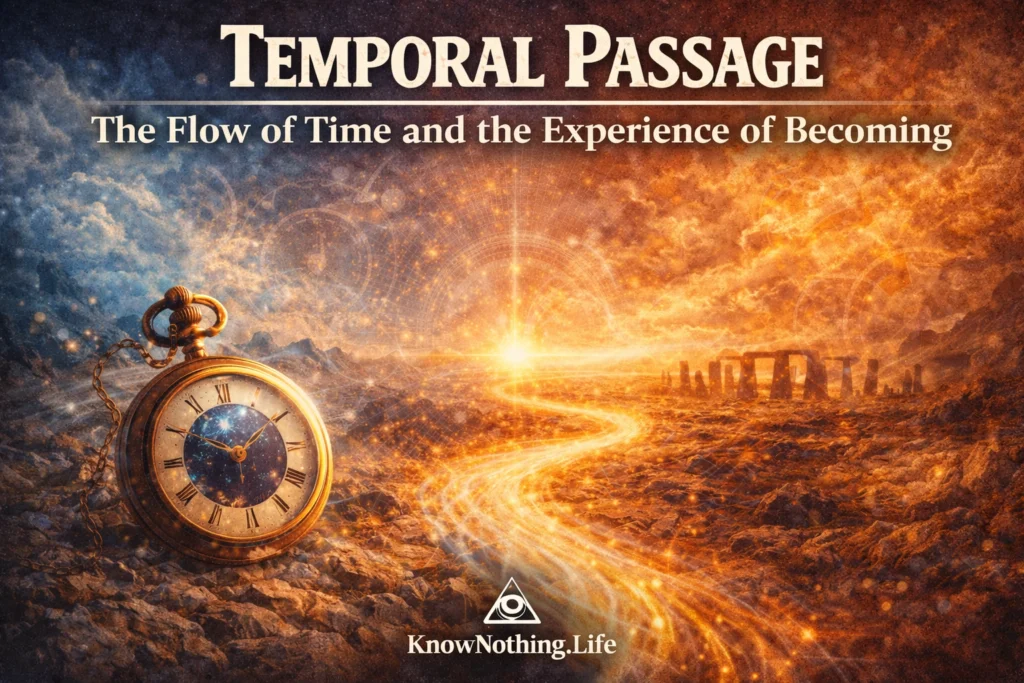
Temporal passage refers to the apparent flow of time—the sense that moments move from future to present to past. It is one of the most immediate features of human experience, shaping how we perceive change, memory, and anticipation. Yet despite its familiarity, the nature of temporal passage remains deeply controversial. Is the flow of time an objective feature of reality, or is it a construct of human consciousness?
Philosophers and scientists have long debated whether time truly “passes” or whether this impression arises from how we experience events. The question reaches into the heart of metaphysics, intersecting with issues of identity, causality, and the structure of the universe. While some theories treat temporal passage as fundamental, others argue that it is an illusion imposed by the mind. Understanding temporal passage requires examining both the structure of time itself and the way it is experienced.
The A-Theory of Time: Past, Present, and Future
One of the primary frameworks for understanding temporal passage is the A-theory of time, which holds that the distinctions between past, present, and future are real and constantly changing. According to this view, the present moment is uniquely real, and events move from being future to present to past. This dynamic structure captures the intuitive sense of time flowing.
The A-theory aligns closely with everyday experience. We feel the present as a moving point, with the future approaching and the past receding. This perspective has been defended by various philosophers who argue that temporal passage is an essential feature of reality. Without it, the concepts of change and becoming would lose their meaning.
However, the A-theory faces significant challenges. It must explain how the present moment can move without invoking a second dimension of time, which would lead to an infinite regress. Despite these difficulties, the theory remains influential because it resonates so strongly with human experience.
McTaggart and the Unreality of Time
The most famous critique of temporal passage comes from J. M. E. McTaggart in his essay The Unreality of Time. McTaggart argued that time, as commonly understood, is ultimately unreal. He distinguished between two ways of ordering events: the A-series and the B-series.
The A-series organizes events in terms of past, present, and future, while the B-series orders them as earlier than or later than each other. McTaggart claimed that the A-series is essential for temporal passage but is also logically contradictory. An event cannot be simultaneously past, present, and future, yet it must possess all three properties at different times.
From this contradiction, McTaggart concluded that time itself is unreal. His argument has had a profound impact on the philosophy of time, prompting ongoing debates about whether temporal passage can be coherently understood. Even those who reject his conclusion must grapple with the challenges he identified.
The B-Theory of Time: A Static Universe
In contrast to the A-theory, the B-theory of time denies the reality of temporal passage. According to this view, all moments in time are equally real, and the distinctions between past, present, and future are subjective rather than objective. Time does not flow; instead, events are arranged in a fixed temporal order.
This perspective is often associated with the “block universe” model, in which the universe is viewed as a four-dimensional structure. Just as all points in space exist simultaneously, all points in time exist equally. The sense of passage arises from our movement through this structure or from the way our consciousness processes events.
The B-theory aligns closely with modern physics, particularly the theory of relativity, which treats time as a dimension similar to space. However, it raises questions about the nature of experience. If time does not truly pass, why do we perceive it as flowing? This tension between theory and experience remains a central issue in the debate.
Bergson and the Lived Experience of Time
While many philosophers focus on the structure of time, Henri Bergson emphasized its lived experience. In works such as Time and Free Will, Bergson distinguished between “clock time,” which is measured and spatialized, and “duration” (durée), which is the qualitative experience of time.
For Bergson, temporal passage is not an illusion but a fundamental aspect of consciousness. He argued that time, as lived, is continuous and indivisible, unlike the segmented units of clock time. Bergson wrote, “Pure duration is the form which the succession of our conscious states assumes when our ego lets itself live.”
This perspective highlights the difference between objective and subjective time. Even if the physical universe does not contain a flowing time, the experience of passage remains real and significant. Bergson’s work underscores the importance of considering both the external structure of time and its internal perception.
Heidegger and the Temporality of Being
Martin Heidegger approached temporal passage from an existential perspective. In Being and Time, he argued that temporality is fundamental to human existence. Rather than viewing time as a sequence of moments, Heidegger saw it as the horizon within which being is understood.
Heidegger emphasized the role of future, past, and present in shaping human experience. The future represents possibilities, the past reflects what has been, and the present is the site of engagement with the world. Temporal passage, in this view, is not merely a physical process but a structure of existence.
This approach shifts the focus from the metaphysical nature of time to its significance for human life. It suggests that temporal passage is inseparable from how individuals understand themselves and their possibilities. Heidegger’s analysis reveals that time is not just something we experience but something that defines our being.
Temporal Passage and Modern Science
Modern science, particularly physics, offers insights that complicate traditional views of temporal passage. The theory of relativity, developed by Albert Einstein, challenges the notion of a universal present. According to relativity, different observers may disagree about the simultaneity of events, undermining the idea of a single, objective “now.”
This has led some physicists and philosophers to support the block universe model, in which temporal passage is not a fundamental feature of reality. Instead, the universe is seen as a static structure, with the appearance of flow arising from the perspective of observers.
However, not all scientists accept this conclusion. Some argue that the laws of physics may be incomplete and that temporal passage could still play a role at a deeper level. The relationship between physical theory and human experience remains an open question, highlighting the complexity of understanding time.
Conclusion
Temporal passage remains one of the most intriguing and contested concepts in philosophy. From the dynamic framework of the A-theory to the static perspective of the B-theory, and from the critiques of J. M. E. McTaggart to the experiential insights of Henri Bergson and Martin Heidegger, it has inspired a wide range of interpretations.
The debate reveals a fundamental tension between how time appears and how it may actually be. While human experience suggests that time flows, theoretical considerations often challenge this intuition. Whether temporal passage is real or illusory remains unresolved, reflecting the limits of both philosophical reasoning and scientific understanding.
Ultimately, the question of temporal passage invites ongoing reflection. It encourages us to examine not only the nature of time but also the nature of experience itself. In doing so, it reveals the depth and complexity of a phenomenon that is both familiar and profoundly mysterious.