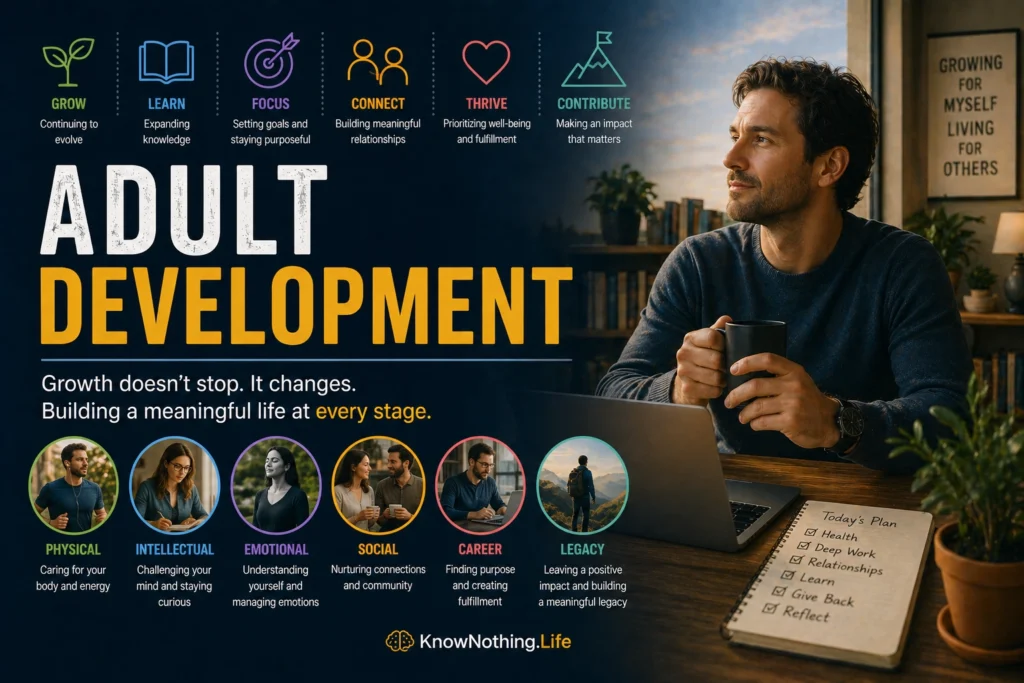
Adult development is the study of how individuals grow, change, and adapt throughout adulthood, encompassing early adulthood, middle adulthood, and later life. While development is often associated with childhood, adulthood represents a dynamic and evolving phase marked by ongoing cognitive, emotional, and social transformation. Far from being a period of stability alone, adulthood involves continuous negotiation between personal goals, societal roles, and changing life circumstances.
What distinguishes adult development is its complexity. Unlike earlier stages, where development follows relatively predictable patterns, adulthood is shaped by diverse experiences, choices, and contexts. Career paths, relationships, health, and cultural expectations all influence the trajectory of development. This variability highlights the importance of understanding adulthood as a multifaceted process, in which growth and change occur in response to both internal motivations and external demands.
Theoretical Foundations of Adult Development
The study of adult development has been shaped by several influential theoretical perspectives. One of the most prominent is the psychosocial theory of Erik Erikson, who proposed that development continues across the lifespan through a series of stages. In adulthood, these stages include “intimacy versus isolation,” “generativity versus stagnation,” and “integrity versus despair.” Each stage involves a central challenge that must be addressed for healthy development to occur.
Another important perspective comes from Daniel Levinson, who emphasized the role of life structures and transitions. Levinson argued that adulthood is characterized by periods of stability and change, as individuals construct and revise their life paths. His work highlighted the importance of transitions, such as career changes or shifts in relationships, in shaping development.
Contemporary approaches to adult development often integrate these theories with insights from cognitive, social, and cultural psychology. They emphasize that development is not linear but involves multiple pathways influenced by individual differences and environmental contexts. These perspectives provide a framework for understanding the diverse experiences that characterize adulthood.
Early Adulthood: Formation and Exploration
Early adulthood, typically spanning the late teens through the thirties, is a period of exploration and formation. Individuals begin to establish independence, pursue education or careers, and form intimate relationships. This stage is often marked by significant decision-making, as individuals define their goals, values, and identities in the context of adult life.
The development of intimate relationships is a central focus during this period. According to Erikson, the challenge of “intimacy versus isolation” involves the ability to form deep, meaningful connections with others. Successful navigation of this stage leads to strong relationships and emotional support, while difficulties can result in feelings of loneliness and isolation. These relationships play a crucial role in shaping emotional well-being and social development.
Career development is another key aspect of early adulthood. Individuals explore different paths, develop skills, and establish professional identities. This process is influenced by education, opportunities, and personal interests, reflecting the interplay between individual aspirations and societal structures. Early adulthood is therefore a time of both opportunity and uncertainty, as individuals navigate the transition into stable roles and responsibilities.
Cognitive Development in Adulthood
Cognitive development does not end in adolescence but continues throughout adulthood, though its nature changes over time. In early adulthood, individuals often reach peak levels of cognitive performance, particularly in areas such as processing speed, memory, and problem-solving. These abilities support learning, decision-making, and professional development.
As individuals move into middle adulthood, certain cognitive abilities may begin to decline, particularly those related to speed and working memory. However, other aspects of cognition, such as knowledge, expertise, and practical reasoning, often improve. This form of intelligence, sometimes referred to as crystallized intelligence, reflects the accumulation of experience and learning over time.
Later in life, cognitive changes become more pronounced, but they are not uniform. While some decline is common, many individuals maintain high levels of cognitive functioning, particularly when they remain mentally and socially active. Research suggests that lifestyle factors, such as education, physical health, and engagement in stimulating activities, play a significant role in cognitive aging. This perspective emphasizes that cognitive development in adulthood is not simply a process of decline but one of adaptation and continued growth.
Emotional and Personality Development
Emotional development in adulthood involves changes in how individuals experience, express, and regulate emotions. Over time, many adults develop greater emotional stability and resilience, becoming better able to manage stress and navigate complex situations. This development is often associated with increased self-awareness and the ability to reflect on one’s experiences.
Personality development also continues throughout adulthood, though it tends to become more stable over time. Research suggests that traits such as conscientiousness and emotional stability often increase with age, reflecting greater maturity and self-regulation. These changes are influenced by life experiences, social roles, and cultural expectations, highlighting the dynamic nature of personality.
The concept of generativity, introduced by Erikson, plays a significant role in middle adulthood. It involves a focus on contributing to others, whether through parenting, mentoring, or community involvement. This orientation toward giving back reflects a shift from self-focused goals to broader concerns, contributing to a sense of purpose and fulfillment. Emotional and personality development in adulthood thus involves both stability and transformation.
Social Roles and Relationships
Social roles and relationships are central to adult development, shaping how individuals interact with others and define their identities. Throughout adulthood, individuals take on multiple roles, such as partner, parent, employee, and community member. These roles provide structure and meaning but also involve responsibilities and challenges.
Relationships evolve over time, reflecting changes in circumstances and priorities. In early adulthood, friendships and romantic relationships are often central, while in middle adulthood, family and work relationships may take precedence. Later in life, social networks may become smaller but more emotionally significant, emphasizing quality over quantity.
Family relationships, particularly parenting, play a crucial role in adult development. Raising children involves both challenges and rewards, influencing emotional growth and life satisfaction. At the same time, relationships with aging parents may become more prominent, reflecting the shifting dynamics of the family system. These changes highlight the interconnected nature of social roles and development.
Middle Adulthood: Stability and Transition
Middle adulthood, typically ranging from the forties to the sixties, is often characterized by a combination of stability and transition. Individuals may reach a level of stability in their careers and personal lives, but they also face new challenges and changes. These may include shifts in family dynamics, career transitions, and changes in physical health.
The concept of a “midlife transition” has been widely discussed, though its nature varies among individuals. For some, this period involves reflection and reassessment of goals and achievements, leading to changes in direction. For others, it may be a time of continued growth and satisfaction. The diversity of experiences during this stage reflects the complexity of adult development.
Generativity remains a central theme in middle adulthood, as individuals focus on contributing to future generations and society. This may involve mentoring, community involvement, or creative pursuits. By engaging in meaningful activities, individuals can achieve a sense of purpose and fulfillment, supporting positive development during this stage.
Later Adulthood: Reflection and Adaptation
Later adulthood, often defined as the period from the sixties onward, involves significant changes in physical, cognitive, and social domains. While aging is associated with certain challenges, it is also a time of reflection, adaptation, and continued growth. Individuals may experience changes in health, retirement, and shifts in social roles, all of which require adjustment.
Erikson’s stage of “integrity versus despair” highlights the importance of reflecting on one’s life and achieving a sense of coherence and satisfaction. Individuals who are able to integrate their experiences and accept their life course tend to experience a sense of integrity, while those who struggle may feel regret or dissatisfaction. This process of reflection is central to emotional well-being in later life.
Despite challenges, many individuals maintain active and fulfilling lives in later adulthood. Engagement in social, intellectual, and physical activities can support well-being and cognitive functioning. This stage underscores the capacity for adaptation and resilience, demonstrating that development continues throughout the lifespan.
Cultural and Contextual Influences
Adult development is deeply influenced by cultural and contextual factors that shape opportunities, expectations, and experiences. Cultural norms define the roles and responsibilities associated with different stages of adulthood, influencing how individuals navigate transitions and make decisions. These norms can vary widely, reflecting the diversity of human societies.
Socioeconomic conditions also play a significant role, affecting access to education, healthcare, and resources. Individuals in different contexts may experience different developmental trajectories, highlighting the importance of considering environmental influences. Historical and generational factors further shape development, as individuals are influenced by the social and economic conditions of their time.
The increasing diversity of modern societies has led to a broader understanding of adult development, recognizing multiple pathways and experiences. This perspective emphasizes flexibility and inclusivity, acknowledging that development is not a single, uniform process but a complex and varied journey shaped by context.
Conclusion
Adult development is a complex and multifaceted process that extends across the lifespan, encompassing changes in cognitive, emotional, and social domains. From the exploration of early adulthood to the reflection of later life, individuals continue to grow and adapt in response to their experiences and environments. Theoretical perspectives from figures such as Erik Erikson and Daniel Levinson provide valuable frameworks for understanding these processes.
By examining adult development, we gain insight into the nature of human growth and the factors that shape it. This understanding has important implications for education, healthcare, and social policy, as well as for individuals seeking to navigate their own life paths. Ultimately, adult development highlights the enduring capacity for change, adaptation, and meaning throughout the human lifespan.