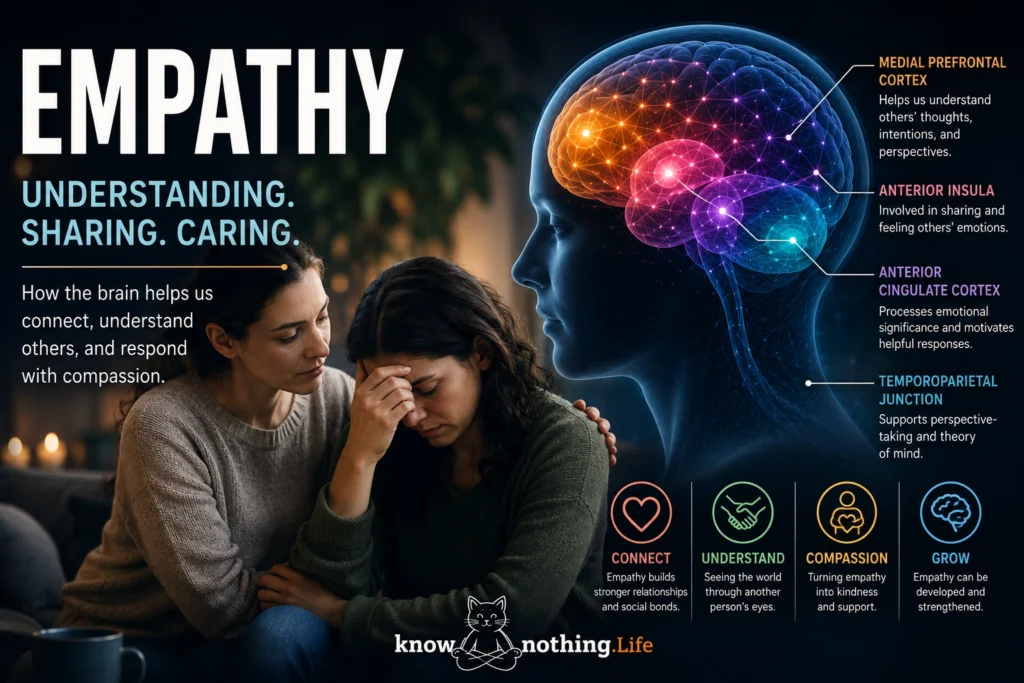
Empathy is the capacity to recognize, understand, and respond to another person’s emotional experience. It allows someone to perceive distress in a friend, imagine how a stranger interprets a difficult situation, or share another person’s excitement without directly experiencing the event. Although empathy is often described as a single human ability, psychological and neuroscientific research shows that it contains several distinct processes. Cognitive empathy involves understanding another person’s thoughts, intentions, and perspective. Emotional empathy involves sharing or resonating with part of another person’s emotional state. Empathic concern is an other-focused feeling of care, while personal distress is a self-focused feeling of discomfort that can arise when witnessing suffering. Research using multidimensional assessments has shown that these components can vary independently within the same person.
This distinction matters because understanding someone is not the same as feeling what they feel, and neither ability automatically produces kindness. A person may accurately recognize another individual’s fear without emotionally sharing it. Someone else may become intensely upset by another person’s suffering but feel too overwhelmed to provide support. Empathy therefore depends on a balance between emotional responsiveness and self–other distinction. People must remain aware that the feeling originated in another person while still allowing that person’s experience to influence attention and motivation. Studies of self-concept clarity suggest that a stable distinction between self and other supports empathic concern and helping, whereas poor self–other differentiation may increase personal distress and withdrawal.
Cognitive and Emotional Empathy
Cognitive empathy allows people to infer what another person knows, believes, wants, or intends. It overlaps with perspective taking and theory of mind, but it also includes interpreting emotional meaning from facial expressions, language, tone of voice, and social context. This form of empathy is essential during communication because the same event can mean different things to different people. Understanding another person’s perspective requires temporarily setting aside one’s own interpretation and constructing a model of the situation from someone else’s position.
Emotional empathy involves a more direct resonance with another person’s state. If a person watches someone receive a painful injury, emotional systems may respond even though the observer is physically unharmed. Simone Shamay-Tsoory and colleagues studied people with localized brain injuries and found evidence of a double dissociation between cognitive and emotional empathy. Damage involving ventromedial prefrontal areas was especially associated with impaired cognitive empathy, while damage involving the inferior frontal gyrus was more closely associated with impaired emotional empathy. The findings support the view that empathy is created by interacting but partly separable neural systems rather than one universal empathy center.
The distinction is also evident in autism research. Isabel Dziobek and colleagues used a multidimensional empathy task with autistic adults and found that cognitive empathy was reduced while emotional empathy remained relatively preserved. These results challenged simplified claims that autistic people lack empathy altogether. Someone may care deeply about another person’s suffering yet have difficulty identifying subtle expressions, interpreting indirect communication, or inferring an unspoken emotional state. Differences in social perception and cognitive interpretation should therefore not be assumed to indicate an absence of concern.
The Neuroscience of Sharing Emotion
One of the best-known empathy studies was conducted by Tania Singer and colleagues in 2004. Participants received a painful stimulus themselves and later watched signals indicating that a romantic partner was receiving pain. Personal pain activated sensory and affective systems, while observing a loved one’s pain primarily recruited the anterior insula and anterior cingulate cortex—regions associated with the unpleasant emotional significance of pain. The observer did not reproduce the complete sensory representation of the partner’s injury but shared aspects of its emotional meaning.
These findings are sometimes interpreted as proof that empathy literally makes one person feel another person’s pain. The reality is more nuanced. Empathic responses are constructed from visible cues, remembered experiences, beliefs, attention, and knowledge about the other person. The anterior insula helps represent bodily and emotional states, while the anterior cingulate and related midline regions contribute to affect, motivation, and behavioral control. Prefrontal and temporoparietal systems help distinguish the observer’s perspective from that of the person being observed. Empathy is therefore not a direct transfer of emotion between brains. It is an interpretation produced when social information activates neural systems that also contribute to one’s own emotional experience.
Empathic responses are also shaped by relationships and social categories. Grit Hein and colleagues found that neural responses while participants watched members of their own group or another group receive pain predicted whether they would later accept a personal cost to help. Greater anterior-insula responses to another person’s suffering were associated with more costly helping, while reward-related activity associated with antagonistic feelings predicted less assistance. The study showed that neural resonance is influenced by social identification and that the response to another person’s pain can affect real behavioral choices.
Empathy, Altruism, and Helping
Psychologist C. Daniel Batson developed the empathy-altruism hypothesis, which proposes that empathic concern can create a genuinely other-oriented motivation to improve someone else’s welfare. Across experimental studies, participants were encouraged to adopt either an empathic perspective or a more detached perspective toward a person in need. Greater empathic concern was frequently associated with increased willingness to help, including in conditions where participants could easily leave the situation without assisting. Later experiments tested whether helping was motivated by social approval, anticipated reward, or the desire to escape personal discomfort. Several findings continued to support the possibility that concern for another person can motivate behavior beyond immediate self-interest.
The claim that empathy produces pure altruism remains debated. Robert Cialdini and colleagues proposed that witnessing suffering may produce personal sadness and that people sometimes help primarily to improve their own emotional state. Their experiments found that separating empathic feelings from sadness could weaken the relationship between empathy and assistance. This debate illustrates why researchers distinguish empathic concern from personal distress. Concern tends to focus attention on what the other person needs, while distress focuses attention on relieving one’s own discomfort. Both may produce helping under some conditions, but distress can also encourage avoidance when escape is easier than engagement.
Empathy is therefore neither necessary nor sufficient for every helpful action. People may assist others because of moral principles, fairness, duty, social norms, compassion, or deliberate commitments even when emotional resonance is weak. Conversely, a person may understand and share another’s suffering without knowing how to help effectively. Accurate support requires empathy to operate alongside judgment, emotional regulation, practical knowledge, and respect for what the other person actually wants.
Biases and Limits of Empathy
Empathy is selective rather than evenly distributed. Familiarity, similarity, group membership, perceived responsibility, attractiveness, and judgments of fairness can all influence whose emotions receive attention. People often empathize more readily with those they know, like, or consider part of their group. Experimental research has found reduced empathic responding toward competitive outgroups, while responses to less threatening or noncompetitive groups may remain relatively intact. These patterns suggest that diminished empathy is not always caused by an inability to understand others; it may arise because social motivations determine whose experiences people choose to value.
Empathy can also be narrow and emotionally disproportionate. One vivid personal story may generate more concern than statistics describing a much larger population. Emotional identification with one side of a conflict can make the suffering of the opposing side less visible. Cognitive empathy may even be used manipulatively when someone accurately reads another person’s vulnerabilities without sharing concern for that person’s welfare. Empathy should therefore not be treated as a complete moral system. It can provide valuable information and motivation, but ethical principles are needed to correct its partiality and extend concern beyond the people whose emotions are easiest to imagine.
Another limitation is empathic exhaustion. Continually resonating with suffering can produce negative affect, withdrawal, or burnout, particularly among caregivers and professionals repeatedly exposed to trauma. Olga Klimecki and colleagues found that empathy training increased negative emotional responses and activity in regions associated with sharing distress. Subsequent compassion training produced more positive feelings and recruited systems associated with affiliation and reward. The findings suggest that repeatedly sharing suffering is different from developing a warm, stable motivation to support someone who suffers.
Can Empathy Be Developed?
Empathy is influenced by temperament, development, relationships, culture, and experience, but it is not entirely fixed. People can improve perspective taking by listening carefully, asking questions, reading narratives, encountering unfamiliar lives, and challenging assumptions about other groups. Karina Schumann, Jamil Zaki, and Carol Dweck found that people who believed empathy could be developed invested more effort in understanding individuals whose perspectives were difficult or unfamiliar. Experimentally encouraging a growth-oriented belief about empathy also increased engagement with racial outgroup members and willingness to assist people facing serious illness.
Motivation remains a major barrier. C. Daryl Cameron and colleagues gave participants repeated choices between tasks requiring empathy and tasks that did not. Participants frequently avoided empathy and described it as mentally demanding, uncertain, and emotionally costly. When researchers increased participants’ confidence in their ability to empathize successfully, avoidance declined. The results indicate that apparent empathy deficits may sometimes reflect perceived effort or low confidence rather than a permanent lack of capacity.
Healthy empathy is not unlimited emotional absorption. It combines openness to another person’s experience with the ability to maintain perspective, regulate distress, and act according to broader values. Cognitive empathy helps people understand; emotional empathy helps them resonate; empathic concern directs attention toward another’s welfare; and compassion can sustain support without requiring continuous emotional suffering. Empathy is most constructive when it serves as the beginning of moral understanding rather than its final measure. It helps people recognize that another mind contains fears, hopes, memories, and needs as real as their own—and creates an opportunity to respond with informed care.