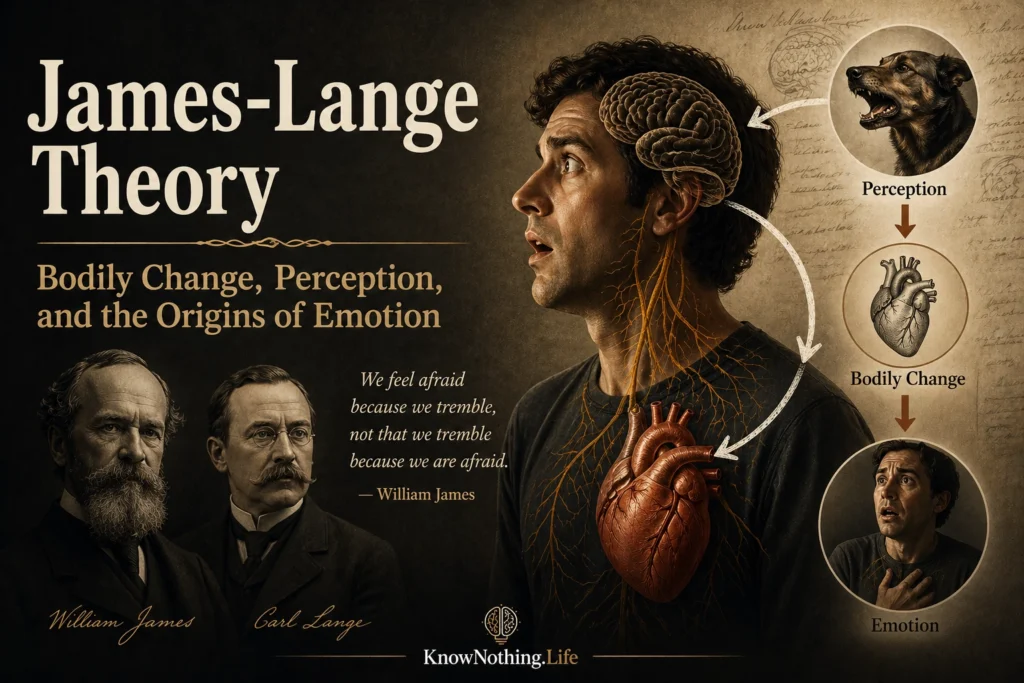
The James-Lange theory of emotion stands as one of the earliest and most influential attempts to explain how emotions arise. Developed independently by William James and Carl Lange in the late 19th century, the theory proposed a radical reversal of common intuition: emotions are not the cause of bodily reactions but their consequence. According to this view, we do not tremble because we are afraid; rather, we feel fear because we tremble.
This perspective challenged long-standing assumptions about emotion as a purely mental or subjective experience. By grounding emotion in physiological processes, the James-Lange theory helped shift psychology toward a more scientific and biological framework. As James wrote in The Principles of Psychology, “My theory… is that the bodily changes follow directly the perception of the exciting fact, and that our feeling of the same changes as they occur is the emotion.” This formulation set the stage for ongoing debates about the relationship between body, brain, and feeling.
Historical Context and Origins
The emergence of the James-Lange theory must be understood within the intellectual climate of the late 19th century, a period marked by rapid advances in physiology and the scientific study of the mind. Psychology was transitioning from philosophy to empirical science, and researchers sought to explain mental phenomena in terms of observable processes. James, working in the United States, and Lange, in Denmark, independently arrived at similar conclusions about the role of the body in emotion.
Before their work, emotions were generally thought to originate in the mind and then produce bodily reactions. This commonsense view aligned with earlier philosophical traditions that placed reason and consciousness at the center of human experience. The James-Lange theory inverted this sequence, suggesting that perception of bodily changes is the defining feature of emotion.
Lange’s contributions, though less widely recognized than James’s, emphasized the role of the vascular system in emotional experience. He argued that changes in blood flow and circulation were central to the feeling of emotion. While later research has refined and expanded these ideas, the core insight—that bodily states are integral to emotion—remains a cornerstone of affective science.
Core Principles of the Theory
At the heart of the James-Lange theory is a simple but powerful sequence: stimulus, physiological response, and emotional experience. When an individual encounters a stimulus—such as a threatening situation—the body undergoes changes, including increased heart rate, muscle tension, and hormonal shifts. The perception of these changes gives rise to the subjective experience of emotion.
This model emphasizes that each emotion is associated with a distinct pattern of physiological activity. Fear, anger, and joy are not merely different labels applied to the same internal state but are rooted in different bodily configurations. The specificity of these patterns allows individuals to distinguish between emotions based on their physical sensations.
The theory also highlights the role of perception in emotion. It is not the bodily changes themselves that constitute emotion, but the awareness of those changes. This focus on perception aligns the James-Lange theory with broader philosophical traditions that emphasize the importance of experience and interpretation in shaping mental life.
Physiological Foundations
The physiological basis of the James-Lange theory lies in the autonomic nervous system and its regulation of bodily functions. Emotional stimuli trigger responses in the sympathetic nervous system, leading to changes such as increased heart rate, sweating, and muscle activation. These responses prepare the organism for action, whether it be fleeing from danger or engaging in confrontation.
Research in modern neuroscience has provided support for aspects of this framework. Studies have shown that feedback from the body, including signals from the heart and other organs, contributes to emotional experience. The concept of interoception—the brain’s ability to sense internal bodily states—has become central to understanding how physiological signals are integrated into conscious awareness.
Neuroscientist Antonio Damasio has extended these ideas through his somatic marker hypothesis, which suggests that bodily states play a crucial role in decision-making and emotion. In Descartes’ Error, Damasio argued that “feelings are mental experiences of body states,” echoing the core insight of the James-Lange theory while integrating it with contemporary neuroscience.
Criticisms and Limitations
Despite its influence, the James-Lange theory has faced significant criticism. One of the primary objections is that different emotions can produce similar physiological responses. For example, both fear and excitement may involve increased heart rate and arousal, making it difficult to distinguish between them based solely on bodily changes.
Another criticism concerns the timing of emotional experience. Some researchers have argued that physiological changes are too slow to account for the rapid onset of emotions. This challenge led to the development of alternative theories, such as the Cannon-Bard model, which proposed that emotional experience and physiological responses occur simultaneously rather than sequentially.
Additionally, experiments involving individuals with impaired bodily feedback have produced mixed results. Some studies suggest that reduced sensory input from the body diminishes emotional intensity, supporting the James-Lange theory, while others indicate that emotions can still be experienced without full physiological feedback. These findings highlight the complexity of the relationship between body and emotion.
Influence on Modern Theories
Although the James-Lange theory is no longer accepted in its original form, it has had a lasting impact on the study of emotion. Many contemporary theories incorporate its central insight that the body plays a crucial role in emotional experience. The two-factor theory proposed by Stanley Schachter and Jerome E. Singer, for example, combines physiological arousal with cognitive interpretation, acknowledging the importance of both body and mind.
Similarly, modern research on embodied cognition emphasizes that mental processes are grounded in bodily states. This perspective aligns with the James-Lange emphasis on the integration of physical and psychological processes, suggesting that cognition and emotion cannot be fully understood in isolation from the body.
The resurgence of interest in interoception and the role of bodily signals in emotion further demonstrates the enduring relevance of the James-Lange framework. While refined and expanded, its core idea continues to inform contemporary research in psychology and neuroscience.
Philosophical Implications
The James-Lange theory has significant philosophical implications for understanding the nature of emotion and consciousness. By locating emotion in the perception of bodily states, it challenges dualistic views that separate mind and body. Instead, it suggests that emotional experience is fundamentally embodied, arising from the interaction between physiological processes and conscious awareness.
This perspective also raises questions about the nature of self-awareness. If emotions are tied to bodily perception, then understanding oneself involves not only introspection but also sensitivity to physical states. This idea has influenced philosophical discussions about the relationship between the body, mind, and identity.
William James himself was deeply engaged with these questions, viewing emotion as a bridge between physiology and experience. His work reflects a broader effort to integrate scientific and philosophical approaches to the mind, highlighting the complexity of human consciousness.
Conclusion
The James-Lange theory of emotion represents a foundational moment in the scientific study of feeling. By proposing that emotions arise from the perception of bodily changes, it shifted the focus of psychology toward the integration of physiological and psychological processes. Although later theories have revised and expanded its claims, its central insight—that the body is essential to emotion—remains influential.
As research continues to explore the interplay between brain, body, and experience, the legacy of the James-Lange theory endures. It reminds us that emotions are not abstract states detached from the physical world but are deeply rooted in the biological processes that sustain life. In doing so, it provides a framework for understanding the embodied nature of human experience.