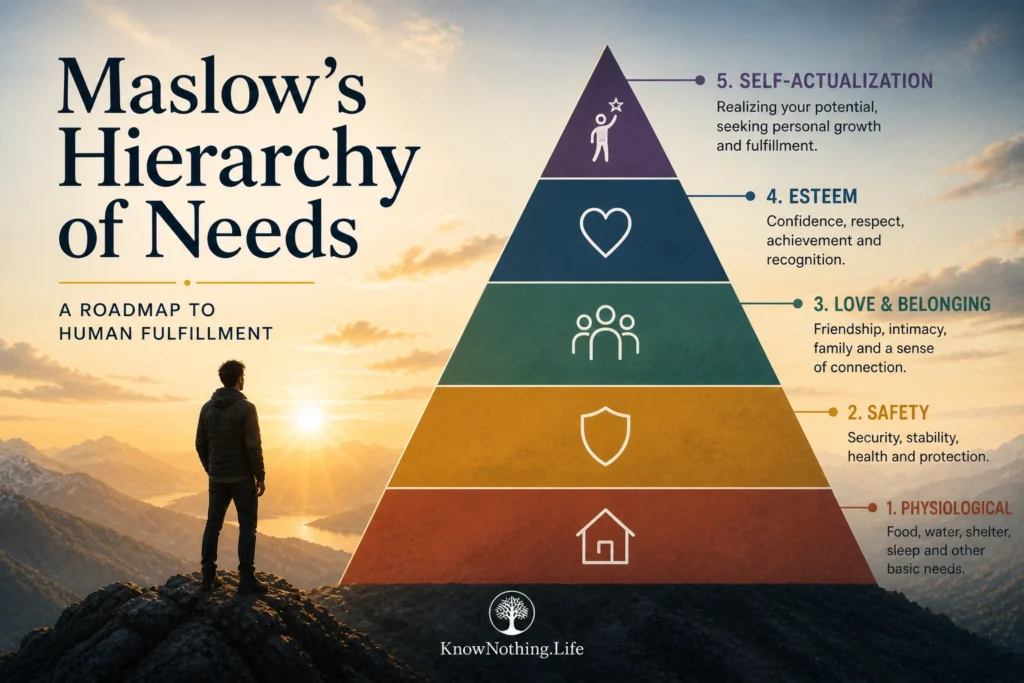
Maslow’s Hierarchy of Needs is one of the most influential frameworks in psychology for understanding human motivation. Proposed by Abraham Maslow in his 1943 paper “A Theory of Human Motivation”, the model organizes human needs into a structured hierarchy, suggesting that basic physiological requirements must be met before individuals can pursue higher levels of psychological growth. Often depicted as a pyramid, the hierarchy moves from fundamental survival needs to the pursuit of self-actualization—the realization of one’s fullest potential.
Maslow’s theory marked a departure from earlier models that emphasized either biological drives or external reinforcement. Instead, he introduced a humanistic perspective, focusing on the inherent tendency toward growth and fulfillment. He argued that humans are not merely reactive organisms driven by deficiency, but proactive beings capable of seeking meaning, creativity, and purpose. As Maslow famously stated, “What a man can be, he must be. This need we may call self-actualization.”
The enduring appeal of Maslow’s hierarchy lies in its intuitive structure and broad applicability. It has been used in fields ranging from education and business to healthcare and personal development. While the model has been refined and critiqued over time, its central insight—that human motivation unfolds across multiple levels of need—remains a foundational concept in understanding behavior.
The Structure of the Hierarchy
Maslow’s hierarchy is typically divided into five levels: physiological needs, safety needs, love and belongingness, esteem, and self-actualization. These levels are often grouped into two broader categories: deficiency needs (D-needs), which arise from a lack of essential resources, and growth needs (B-needs), which reflect the desire for personal development and fulfillment. According to Maslow, lower-level needs must be sufficiently satisfied before higher-level needs become dominant.
Physiological needs form the base of the hierarchy and include essentials such as food, water, sleep, and shelter. These needs are directly tied to survival and are the most immediate drivers of behavior when unmet. Once these basic requirements are fulfilled, attention shifts to safety needs, which encompass physical security, stability, and protection from harm. Together, these foundational levels ensure the organism’s survival and create the conditions necessary for more complex forms of motivation.
As individuals move up the hierarchy, the focus shifts from survival to social and psychological needs. Love and belongingness involve relationships, connection, and a sense of community, while esteem needs relate to self-respect, achievement, and recognition. At the top of the hierarchy lies self-actualization, representing the pursuit of personal growth and the realization of one’s potential. This progression reflects Maslow’s belief that human motivation evolves from basic necessity to higher aspirations.
Physiological and Safety Needs
The first two levels of Maslow’s hierarchy—physiological and safety needs—are fundamental to survival and form the foundation upon which all other motivations are built. Physiological needs are the most immediate and pressing, driving behavior when the body is deprived of essential resources. Hunger, thirst, and fatigue create powerful motivational states that dominate attention until they are satisfied.
Safety needs emerge once physiological stability is achieved. These include the desire for security, predictability, and protection from physical or psychological harm. In modern societies, safety needs extend beyond physical safety to include financial stability, healthcare, and a stable environment. The importance of these needs is evident in situations of uncertainty or danger, where individuals prioritize security over other concerns.
Maslow emphasized that unmet lower-level needs can inhibit the pursuit of higher-level goals. For example, an individual struggling to meet basic survival needs is unlikely to focus on personal growth or creative expression. This hierarchical structure underscores the importance of addressing fundamental needs as a prerequisite for psychological development and well-being.
Love, Belongingness, and Social Connection
Once basic survival and safety needs are met, individuals are motivated by the desire for social connection and belonging. This level of the hierarchy reflects the fundamentally social nature of human beings. Relationships with family, friends, and communities provide emotional support, identity, and a sense of purpose, making belongingness a central aspect of psychological health.
Maslow argued that the need for love and belonging is not merely a preference but a fundamental human requirement. The absence of meaningful relationships can lead to feelings of loneliness, isolation, and anxiety. Conversely, strong social connections contribute to resilience, well-being, and overall life satisfaction. This insight has been supported by modern research, including studies by John Bowlby on attachment, which highlight the importance of early relationships in shaping emotional development.
Belongingness also extends to broader social structures, such as cultural and community affiliations. These connections provide a framework for identity and meaning, influencing how individuals perceive themselves and their place in the world. In this sense, the need for belonging bridges the gap between individual and collective experience, reflecting the interconnected nature of human life.
Esteem and the Need for Recognition
The fourth level of Maslow’s hierarchy focuses on esteem, encompassing both self-esteem and the recognition received from others. Self-esteem involves a sense of competence, confidence, and self-worth, while external recognition includes respect, status, and appreciation. Together, these elements contribute to a stable and positive sense of identity.
Maslow distinguished between lower and higher forms of esteem. Lower esteem is dependent on external validation, such as approval or recognition, while higher esteem is rooted in self-respect and intrinsic confidence. While both forms are important, Maslow emphasized that true psychological health requires the development of internal self-worth rather than reliance on external validation.
The pursuit of esteem can motivate individuals to achieve goals, develop skills, and contribute to society. However, it can also lead to challenges when self-worth becomes tied to external measures of success. Balancing internal and external sources of esteem is therefore essential for maintaining psychological stability and fostering long-term well-being.
Self-Actualization and Human Potential
At the вершине of Maslow’s hierarchy lies self-actualization, the realization of one’s fullest potential. This level represents the culmination of human motivation, where individuals seek to express their abilities, pursue meaningful goals, and engage in activities that reflect their true nature. Self-actualization is not a fixed state but an ongoing process of growth and development.
Maslow described self-actualizing individuals as creative, autonomous, and deeply engaged with life. They are motivated by intrinsic values rather than external rewards and often experience a sense of purpose and fulfillment. Examples of self-actualization can be found in artistic expression, scientific discovery, and acts of compassion, all of which reflect the pursuit of meaning beyond basic needs.
Importantly, Maslow acknowledged that self-actualization is not universally achieved. It requires not only the satisfaction of lower-level needs but also the opportunity and environment to pursue growth. As he noted, “A musician must make music, an artist must paint, a poet must write, if he is to be ultimately happy.” This statement underscores the idea that fulfillment arises from aligning one’s actions with one’s inherent capacities.
Critiques and Modern Perspectives
Despite its influence, Maslow’s hierarchy has been subject to criticism and revision. One major critique is that the hierarchy is not as rigid as originally proposed. Research suggests that individuals may pursue higher-level needs even when lower-level needs are not fully satisfied, particularly in situations where values or cultural factors prioritize certain goals over others.
Another limitation is the model’s cultural bias. Maslow’s theory reflects a largely individualistic perspective, emphasizing personal achievement and self-fulfillment. In collectivist cultures, however, social harmony and community may take precedence over individual self-actualization. This has led researchers to propose more flexible models that account for cultural variation in motivation.
Contemporary psychology has also expanded on Maslow’s ideas by integrating them with other theories, such as self-determination theory and positive psychology. These approaches emphasize the importance of autonomy, competence, and relatedness, aligning with Maslow’s emphasis on growth while providing a more nuanced understanding of motivation. Despite its limitations, the hierarchy remains a valuable framework for exploring the complexity of human needs.
Conclusion
Maslow’s Hierarchy of Needs provides a powerful lens for understanding human motivation, illustrating how behavior is shaped by a progression of needs from basic survival to personal fulfillment. Through the work of Abraham Maslow, the theory introduced a humanistic perspective that emphasizes growth, potential, and the pursuit of meaning.
While the model has been refined and critiqued, its core insight—that human motivation operates across multiple levels—continues to influence psychology and related fields. By recognizing the interplay between physiological, social, and psychological needs, the hierarchy offers a comprehensive framework for understanding behavior.
Ultimately, Maslow’s theory invites a broader reflection on what it means to live a fulfilling life. It suggests that true well-being involves not only meeting basic needs but also pursuing growth, creativity, and purpose. In this sense, the hierarchy is not merely a model of motivation but a vision of human potential—one that continues to inspire both scientific inquiry and personal reflection.