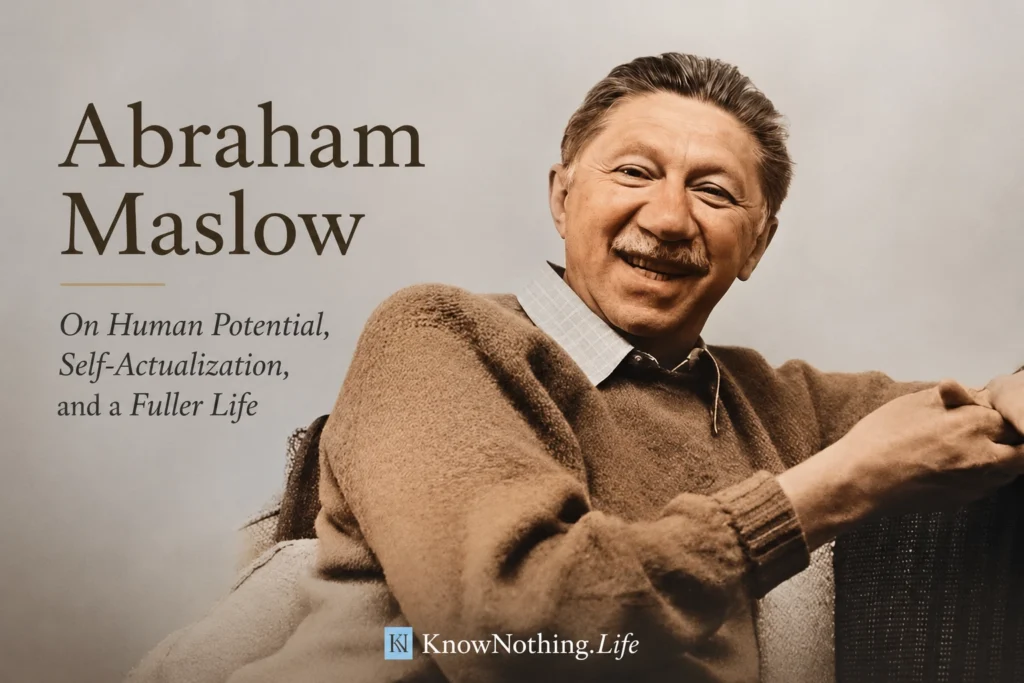
Few psychologists have influenced modern thought about human motivation, fulfillment, and personal development as profoundly as Abraham Maslow. Best known for creating the Hierarchy of Needs, Maslow challenged the dominant psychological theories of his time by arguing that human beings are driven not only by unconscious conflict or conditioned behavior, but also by an innate desire for growth, meaning, and self-actualization. His work marked the emergence of humanistic psychology, often called psychology’s “third force,” standing in contrast to both psychoanalysis and behaviorism.
Maslow believed psychology had spent too much time studying illness, dysfunction, and pathology while neglecting the healthiest and most creative aspects of human nature. Instead of asking why people break down psychologically, he wanted to understand why some individuals thrive, innovate, and reach extraordinary levels of personal fulfillment. His ideas transformed psychology, education, business leadership, and self-development culture, and they continue to influence discussions about happiness, success, and what it means to live a meaningful life.
Early Life and Intellectual Development
Abraham Harold Maslow was born on April 1, 1908, in Brooklyn, New York, to Russian Jewish immigrant parents. His childhood was difficult and often emotionally isolating. Raised in a strict household, Maslow later described his early family life as lonely and intellectually detached, experiences that would eventually shape his lifelong interest in human emotional development and psychological well-being. Books became his refuge, and he developed a strong fascination with philosophy, literature, and intellectual exploration at an early age.
Maslow initially enrolled at the City College of New York before transferring to the University of Wisconsin, where he studied psychology. There he worked under psychologist Harry Harlow, whose research on primates and attachment deeply influenced Maslow’s understanding of emotional development. His early academic work focused heavily on behaviorism, which at the time dominated American psychology, but he gradually became dissatisfied with theories that reduced human beings to mechanical systems of stimulus and response.
During the 1930s and 1940s, Maslow encountered influential thinkers who would dramatically reshape his worldview, including Max Wertheimer and Ruth Benedict. Observing what he considered psychologically exceptional individuals led him to ask a question few psychologists were asking: what creates greatness, creativity, and psychological health rather than dysfunction? That question would define the rest of his career.
Breaking Away From Traditional Psychology
In the early twentieth century, psychology was largely dominated by two competing schools of thought. Psychoanalysis, pioneered by Sigmund Freud, focused heavily on unconscious conflict, trauma, and neurosis. Behaviorism, championed by figures such as John B. Watson and B. F. Skinner, treated behavior as a product of environmental conditioning and reinforcement.
Maslow found both perspectives incomplete. He believed psychoanalysis concentrated too heavily on pathology while behaviorism ignored the internal richness of human experience. Human beings, he argued, are not simply products of trauma or conditioning. They possess creativity, aspirations, moral awareness, curiosity, and an inherent drive toward growth. He wanted psychology to study these positive dimensions rather than focusing almost exclusively on dysfunction.
This philosophical break led Maslow to help establish what became known as humanistic psychology. This movement emphasized free will, personal agency, creativity, emotional growth, and the human capacity for self-improvement. Maslow famously stated, “If the only tool you have is a hammer, you tend to see every problem as a nail.” The quote reflected his belief that psychology had become trapped within narrow theoretical frameworks that overlooked much of human nature.
The Hierarchy of Needs
Maslow’s most famous contribution emerged in 1943 when he introduced the Hierarchy of Needs, one of the most recognizable psychological models ever developed. The theory proposed that human motivation operates in stages, with lower needs requiring fulfillment before higher forms of growth can emerge. At the base are physiological needs such as food, water, and shelter. Above those come safety needs, followed by love and belonging, esteem, and finally self-actualization at the top.
According to Maslow, people cannot fully pursue creativity, purpose, or self-discovery if their basic survival needs remain unmet. A starving person does not prioritize artistic achievement. Someone living in constant fear struggles to focus on personal growth. Only when fundamental needs are reasonably satisfied can individuals move toward higher psychological development and ultimately realize their fullest potential.
Maslow’s hierarchy became influential far beyond psychology. Businesses began using it to understand employee motivation. Educators applied it to learning environments. Marketers used it to understand consumer behavior. Though often represented visually as a pyramid, Maslow emphasized that human motivation is fluid rather than rigidly sequential. He wrote, “What a man can be, he must be. This need we may call self-actualization.” That statement became the philosophical heart of his life’s work.
Self-Actualization and Human Potential
For Maslow, self-actualization represented the highest expression of human development. It referred to the process of becoming fully oneself and realizing one’s deepest capacities. Self-actualized individuals were not necessarily famous or powerful, but they demonstrated authenticity, creativity, independence, moral awareness, and deep engagement with life.
Maslow became fascinated with studying highly accomplished individuals whom he believed represented extraordinary psychological health. He examined figures such as Albert Einstein, Eleanor Roosevelt, and Abraham Lincoln, searching for common personality traits among exceptional human beings. He concluded that psychologically healthy people shared qualities such as spontaneity, autonomy, acceptance of reality, and a strong sense of purpose.
One of his most famous observations remains deeply influential: “In any given moment we have two options: to step forward into growth or step back into safety.” This idea reflected his belief that personal development requires constant engagement with uncertainty. Growth demands courage, and human fulfillment depends largely on our willingness to embrace that challenge.
Major Works and Intellectual Contributions
Maslow’s ideas reached a broad audience through a number of highly influential books. Motivation and Personality (1954) introduced his hierarchy theory in greater detail and explored the foundations of human motivation. This work remains one of the central texts in personality psychology and human motivation research.
Later, Toward a Psychology of Being (1962) expanded his theories beyond motivation into deeper questions of consciousness, identity, creativity, and psychological fulfillment. In this work, Maslow argued that psychology should not simply repair dysfunction but actively help individuals achieve their highest potential. He introduced the concept of “peak experiences,” moments of profound joy, clarity, transcendence, and deep connection that reveal the fullest dimensions of human existence.
His final major work, The Farther Reaches of Human Nature (1971), explored transcendence and spirituality, suggesting that self-actualization itself may not represent the endpoint of development. He increasingly believed that human beings also seek experiences that connect them to something beyond the self, expanding his theory into questions of meaning and consciousness.
Criticism and Scientific Debate
Despite his enormous cultural influence, Maslow’s work has faced criticism from psychologists who argue that his theories lack empirical precision. Critics note that the hierarchy of needs does not apply universally across all cultures. In some societies, communal belonging may take priority over individual achievement, challenging the sequential structure of his model.
Others argue that self-actualization is difficult to define scientifically. Because concepts like fulfillment, meaning, and peak experience are deeply subjective, researchers have struggled to measure them consistently. Behaviorists particularly criticized Maslow for emphasizing internal experience rather than observable behavior, arguing that many of his concepts were philosophically appealing but experimentally difficult to verify.
Maslow acknowledged many of these limitations. He viewed psychology as an evolving discipline and believed that not everything important about human nature could be easily quantified. His willingness to explore areas neglected by mainstream psychology remains one reason his work continues to resonate decades later.
Legacy and Lasting Influence
Abraham Maslow fundamentally changed the direction of modern psychology. His emphasis on human growth, creativity, and emotional well-being helped launch humanistic psychology and inspired later thinkers such as Carl Rogers. Together, they shifted psychology toward understanding the healthiest dimensions of human experience rather than focusing exclusively on mental illness.
His influence now extends across leadership theory, education, psychotherapy, coaching, organizational behavior, and modern self-development culture. Discussions about purpose, fulfillment, authenticity, and personal growth often trace directly back to Maslow’s original ideas. Even popular conversations about “living your best life” carry echoes of his theory of self-actualization.
Maslow once said, “The story of the human race is the story of men and women selling themselves short.” Few statements better summarize his worldview. He believed human beings possess extraordinary untapped potential and that society too often conditions people to settle for less than they are capable of becoming.
Final Thoughts
To study Abraham Maslow is to encounter one of psychology’s most optimistic and transformative thinkers. At a time when the discipline focused largely on dysfunction, he insisted that understanding greatness, creativity, and fulfillment was equally important. He challenged psychology to ask not only how people suffer, but how they flourish.
His work remains remarkably relevant in a world increasingly focused on mental health, purpose, emotional intelligence, and personal development. Maslow reminded both psychologists and society that human beings are not simply creatures seeking survival. At our best, we are builders of meaning, seekers of truth, and creators of possibility. His legacy endures because he understood something fundamental: the deepest human need may ultimately be becoming who we are capable of becoming.