Harry Frederick Harlow was born Harry Frederick Israel on October 31, 1905, in Fairfield, Iowa. He became one of the most famous and controversial psychologists of the twentieth century, known for experiments that changed how scientists, physicians, and parents understood affection, attachment, and early emotional development. Harlow’s work entered psychology at a time when love was often treated as too sentimental or vague for laboratory science. Behaviorism dominated much of American psychology, and many experts emphasized feeding, habit, and reinforcement rather than tenderness, comfort, and emotional security.
Harlow began studies at Reed College before transferring to Stanford University, where he studied psychology and earned his Ph.D. in 1930. At Stanford, he was influenced by major figures in psychology, including Lewis Terman, known for his work on intelligence testing. Around the time he completed his doctorate, Harlow changed his surname from Israel to Harlow, a decision often linked to concerns about antisemitic hiring bias, even though his family background was not Jewish. After finishing his doctoral work, he joined the University of Wisconsin–Madison, where he would spend most of his career and build one of the most important primate research laboratories in the United States.
Building the Wisconsin Primate Laboratory
When Harlow arrived at Wisconsin, he did not immediately inherit a grand laboratory. Instead, he helped create one from limited space, improvised materials, and student labor. The result became the University of Wisconsin Primate Laboratory, a center that attracted researchers interested in learning, cognition, social development, and emotional life. Before he became famous for attachment research, Harlow studied problem solving and learning in monkeys. His work with the Wisconsin General Test Apparatus helped show that rhesus monkeys could develop “learning sets,” meaning they could learn how to learn across repeated tasks.
This early research mattered because it challenged simplistic views of animal intelligence. Harlow did not see monkeys as reflex machines responding only to reward and punishment. He saw them as active, adaptable organisms capable of memory, curiosity, strategy, and social need. That belief prepared the ground for his later work on affection. If primates were cognitively and emotionally complex, then mother-infant attachment could not be reduced to feeding alone. The laboratory became the place where Harlow would ask one of psychology’s most unsettling questions: what does an infant actually need from a mother?
The Nature of Love
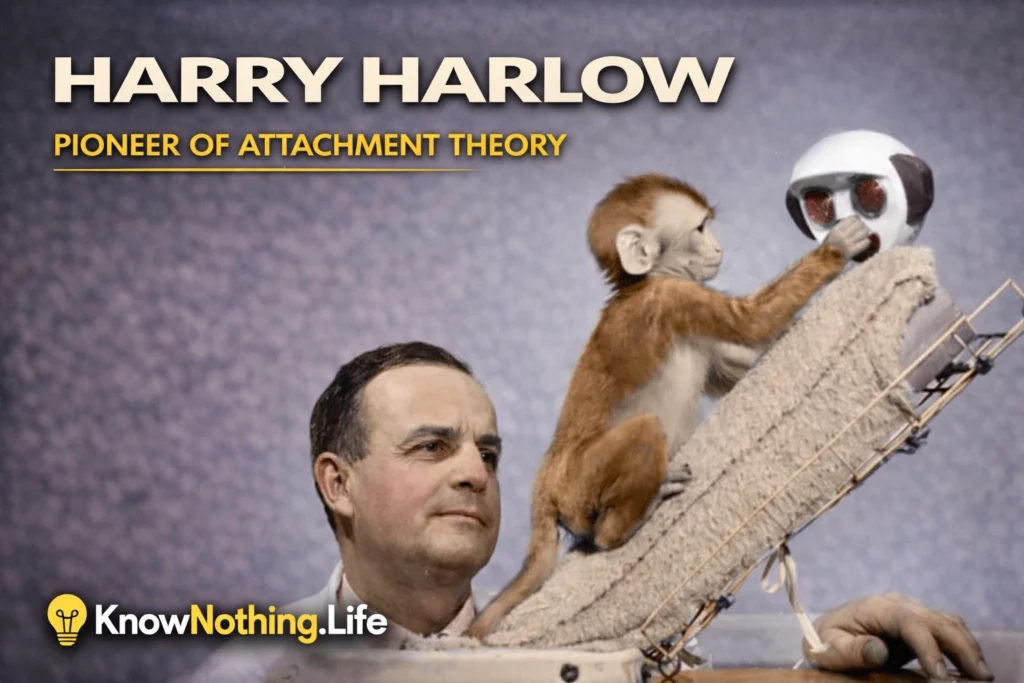
Harlow’s most famous work began in the 1950s with experiments using infant rhesus monkeys and artificial surrogate mothers. In one version, a baby monkey had access to two “mothers.” One was made of bare wire and provided milk. The other was covered in soft terry cloth but did not provide food. At the time, many theories assumed that infants attached to mothers primarily because mothers supplied nourishment. Harlow’s monkeys challenged that assumption. They spent far more time clinging to the cloth mother, and when frightened, they ran to the cloth mother for security.
In his 1958 American Psychological Association presidential address, later published as “The Nature of Love,” Harlow opened with the striking line, “Love is a wondrous state.” He argued that affection had been neglected not because it was unimportant, but because it was difficult to study objectively. His experiments introduced the concept of contact comfort, the idea that soft physical closeness can be a primary need rather than a secondary reward. This was the heart of Harlow’s scientific revolution. Infants do not live by milk alone. Warmth, touch, safety, and attachment are not luxuries added to development; they are part of development itself.
Challenging Behaviorism and Changing Child Psychology
Harlow’s findings helped weaken the belief that affection was merely a sentimental reward attached to feeding. His work arrived during a period when some child-rearing advice warned parents not to hold babies too much or respond too quickly to crying. The fear was that tenderness might spoil children or create dependence. Harlow’s monkeys suggested the opposite. Deprivation of comfort did not produce independence. It produced anxiety, abnormal behavior, and impaired social development. The infant’s search for closeness was not weakness; it was a basic condition of emotional growth.
His research also intersected with the attachment theories of John Bowlby and the later work of Mary Ainsworth. Bowlby argued that children need a secure bond with caregivers, while Ainsworth’s “strange situation” studies later showed different attachment patterns in human infants. Harlow’s work did not prove human attachment theory by itself, but it gave dramatic laboratory evidence that primate infants seek security, not just food. This shifted psychology toward a more emotionally realistic view of development. The mother-child bond became not an embarrassment to scientific psychology, but one of its central subjects.
Major Works and Scientific Contributions
Harlow’s most important works include “The Nature of Love,” “Love in Infant Monkeys,” “The Development of Affectional Patterns in Infant Monkeys,” and “Total Social Isolation in Monkeys.” He also published influential research on learning, primate cognition, and developmental psychology. Across these works, Harlow argued that affection, touch, play, peer contact, and early social experience shape later behavior. He showed that monkeys raised without normal social bonds could develop severe emotional and social disturbances, including fearfulness, withdrawal, repetitive behavior, and poor parenting behavior later in life.
His work also revealed that mothering is not a single simple function. Feeding, warmth, protection, touch, movement, peer play, and social interaction all contribute to healthy development. Harlow’s experiments suggested that infants need more than a body that provides milk; they need a responsive world. This made his research deeply influential in hospitals, orphanages, pediatrics, developmental psychology, and public conversations about childcare. Even critics of his methods often acknowledged that his findings helped overturn damaging assumptions about emotional neglect and infant care.
Controversy and Ethical Criticism
No honest biography of Harlow can ignore the ethical controversy surrounding his research. Many of his experiments involved maternal separation, isolation, and emotional deprivation in infant monkeys. Later studies, especially those involving total social isolation and devices associated with depression research, have been strongly criticized as cruel. Modern readers often find the experiments disturbing, and many contemporary animal welfare standards developed partly in reaction to the kind of research Harlow represented. His work raises a difficult moral question: how should science weigh knowledge gained from suffering?
The answer cannot be simple. Harlow’s research helped demonstrate the importance of care, touch, and companionship, but it did so by depriving animals of those very things. That contradiction remains central to his legacy. He forced psychology to take love seriously, yet his methods exposed the danger of studying emotional pain through inflicted emotional pain. Today, Harlow is remembered both as a pioneer of attachment research and as a symbol of why research ethics matter. His career shows that scientific importance and moral unease can exist in the same historical figure.
Legacy and Lasting Importance
Harry Harlow died on December 6, 1981, in Tucson, Arizona. By then, he had received major honors, including election to the National Academy of Sciences, the National Medal of Science, and the Gold Medal from the American Psychological Foundation. His students and colleagues carried his influence into developmental psychology, primatology, psychiatry, comparative psychology, and attachment research. His laboratory also helped train important figures, including researchers who later studied primate social development and the long-term effects of early experience.
Harlow’s lasting importance lies in the fact that he changed what psychology was willing to study. He made love, comfort, affection, and attachment experimental subjects at a time when many scientists preferred cleaner, colder concepts. His work showed that emotional bonds are not decorative parts of life. They are structural. Infants need connection before they can become independent; they need security before they can explore; they need touch before the world feels safe. Harry Harlow’s legacy is therefore both powerful and troubling: he helped prove the necessity of love, while leaving behind one of psychology’s most difficult ethical inheritances.