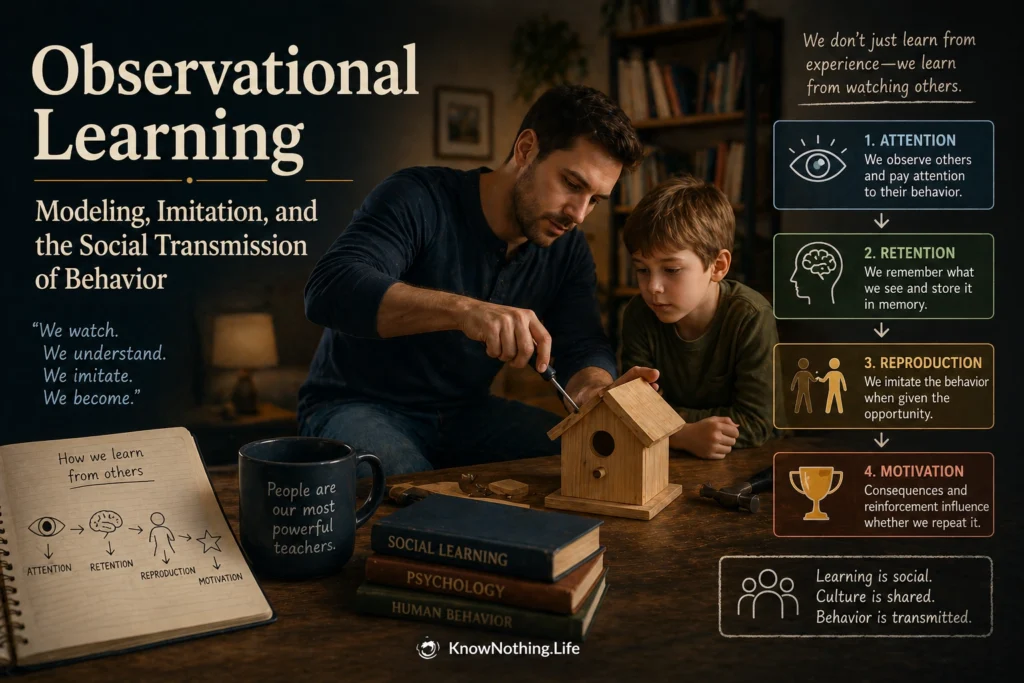
Observational learning is the process through which individuals acquire new behaviors, knowledge, or attitudes by watching others. Unlike forms of learning that rely on direct experience, such as trial-and-error or reinforcement, observational learning allows individuals to learn vicariously—through the actions and outcomes of others. This capacity dramatically expands the range of possible learning, enabling complex skills and social norms to be transmitted across individuals and generations without each person needing to experience everything firsthand.
At its core, observational learning reflects the fundamentally social nature of human cognition. Humans are not isolated learners; they exist within networks of interaction where behavior is constantly observed, interpreted, and replicated. From early childhood, individuals watch caregivers, peers, and authority figures, extracting patterns that guide their own behavior. This process supports cultural continuity, skill acquisition, and social adaptation, making observational learning one of the most powerful mechanisms in human development.
Historical Foundations and Social Learning Theory
The modern understanding of observational learning is largely shaped by the work of Albert Bandura, who challenged traditional behaviorist views that emphasized direct reinforcement as the primary driver of learning. Bandura argued that individuals can learn simply by observing others, even in the absence of immediate rewards or punishments. His social learning theory integrated behavioral and cognitive perspectives, emphasizing the role of mental processes in interpreting and storing observed information.
Bandura’s most famous research, the Bobo doll experiments, demonstrated that children who observed adults behaving aggressively toward a doll were more likely to imitate that behavior. Importantly, the likelihood of imitation was influenced by the observed consequences: children were more likely to replicate actions that were rewarded and less likely to imitate those that were punished. This finding introduced the concept of vicarious reinforcement, where individuals learn from the outcomes experienced by others.
These insights marked a significant shift in the study of learning, highlighting the importance of observation, cognition, and social context. Observational learning was no longer seen as a passive process but as an active interpretation of behavior and consequences. Bandura’s work remains foundational, influencing fields such as education, psychology, and media studies.
Core Processes of Observational Learning
Observational learning involves several key cognitive processes that determine whether observed behavior is successfully acquired and reproduced. The first is attention, which refers to the ability to focus on relevant aspects of a model’s behavior. Not all observed information is processed equally; factors such as the model’s attractiveness, status, or similarity to the observer can influence attention.
The second process is retention, which involves encoding and storing the observed behavior in memory. This often requires transforming visual or auditory information into mental representations that can be recalled later. Without effective retention, observed behaviors cannot be reproduced, regardless of how well they were initially attended to.
The third process is reproduction, which involves translating stored representations into actual behavior. This requires both cognitive and physical capabilities, as well as practice to refine performance. Finally, motivation determines whether the behavior is performed. Even if a behavior is learned, it may not be expressed unless there is a reason to do so, such as the expectation of reward or the desire to conform. Together, these processes illustrate the complexity of observational learning as an active and multifaceted system.
Modeling and Imitation
Modeling is the central mechanism of observational learning, referring to the process of observing and imitating the behavior of others. Models can take many forms, including parents, teachers, peers, and media figures. The effectiveness of a model depends on various factors, such as perceived competence, authority, and similarity to the observer.
Imitation is not a simple copying process but involves interpretation and adaptation. Observers may replicate the general structure of a behavior while modifying specific details to suit their own context. This flexibility allows for the transfer of knowledge across different situations, supporting innovation and creativity. For example, learning to play a musical instrument often involves observing others, but individual style and variation emerge over time.
Modeling also plays a crucial role in the acquisition of social norms and values. By observing how others behave and the consequences they receive, individuals learn what is considered acceptable or desirable within a given context. This process contributes to the development of identity and social understanding, highlighting the broader significance of observational learning beyond individual behavior.
Vicarious Reinforcement and Punishment
A distinctive feature of observational learning is the role of vicarious reinforcement and punishment. Unlike direct reinforcement, where individuals experience consequences themselves, vicarious processes involve observing the outcomes of others’ actions. These observed consequences influence the likelihood of imitating the behavior.
When a model is rewarded for a behavior, observers are more likely to adopt that behavior, anticipating similar outcomes. Conversely, when a model is punished, observers may avoid the behavior, learning from the negative consequences experienced by others. This mechanism allows individuals to learn efficiently, reducing the need for direct trial-and-error experiences.
Vicarious processes also highlight the importance of cognitive evaluation in learning. Observers do not simply mimic behavior; they interpret the significance of outcomes and adjust their actions accordingly. This evaluative aspect distinguishes observational learning from purely behavioral models, emphasizing the integration of cognition and social context.
Observational Learning in Development
Observational learning plays a central role in human development, particularly during childhood. From an early age, children learn language, social behaviors, and problem-solving strategies by observing others. This process enables rapid acquisition of complex skills that would be difficult to learn through direct experience alone.
Parents and caregivers serve as primary models, influencing children’s behavior through both intentional instruction and everyday actions. Children are highly sensitive to the behaviors of those around them, often imitating actions even when not explicitly encouraged. This sensitivity underscores the importance of modeling in shaping development.
As individuals grow, peers and media become increasingly influential. Observational learning continues to shape behavior across the lifespan, contributing to the acquisition of new skills and the adaptation to changing environments. Its role in development highlights the interconnected nature of learning and social interaction.
Neural Basis of Observational Learning
The neural mechanisms underlying observational learning involve brain systems that support perception, action, and social cognition. One of the most significant discoveries in this area is the identification of mirror neurons, which are activated both when an individual performs an action and when they observe the same action performed by others. These neurons provide a neural basis for imitation and understanding of others’ behavior.
In addition to mirror neuron systems, regions such as the prefrontal cortex and temporal lobes are involved in processing social information and evaluating outcomes. These areas support the interpretation of observed behavior and the integration of cognitive and emotional responses. The interaction of these systems enables the complex processes required for observational learning.
Neuroscientific research continues to explore how these mechanisms contribute to learning and behavior. By linking cognitive processes to neural activity, this research provides a deeper understanding of how observational learning operates at both psychological and biological levels.
Applications in Education and Society
Observational learning has significant implications for education, where modeling is a powerful tool for teaching new skills and concepts. Teachers often demonstrate procedures, strategies, and behaviors that students can observe and replicate. This approach is particularly effective for tasks that involve complex or procedural knowledge, such as problem-solving or physical skills.
In society, observational learning influences behavior through media, culture, and social interaction. The behaviors portrayed in television, film, and digital platforms can shape attitudes and actions, particularly when models are perceived as influential or relatable. This influence highlights the responsibility associated with modeling behavior in public contexts.
Observational learning is also used in therapeutic settings, where individuals learn adaptive behaviors by observing others. Techniques such as modeling and role-playing can help individuals develop new skills and overcome challenges. These applications demonstrate the practical value of understanding observational learning and its role in shaping behavior.
Future Directions and the Expanding Study of Social Learning
The study of observational learning continues to evolve, incorporating insights from cognitive psychology, neuroscience, and social science. Advances in technology are enabling more detailed analysis of how individuals observe and imitate behavior in real-world contexts. These developments are expanding our understanding of the mechanisms and influences involved in social learning.
Emerging research is also exploring the interaction between observational learning and other cognitive processes, such as attention, memory, and emotion. These interactions highlight the complexity of learning as a system that integrates multiple factors. Understanding these relationships is essential for developing comprehensive models of behavior.
As societies become increasingly interconnected, the importance of observational learning continues to grow. It remains a key mechanism for the transmission of knowledge, culture, and behavior, shaping how individuals adapt to their environments. By examining its processes and applications, cognitive psychology provides valuable insights into one of the most powerful forms of human learning.
Conclusion: Learning Through Observation
Observational learning stands as a testament to the social nature of human cognition, demonstrating that much of what we learn comes not from direct experience but from watching others. Through processes of attention, retention, reproduction, and motivation, individuals acquire behaviors that shape their interactions with the world. This capacity allows for efficient learning, cultural transmission, and the development of complex skills.
By understanding observational learning, we gain insight into how behavior is influenced by social context and how knowledge is shared across individuals and generations. Its principles continue to inform research and practice across fields, highlighting its enduring significance in the study of learning and cognition.