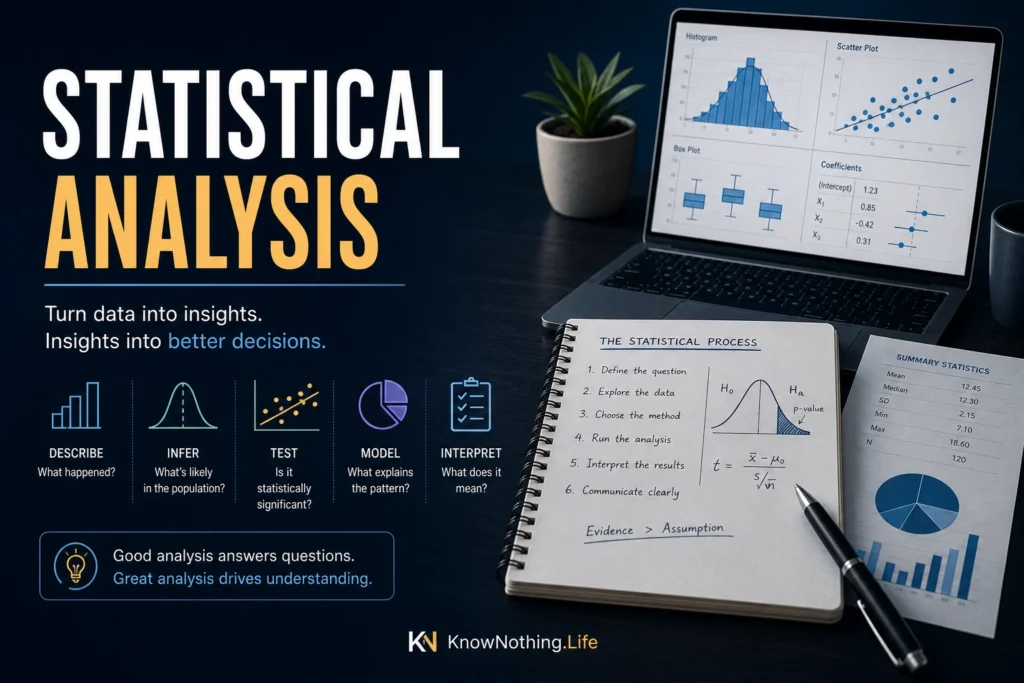
Statistical analysis is the engine that transforms raw data into meaningful insight. In psychology and the broader sciences, researchers collect observations, but without systematic methods to interpret those observations, data remains noise. Statistical analysis provides the framework for identifying patterns, testing hypotheses, and drawing conclusions about human behavior and mental processes. It allows scientists to move beyond anecdote and intuition toward evidence-based understanding.
The development of modern statistics is closely tied to figures such as Ronald Fisher, whose work laid the foundation for experimental design and inferential analysis. Fisher emphasized the importance of probability in evaluating evidence, introducing concepts such as significance testing that remain central to research today. As he famously noted, “To consult the statistician after an experiment is finished is often merely to ask him to conduct a post-mortem examination.”
At its core, statistical analysis is not merely a set of techniques but a way of thinking. It requires careful consideration of uncertainty, variability, and the limits of inference. By understanding both its power and its limitations, researchers can use statistics to illuminate complex phenomena while avoiding common errors in interpretation.
Descriptive Statistics and Data Summarization
The first step in statistical analysis is often descriptive statistics, which summarize and organize data. Measures such as the mean, median, and mode provide information about central tendency, while measures like variance and standard deviation capture the spread of data. These statistics offer a concise way to describe large datasets, making patterns more visible and interpretable.
Descriptive statistics are essential for understanding the basic structure of data before conducting more advanced analyses. For example, identifying outliers or skewed distributions can inform subsequent decisions about statistical tests. Visualization techniques, such as histograms and scatterplots, complement numerical summaries by providing a graphical representation of data.
Although descriptive statistics do not allow for generalization beyond the sample, they play a critical role in the research process. As John Tukey emphasized in his work on exploratory data analysis, understanding data begins with careful examination and visualization. Tukey argued that “the greatest value of a picture is when it forces us to notice what we never expected,” highlighting the importance of exploration in statistical analysis.
Inferential Statistics and Hypothesis Testing
While descriptive statistics summarize data, inferential statistics allow researchers to draw conclusions about populations based on sample data. This process involves estimating parameters, testing hypotheses, and evaluating the likelihood that observed patterns are due to chance. Inferential methods are central to scientific research, enabling generalization and prediction.
Hypothesis testing is one of the most widely used inferential techniques. Researchers begin with a null hypothesis, which assumes no effect or relationship, and an alternative hypothesis, which represents the expected outcome. Statistical tests are then used to determine whether the observed data provide sufficient evidence to reject the null hypothesis. The concept of statistical significance, often associated with a p-value threshold, plays a key role in this process.
However, the interpretation of significance has been widely debated. Jacob Cohen criticized the overreliance on p-values, arguing that “the earth is round (p < .05).” His point underscores the need to consider effect sizes and practical significance alongside statistical results. Inferential statistics provide powerful tools, but their conclusions must be interpreted with care and context.
Probability, Uncertainty, and Variability
Probability theory underpins statistical analysis, providing a framework for understanding uncertainty and variability. In real-world data, outcomes are rarely deterministic; instead, they are influenced by a range of factors that introduce randomness. Statistical methods allow researchers to quantify this uncertainty and make informed inferences.
Variability is a fundamental feature of data, reflecting differences between individuals, conditions, or measurements. Understanding variability is essential for distinguishing meaningful patterns from random fluctuations. Techniques such as confidence intervals provide a range of values within which a parameter is likely to fall, offering a more nuanced view than single-point estimates.
The role of probability in scientific reasoning has been shaped by thinkers such as Thomas Bayes, whose work laid the foundation for Bayesian inference. Bayesian methods incorporate prior knowledge into the analysis, updating beliefs in light of new evidence. This approach contrasts with traditional frequentist methods, highlighting the diversity of perspectives within statistical analysis.
Correlation, Regression, and Relationships
Statistical analysis often focuses on relationships between variables. Correlation measures the strength and direction of association between two variables, providing insight into how they co-vary. However, as emphasized by researchers such as Karl Pearson, correlation does not imply causation, underscoring the importance of careful interpretation.
Regression analysis extends this idea by modeling the relationship between variables, allowing researchers to predict outcomes and assess the influence of multiple factors. Linear regression, for example, estimates how changes in one variable are associated with changes in another, while controlling for additional variables. These models are widely used in psychology, economics, and other fields.
Understanding relationships in data is crucial for developing theories and testing hypotheses. However, statistical models are simplifications of reality, and their validity depends on the assumptions underlying them. Recognizing these limitations is essential for drawing accurate conclusions from statistical analysis.
Advanced Methods and Modern Applications
Advances in technology and computation have expanded the scope of statistical analysis, enabling the use of complex models and large datasets. Techniques such as multivariate analysis, machine learning, and network analysis allow researchers to explore patterns that were previously inaccessible. These methods have transformed fields such as neuroscience, where large-scale data can reveal intricate patterns of brain activity.
Machine learning, in particular, represents a shift toward predictive modeling, focusing on the ability to make accurate predictions rather than solely testing hypotheses. While these approaches offer powerful tools, they also introduce new challenges, including issues of interpretability and overfitting. Balancing predictive accuracy with theoretical understanding remains a key concern.
The integration of advanced methods with traditional statistical principles reflects the evolving nature of the field. As Leo Breiman noted in his discussion of statistical modeling, there is a tension between data-driven and theory-driven approaches. Navigating this tension is essential for advancing both scientific knowledge and practical applications.
Ethical Considerations and Misuse
Statistical analysis carries significant ethical responsibilities, particularly in how data is interpreted and presented. Misuse of statistics—whether through selective reporting, data manipulation, or misinterpretation—can lead to misleading conclusions and undermine trust in research. Transparency and rigor are therefore essential for maintaining the integrity of statistical analysis.
The replication crisis in psychology has highlighted the importance of reproducibility and openness in research. Practices such as preregistration, data sharing, and replication studies aim to address these issues, ensuring that findings are robust and reliable. These initiatives reflect a broader commitment to improving the quality and credibility of scientific research.
Ethical considerations also extend to the communication of statistical results. Researchers must present findings in a way that is accurate and accessible, avoiding exaggeration or oversimplification. As statistics increasingly influence public policy and decision-making, the responsibility to communicate clearly and responsibly becomes even more critical.
Conclusion
Statistical analysis is an essential tool for understanding the complexities of human behavior and the natural world. From the foundational contributions of Ronald Fisher to the modern advancements in computational methods, the field has evolved into a sophisticated and indispensable component of scientific inquiry.
By combining descriptive and inferential techniques, statistical analysis allows researchers to summarize data, test hypotheses, and explore relationships. At the same time, it requires careful consideration of uncertainty, variability, and the limitations of inference. These challenges highlight the importance of both technical skill and critical thinking in the use of statistics.
Ultimately, statistical analysis is not just about numbers; it is about making sense of the world. By providing a framework for interpreting data, it enables researchers to uncover patterns, evaluate evidence, and contribute to a deeper understanding of human behavior and experience.