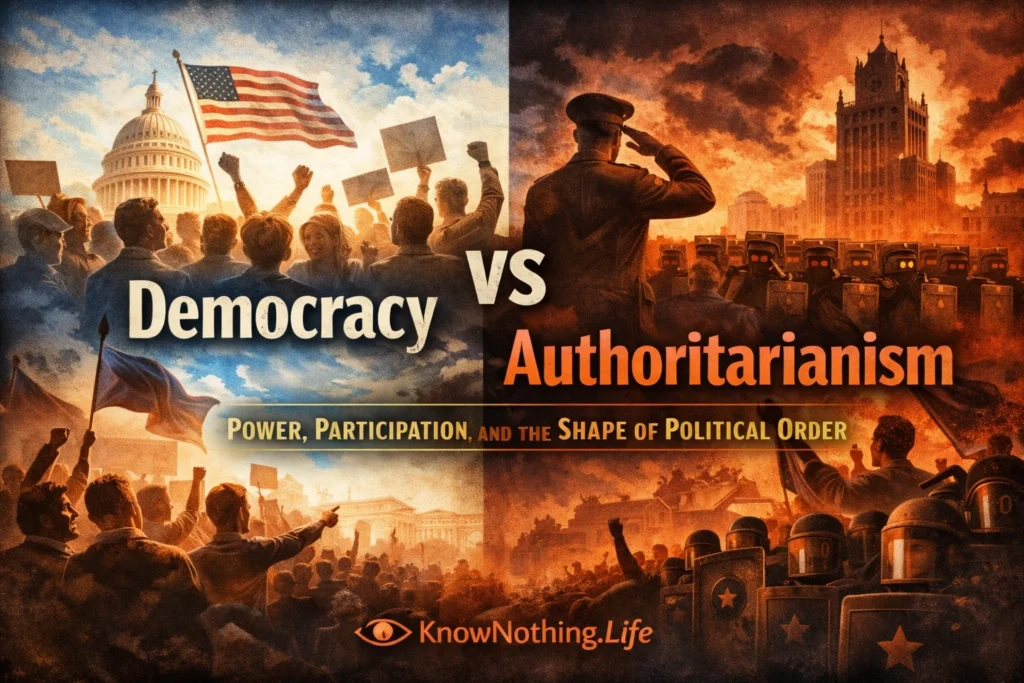
The contrast between democracy and authoritarianism represents one of the most enduring and consequential divides in political thought. At stake is not merely the structure of government but the deeper question of who holds power and how it is justified. Democracy is typically defined by the participation of citizens in political decision-making, whether directly or through elected representatives, while authoritarianism concentrates power in the hands of a single ruler or a limited elite, often without meaningful accountability. These two systems embody fundamentally different assumptions about human nature, legitimacy, and the role of the state.
This opposition is not always absolute. Many political systems exist along a spectrum, blending elements of both democratic and authoritarian governance. Nevertheless, the distinction provides a powerful framework for analyzing political institutions and their moral foundations. It raises critical questions about freedom, stability, equality, and efficiency, inviting ongoing debate about which system best serves the needs of society. Understanding this contrast requires examining both the theoretical justifications and the practical consequences of each model.
Foundations of Democratic Thought
The philosophical roots of democracy can be traced to ancient Athens, but its modern formulation emerges more clearly in the work of Enlightenment thinkers. John Locke, in Two Treatises of Government, argues that legitimate government is based on the consent of the governed and exists to protect natural rights. This idea establishes a moral foundation for democratic authority, emphasizing that political power must be accountable to the people it serves.
Jean-Jacques Rousseau develops this principle further in The Social Contract, where he introduces the concept of the general will. For Rousseau, democracy is not merely a mechanism for aggregating preferences but a system in which citizens collectively determine the laws under which they live. He famously declares, “The people, being subject to the laws, ought to be their author.” This statement captures the ideal of self-governance at the heart of democratic theory.
Modern democratic thought also draws on the insights of Alexis de Tocqueville, whose work Democracy in America examines the strengths and weaknesses of democratic societies. Tocqueville highlights the importance of civic engagement, equality of conditions, and local institutions in sustaining democracy, while also warning of the “tyranny of the majority,” in which the will of the majority can suppress minority rights. These foundational ideas continue to shape contemporary debates about democratic governance.
The Logic of Authoritarian Rule
Authoritarianism, by contrast, is characterized by centralized authority and limited political participation. While often associated with coercion and repression, it also has its own philosophical justifications. Thomas Hobbes provides one of the most influential defenses of strong centralized authority in Leviathan. Writing in the context of civil war, Hobbes argues that a powerful sovereign is necessary to prevent chaos and ensure security. Without such authority, he contends, human life would be “solitary, poor, nasty, brutish, and short.”
Hobbes’s argument does not advocate authoritarianism in the modern sense, but it establishes a key rationale for concentrated power: the need for order. In situations of instability or conflict, authoritarian systems may be seen as providing decisive leadership and rapid decision-making. This perspective emphasizes the trade-off between freedom and security, suggesting that some degree of coercion may be necessary to maintain social order.
Later thinkers, such as Carl Schmitt, further develop the logic of authoritarian rule. In works like Political Theology, Schmitt argues that sovereignty is defined by the ability to decide in exceptional situations. For him, the authority to suspend normal rules in times of crisis is the true mark of political power. This view highlights the limits of procedural governance and the role of decisive leadership, but it also raises concerns about the potential for abuse and the erosion of legal norms.
Participation, Representation, and Legitimacy
A central difference between democracy and authoritarianism lies in how legitimacy is established. Democratic systems derive legitimacy from participation, representation, and consent. Elections, public deliberation, and the rule of law provide mechanisms through which citizens can influence decisions and hold leaders accountable. This process is not always perfect, but it reflects the principle that authority must be justified to those subject to it.
In authoritarian systems, legitimacy is often based on different criteria, such as tradition, ideology, or performance. A regime may claim legitimacy by delivering economic growth, maintaining stability, or embodying a particular national identity. Max Weber’s analysis of authority types—traditional, charismatic, and legal-rational—helps explain how such systems justify their rule. Authoritarian regimes may rely heavily on charismatic leadership or appeals to historical continuity, rather than formal democratic procedures.
The contrast between these forms of legitimacy raises important questions about the nature of political obligation. Should individuals obey authority because they have participated in its creation, or because it delivers desirable outcomes? This tension reflects broader disagreements about the foundations of political order and the role of citizens within it.
Freedom, Equality, and Control
Democracy is often associated with freedom and equality, but these values can come into tension with one another. Democratic systems aim to protect individual rights while also ensuring that all citizens have an equal voice. Achieving this balance is a complex task, as expanding participation can sometimes lead to conflicts over resources, representation, and policy priorities.
Authoritarian systems, on the other hand, typically prioritize control and stability over individual freedom. While this can lead to efficient decision-making and rapid implementation of policies, it often comes at the cost of personal liberties and political dissent. The suppression of opposition and the concentration of power raise concerns about accountability and the potential for abuse.
The philosopher John Stuart Mill, in On Liberty, defends the importance of individual freedom within democratic societies. He argues that liberty is essential for personal development and social progress, warning against both governmental overreach and social conformity. His work highlights the idea that democracy must be more than a system of majority rule; it must also protect the rights and freedoms of individuals.
Stability, Efficiency, and Adaptability
One of the most frequently cited advantages of authoritarian systems is their ability to act decisively and efficiently. Without the constraints of electoral politics and public deliberation, authoritarian governments can implement policies quickly and respond to crises with fewer delays. This can be particularly appealing in situations that require immediate action, such as economic crises or national emergencies.
However, this efficiency often comes at the expense of adaptability and accountability. Democratic systems, while slower and more complex, provide mechanisms for feedback and correction. Elections, public debate, and institutional checks allow for the revision of policies and the removal of ineffective leaders. This capacity for self-correction is one of the key strengths of democracy, even if it can lead to short-term inefficiencies.
The tension between stability and adaptability reflects a deeper trade-off between control and participation. Authoritarian systems may offer stability through centralized authority, but they risk becoming rigid and unresponsive. Democratic systems, by contrast, embrace a degree of uncertainty and conflict as part of the process of governance, viewing these elements as essential to maintaining legitimacy and responsiveness.
Contemporary Challenges and Hybrid Systems
In the modern world, the distinction between democracy and authoritarianism is increasingly blurred by the emergence of hybrid systems. Some regimes maintain the formal structures of democracy—such as elections and constitutions—while limiting genuine political competition and dissent. These systems challenge traditional classifications and raise questions about what constitutes true democratic governance.
Globalization and technological change further complicate the picture. The spread of information technologies has created new opportunities for participation and mobilization, but it has also enabled new forms of surveillance and control. Authoritarian regimes can use digital tools to monitor citizens and suppress opposition, while democratic societies grapple with issues such as misinformation and political polarization.
These developments highlight the evolving nature of political systems and the need for ongoing analysis. The debate between democracy and authoritarianism is not merely historical but deeply relevant to contemporary politics, shaping discussions about governance, rights, and the future of global order.
The Enduring Contrast
The contrast between democracy and authoritarianism ultimately reflects different visions of human nature and political life. Democracy is grounded in the belief that individuals are capable of self-governance and that collective decision-making can produce legitimate authority. Authoritarianism, by contrast, emphasizes the need for order, unity, and decisive leadership, often at the expense of participation and freedom.
Neither system is without challenges, and both must contend with the complexities of modern society. However, the enduring appeal of democracy lies in its commitment to participation, accountability, and the protection of individual rights. It offers a framework for addressing conflict and diversity through dialogue and institutional processes, rather than coercion.
The ongoing tension between these systems serves as a reminder that political order is not fixed but continually contested. It invites reflection on the values that should guide governance and the structures that best embody those values. In this sense, the debate between democracy and authoritarianism is not only about political systems but about the principles that define a just and legitimate society.