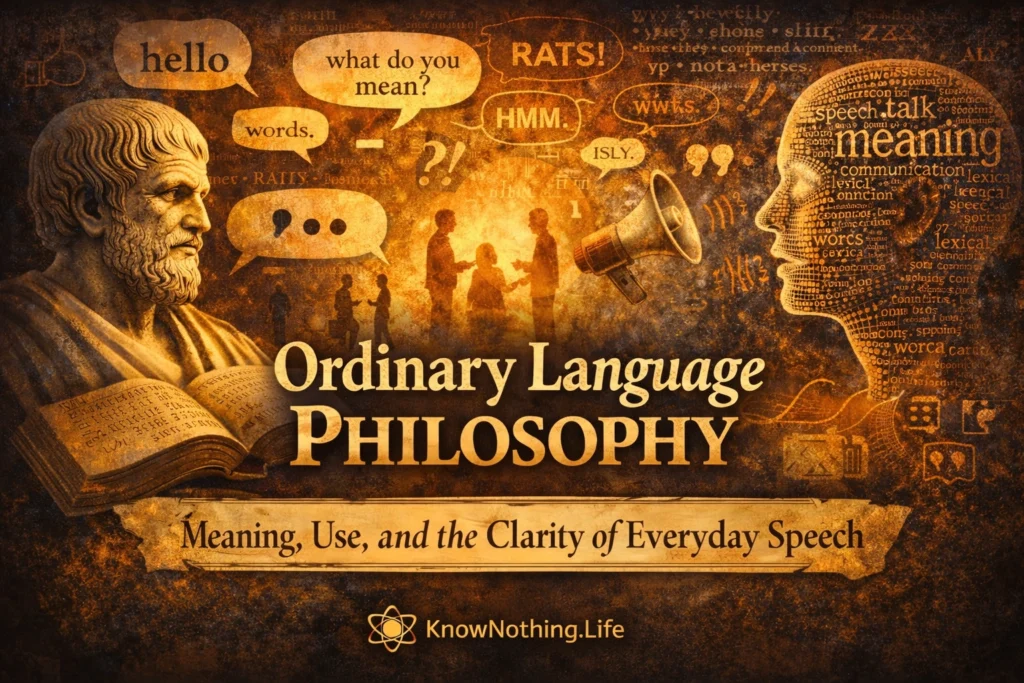
Ordinary Language Philosophy is a twentieth-century philosophical movement that emphasizes the importance of everyday language in resolving philosophical problems. Rather than constructing ideal logical systems or abstract symbolic frameworks, this approach turns to the ways language is actually used in daily life. Its central claim is both simple and radical: many philosophical puzzles arise not from deep metaphysical mysteries, but from misunderstandings about how language functions in ordinary contexts.
This movement emerged as a response to earlier trends in analytic philosophy, particularly the emphasis on formal logic and idealized language. While thinkers like Bertrand Russell sought to refine language into precise logical forms, proponents of ordinary language philosophy argued that such refinement often obscures rather than clarifies meaning. By examining how words are used in practice—across different situations, activities, and social contexts—philosophers aimed to dissolve conceptual confusions rather than solve them through theoretical construction.
The Turn to Everyday Language
At the heart of ordinary language philosophy is a methodological shift: instead of asking what words should mean in an ideal system, it asks how they are actually used by speakers. This approach treats language as a living, dynamic phenomenon shaped by human activity. Words do not derive their meaning from fixed definitions or abstract correspondences with reality, but from their role in communication.
Ludwig Wittgenstein played a foundational role in this shift. In his later philosophy, particularly in Philosophical Investigations, he rejected the idea that language operates through strict logical structures. Instead, he introduced the concept of “language games,” emphasizing that meaning is determined by use within specific forms of life. Words function differently depending on the context—giving orders, making jokes, asking questions—and there is no single essence underlying all uses of a term.
This perspective challenges the assumption that philosophical problems can be resolved by defining terms more precisely. Instead, it suggests that many such problems arise from taking words out of their ordinary contexts and treating them as if they had fixed, context-independent meanings. By returning to everyday usage, philosophers can reveal the sources of confusion and restore clarity.
Language, Context, and Meaning
Ordinary language philosophers argue that meaning is inherently tied to context. A single word or phrase can have multiple meanings depending on how it is used, and understanding those meanings requires attention to the situations in which language is employed. This insight has profound implications for philosophical analysis, as it undermines the search for universal definitions that apply across all contexts.
J. L. Austin developed this idea further through his work on speech acts. He showed that language is not merely descriptive but performative—when we speak, we often do things rather than simply describe states of affairs. For example, saying “I apologize” is not a report about an apology; it is the act of apologizing itself. This distinction highlights the richness of ordinary language, which cannot be fully captured by traditional logical models.
Austin’s work also emphasized the importance of subtle distinctions in everyday speech. Philosophical problems often arise when these distinctions are ignored or oversimplified. By carefully analyzing how words are used in different contexts, ordinary language philosophers aim to uncover the implicit rules and conventions that govern communication. This approach treats language as a tool embedded in human practices, rather than as a static system of symbols.
Dissolving Philosophical Problems
One of the defining features of ordinary language philosophy is its approach to philosophical problems. Rather than attempting to solve these problems through new theories, it seeks to dissolve them by showing that they are based on linguistic confusion. Many traditional philosophical questions—about the nature of knowledge, the existence of the external world, or the meaning of consciousness—are seen as arising from misuse or misunderstanding of language.
For example, questions about whether the mind is a “thing” separate from the body may stem from treating mental concepts as if they referred to physical objects. By examining how words like “mind,” “thought,” and “experience” are used in everyday language, philosophers can reveal that such questions may be misguided. The goal is not to provide definitive answers, but to clarify the concepts involved and eliminate confusion.
Gilbert Ryle famously applied this method in his critique of Cartesian dualism. He argued that the idea of the mind as a separate substance involves a “category mistake,” arising from treating mental phenomena as if they belonged to the same category as physical objects. By analyzing ordinary language, Ryle sought to show that this conception is fundamentally flawed.
Critiques of Ideal Language
Ordinary language philosophy emerged partly as a critique of the ideal language tradition, which aimed to construct logically perfect languages free from ambiguity and vagueness. While this approach achieved significant advances in logic and mathematics, ordinary language philosophers argued that it fails to account for the richness and flexibility of natural language.
Bertrand Russell and other proponents of ideal language sought to eliminate ambiguity by translating ordinary sentences into precise logical forms. However, critics argued that this process often strips language of its practical significance. Everyday speech is not merely a flawed version of an ideal system; it is a complex and effective tool adapted to a wide range of human activities.
Ordinary language philosophers contend that ambiguity and context-dependence are not defects but essential features of language. They allow for nuance, creativity, and adaptability, enabling communication in diverse situations. Attempts to impose rigid logical structures may overlook these features and lead to distorted interpretations of meaning.
Language and Human Practices
A central insight of ordinary language philosophy is that language is inseparable from human practices. Words gain their meaning through their use in activities such as teaching, negotiating, storytelling, and expressing emotions. This perspective emphasizes the social and practical dimensions of language, highlighting its role in shaping and reflecting human life.
Ludwig Wittgenstein described language as part of a “form of life,” suggesting that it cannot be understood in isolation from the broader context of human activity. This view challenges the idea that language can be fully analyzed through abstract theories, pointing instead to the importance of lived experience and shared practices.
By focusing on ordinary language, philosophers gain insight into how concepts function in real-world contexts. This approach bridges the gap between philosophy and everyday life, showing that philosophical reflection is not confined to abstract speculation but is deeply connected to how we speak and act.
Legacy and Influence
Although ordinary language philosophy was most prominent in the mid-twentieth century, its influence continues to be felt in contemporary philosophy. Its emphasis on context, use, and the social nature of language has shaped fields such as pragmatics, linguistics, and cognitive science. It has also contributed to a broader shift away from purely formal approaches toward more holistic and context-sensitive analyses.
At the same time, the movement has faced criticism. Some argue that it lacks the ambition to address deeper philosophical questions, focusing instead on minor linguistic details. Others contend that not all philosophical problems can be dissolved through language analysis, and that some require substantive theoretical solutions.
Despite these criticisms, ordinary language philosophy remains an important and enduring approach. It serves as a reminder that clarity often begins with careful attention to how we use words, and that philosophical insight can emerge from examining the familiar rather than constructing the abstract.
Conclusion
Ordinary Language Philosophy offers a distinctive approach to understanding meaning, emphasizing the importance of everyday speech and the contexts in which it is used. By focusing on how language functions in practice, it seeks to dissolve philosophical problems rather than solve them through theoretical construction. This method, associated with thinkers like Ludwig Wittgenstein, J. L. Austin, and Gilbert Ryle, has had a lasting impact on the study of language and philosophy more broadly.
Ultimately, ordinary language philosophy invites us to look more closely at the words we use and the practices in which they are embedded. In doing so, it reveals that many philosophical puzzles arise not from the world itself, but from the ways we speak about it—and that clarity can often be found in the ordinary.