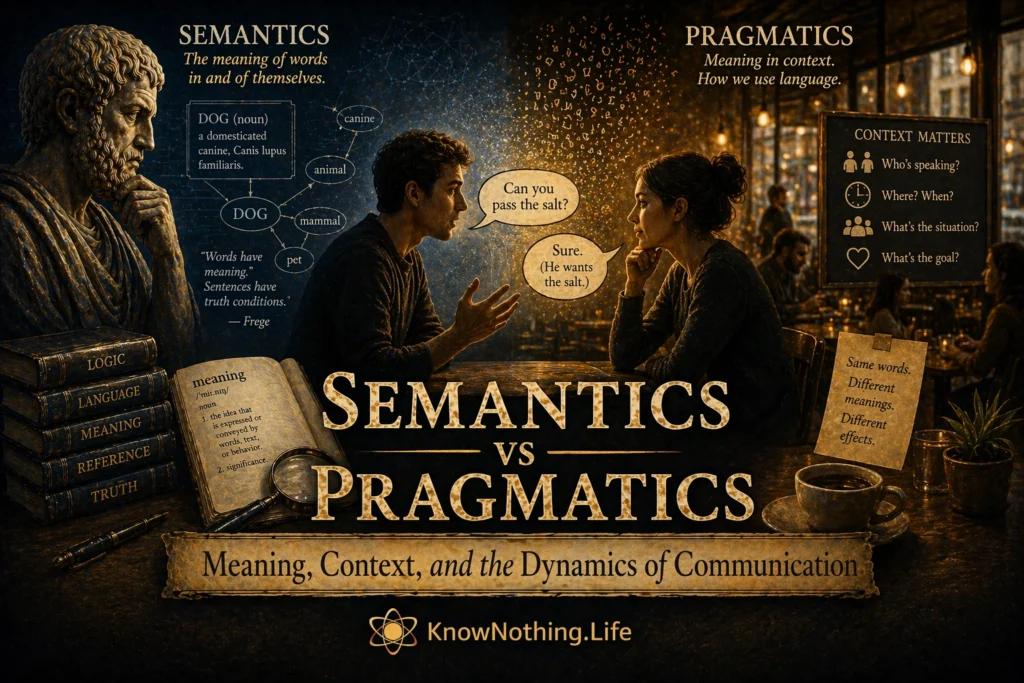
The distinction between semantics and pragmatics lies at the heart of how language conveys meaning. Semantics is concerned with the literal meaning of words, phrases, and sentences—their conventional content as determined by linguistic rules. Pragmatics, by contrast, examines how context, intention, and social factors shape meaning in actual use. Together, these two domains provide a comprehensive framework for understanding communication, revealing that meaning is not fixed solely by language itself but emerges through interaction between linguistic structure and situational context.
Philosophers and linguists have long debated where the boundary between semantics and pragmatics should be drawn. While it may seem straightforward to separate literal meaning from contextual interpretation, in practice the two are deeply intertwined. Everyday communication relies on both: we depend on shared linguistic conventions to convey basic information, but we also rely on context to infer what is meant beyond what is explicitly stated. This interplay makes the philosophical study of semantics and pragmatics essential for understanding not only language, but also thought and social interaction.
Semantics: The Structure of Meaning
Semantics focuses on the meaning encoded in language independently of specific contexts. It seeks to explain how words and sentences represent the world, how they can be true or false, and how their meanings are determined by linguistic rules. Central to semantic theory is the idea that meaning can be systematically analyzed, often using formal tools derived from logic.
Philosophers such as Gottlob Frege and Alfred Tarski made foundational contributions to this field. Frege introduced the distinction between sense and reference, showing that meaning involves more than simply pointing to objects in the world. Tarski, meanwhile, developed a formal account of truth, providing a way to define when a statement is true based on its relationship to reality. These approaches treat meaning as something that can be precisely specified and analyzed.
In modern linguistics, semantics often involves the study of compositionality—the principle that the meaning of a sentence is determined by the meanings of its parts and the way they are combined. This principle allows for the systematic construction of meaning, enabling speakers to understand an infinite number of sentences from a finite vocabulary. Despite its strengths, semantic analysis alone cannot account for all aspects of meaning, particularly those that depend on context.
Pragmatics: Meaning in Context
Pragmatics addresses the aspects of meaning that arise from context, speaker intention, and social interaction. It examines how people use language to achieve goals, convey implied meanings, and navigate complex communicative situations. Unlike semantics, which focuses on what sentences mean in themselves, pragmatics focuses on what speakers mean when they use those sentences.
A central figure in the development of pragmatics is H. P. Grice, who introduced the concept of conversational implicature. Grice showed that speakers often convey more than they explicitly say, relying on shared assumptions and cooperative principles. For example, if someone says, “It’s getting late,” they may be implying that it is time to leave, even though this is not stated directly. Such inferences depend on context and cannot be captured by semantics alone.
Pragmatics also includes the study of speech acts, developed by philosophers like J. L. Austin and John Searle. They demonstrated that language is not merely a tool for describing the world but also for performing actions—making promises, issuing commands, or expressing emotions. These insights highlight the dynamic and interactive nature of language, emphasizing that meaning is often shaped by how language is used rather than by its formal structure.
The Boundary Between Semantics and Pragmatics
One of the most challenging issues in the study of language is determining where semantics ends and pragmatics begins. While the distinction is conceptually useful, it is not always clear-cut. Many aspects of meaning appear to involve both semantic and pragmatic elements, making it difficult to assign them exclusively to one domain.
Consider indexical expressions such as “I,” “here,” and “now.” Their meaning depends on context, as their reference changes depending on who is speaking and when. Some philosophers, such as David Kaplan, have argued that these expressions have a semantic component that determines how context affects their meaning. This suggests that context-sensitivity can be built into semantics rather than treated purely as a pragmatic phenomenon.
Other cases, such as ambiguity and vagueness, further blur the boundary. A sentence may have multiple possible interpretations, and context helps determine which one is intended. Similarly, vague terms like “tall” or “rich” depend on contextual standards for their application. These examples illustrate that semantics and pragmatics are deeply interconnected, and that understanding meaning requires attention to both.
Implicature and Inference
Pragmatics plays a crucial role in how we infer meaning beyond what is explicitly stated. Conversational implicature, as introduced by H. P. Grice, is a key mechanism in this process. It explains how speakers can convey additional information indirectly, relying on shared norms of communication.
Grice proposed that communication is guided by a cooperative principle, supported by maxims such as relevance, quantity, quality, and manner. When speakers appear to violate these maxims, listeners infer that there is an underlying meaning. For example, if someone responds to a question with an apparently unrelated statement, the listener may search for a connection, assuming that the speaker is still being cooperative.
These inferences are highly context-dependent and can vary across situations and cultures. They demonstrate that meaning is not fully determined by linguistic form but emerges through interaction between speaker and listener. This insight has had a profound impact on the study of language, highlighting the importance of pragmatic reasoning in communication.
Semantics, Pragmatics, and Truth
The relationship between semantics and pragmatics also has implications for the concept of truth. Semantics typically defines truth in terms of the correspondence between a statement and the world. However, pragmatic factors can influence how statements are interpreted and evaluated.
For instance, a sentence may be literally true but misleading in a given context. Conversely, a statement that is not strictly accurate may still convey a meaningful truth in a broader sense. These cases show that truth is not always a simple matter of semantic content, but can be shaped by pragmatic considerations.
Philosophers have debated whether truth should be understood purely in semantic terms or whether it requires a broader framework that includes pragmatic factors. This debate reflects the broader tension between formal and contextual approaches to language, highlighting the complexity of meaning and its relationship to reality.
Applications and Contemporary Relevance
The distinction between semantics and pragmatics has important applications in fields such as linguistics, psychology, artificial intelligence, and communication studies. In AI, for example, understanding both literal meaning and contextual nuance is essential for developing systems that can interact effectively with humans. While machines can process semantic information with increasing accuracy, capturing pragmatic meaning remains a significant challenge.
In everyday communication, the interplay between semantics and pragmatics is evident in everything from casual conversation to political discourse. Misunderstandings often arise when contextual cues are overlooked or interpreted differently. By studying how meaning is constructed and interpreted, philosophers and linguists contribute to a deeper understanding of communication and its complexities.
This distinction also has implications for cross-cultural communication, where differences in norms and expectations can affect how language is used and understood. Pragmatic competence—knowing how to use language appropriately in different contexts—is as important as semantic knowledge, underscoring the multifaceted nature of linguistic understanding.
Conclusion
Semantics and pragmatics together provide a comprehensive account of how language conveys meaning. While semantics focuses on the structure and content of language, pragmatics emphasizes the role of context, intention, and social interaction. The distinction between the two is not always clear, but their interplay is essential for understanding communication.
From the formal theories of Gottlob Frege to the pragmatic insights of H. P. Grice, the study of meaning has evolved into a rich and dynamic field. By exploring both the literal and contextual dimensions of language, we gain a deeper appreciation of how meaning is created, shared, and understood in human interaction.