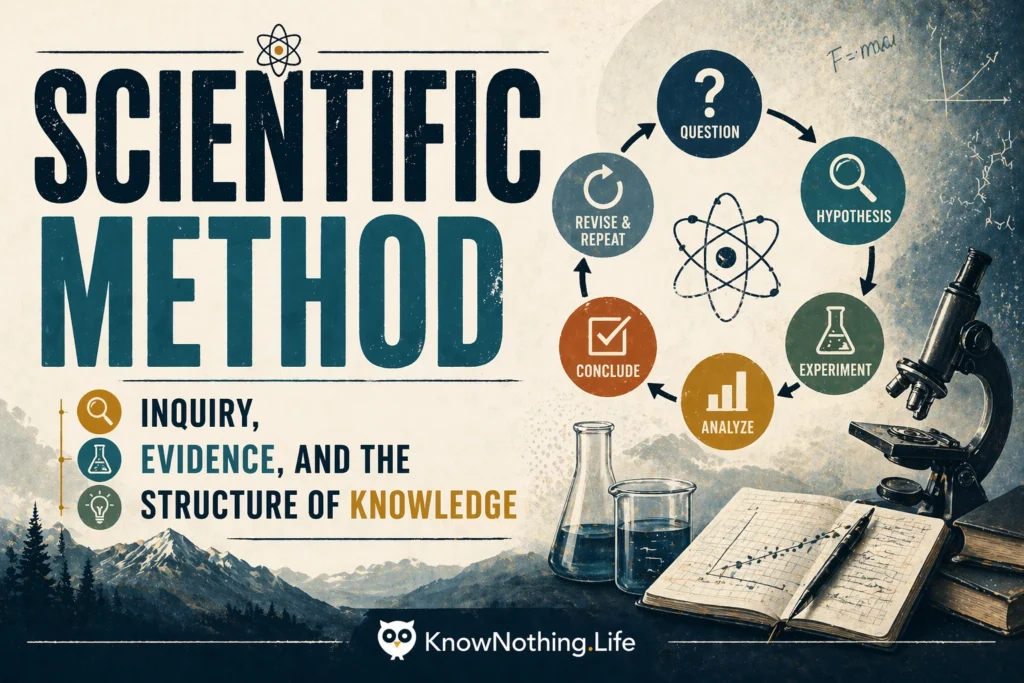
The scientific method is often presented as a systematic procedure for acquiring knowledge about the natural world. It typically involves observation, hypothesis formation, experimentation, and evaluation. Yet beyond this familiar outline lies a deeper philosophical question: what exactly makes the scientific method reliable, and how does it produce knowledge that is considered objective? The method is not merely a checklist of steps, but a framework shaped by assumptions about evidence, reasoning, and the nature of reality.
From early modern science to contemporary research practices, the scientific method has evolved in response to both empirical discoveries and philosophical reflection. Figures such as Francis Bacon emphasized systematic observation and inductive reasoning, while later thinkers challenged the simplicity of this model. Today, the scientific method is understood as a flexible and dynamic process, one that adapts to different disciplines and incorporates both theoretical and experimental components.
Observation and Empirical Foundations
At the heart of the scientific method lies observation—the systematic gathering of data about the world. Scientific inquiry begins with the recognition of patterns, anomalies, or phenomena that require explanation. These observations provide the raw material from which hypotheses are developed, grounding scientific theories in empirical evidence.
However, observation is not as straightforward as it may seem. Philosophers have argued that observation is theory-laden, meaning that what we observe is influenced by our prior beliefs, concepts, and expectations. This insight challenges the idea that science begins with neutral, unbiased data. Instead, observation is shaped by the frameworks through which we interpret the world.
Despite these challenges, empirical observation remains a cornerstone of scientific inquiry. Through careful measurement, replication, and verification, scientists seek to minimize bias and ensure that their findings are reliable. This process reflects a commitment to evidence as the foundation of knowledge, even as it acknowledges the complexities involved in interpreting that evidence.
Hypothesis Formation and Explanation
Once observations are made, scientists formulate hypotheses—proposed explanations for the phenomena under investigation. A good hypothesis is not merely a guess; it is a carefully constructed statement that can be tested and potentially falsified. It must be consistent with existing knowledge while also offering new insights or predictions.
Hypotheses play a crucial role in guiding scientific inquiry. They provide a framework for organizing observations and determining what kinds of experiments or data collection are needed. In this sense, the scientific method is not purely inductive but involves a creative and interpretive process, where imagination and reasoning are used to generate explanations.
Philosophers have debated the nature of this process, particularly the role of induction. Inductive reasoning involves drawing general conclusions from specific observations, but it raises questions about justification. As David Hume famously argued, there is no logical guarantee that the future will resemble the past, casting doubt on the certainty of inductive inferences. This problem remains a central issue in the philosophy of science.
Experimentation and Testing
Experimentation is a defining feature of the scientific method, allowing hypotheses to be tested under controlled conditions. By manipulating variables and observing the outcomes, scientists can determine whether their hypotheses are supported or refuted. This process provides a way of distinguishing between competing explanations and refining theoretical models.
The importance of testing was emphasized by Karl Popper, who argued that scientific theories must be falsifiable. According to Popper, a theory is scientific only if it can, in principle, be proven false. This criterion shifts the focus from verification to refutation, highlighting the provisional nature of scientific knowledge. Rather than seeking absolute certainty, science progresses by eliminating errors and refining its theories.
However, real-world scientific practice often deviates from this idealized model. Experiments may produce ambiguous results, and theories are rarely abandoned after a single failure. Instead, scientists may modify auxiliary assumptions or refine their methods. This complexity suggests that experimentation is not a straightforward process but one that involves judgment, interpretation, and ongoing revision.
Theory, Laws, and Models
Scientific inquiry ultimately aims to develop theories—comprehensive explanations that integrate observations and hypotheses into a coherent framework. Theories are not mere speculations; they are supported by extensive evidence and are capable of making predictions about future events. Examples include the theory of evolution and the theory of relativity, both of which have transformed our understanding of the world.
In addition to theories, science also employs laws and models. Laws describe regularities in nature, often expressed in mathematical form, while models provide simplified representations of complex systems. Together, these tools allow scientists to explain and predict phenomena, even in cases where direct observation is not possible.
Philosophers have debated the status of these entities, particularly whether they reflect reality or merely serve as useful instruments. Some argue that scientific theories and models provide a true description of the world, while others view them as approximations or tools for organizing experience. This debate highlights the interpretive dimension of the scientific method.
Objectivity and the Social Dimension of Science
The scientific method is often associated with objectivity—the idea that scientific knowledge is independent of individual biases and perspectives. Through standardized procedures, peer review, and replication, science aims to produce reliable and universally valid results. However, philosophers have pointed out that science is conducted by human beings within social and cultural contexts, raising questions about the nature of objectivity.
Thomas Kuhn introduced the concept of paradigms to describe the frameworks within which scientific research takes place. According to Kuhn, periods of “normal science” are guided by shared assumptions and methods, but these can be disrupted by anomalies, leading to paradigm shifts. This perspective suggests that scientific progress is not purely cumulative but involves conceptual changes that reshape how scientists understand the world.
The social dimension of science does not undermine its reliability but rather provides a more nuanced account of how knowledge is produced. By recognizing the role of community, collaboration, and critique, we gain a deeper understanding of the scientific method as a collective enterprise.
Limitations and Critiques
Despite its success, the scientific method has limitations. It is most effective in domains where phenomena can be observed, measured, and tested, but it may be less suited to addressing questions about values, meaning, or subjective experience. This has led to debates about the scope of scientific knowledge and its relationship to other forms of inquiry.
Critics have also questioned the idea of a single, unified scientific method. Different disciplines employ different techniques and standards, suggesting that there may be multiple methods rather than one. This diversity reflects the complexity of the natural and social worlds, requiring flexible approaches to investigation.
Additionally, the reliance on empirical evidence and testing does not eliminate uncertainty. Scientific knowledge is always provisional, subject to revision in light of new evidence. This openness to change is a strength rather than a weakness, as it allows science to adapt and improve over time.
Conclusion
The scientific method is a powerful framework for understanding the world, combining observation, hypothesis, experimentation, and theory into a dynamic process of inquiry. From the empirical emphasis of Francis Bacon to the falsificationism of Karl Popper and the paradigm shifts described by Thomas Kuhn, it has evolved into a sophisticated and multifaceted approach to knowledge.
While not without its challenges and limitations, the scientific method remains one of the most effective tools for exploring and explaining the natural world. By combining rigorous evidence with critical reasoning, it continues to expand our understanding and shape the course of human knowledge.