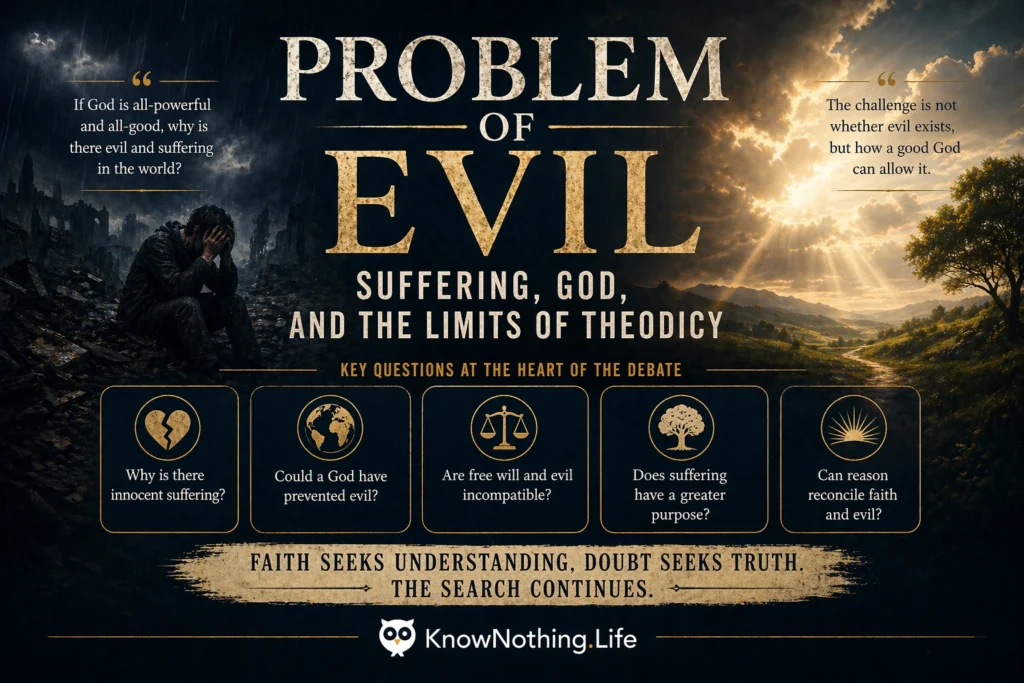
The problem of evil is one of the most enduring and challenging issues in the philosophy of religion. It asks how the existence of evil—understood as suffering, pain, and moral wrongdoing—can be reconciled with the existence of an all-powerful, all-knowing, and perfectly good God. If such a being exists, why does evil occur at all? The question is not merely abstract; it arises from the reality of human experience, where suffering often appears pervasive and unjustified.
Philosophers have approached the problem of evil from multiple angles, distinguishing between logical, evidential, and existential forms of the problem. Some argue that the existence of evil is logically incompatible with the existence of God, while others contend that it makes God’s existence unlikely. Still others focus on the personal and emotional dimensions of suffering, questioning whether any explanation can adequately address the depth of human pain. These perspectives reflect the complexity of the issue and its significance for both philosophy and theology.
The Logical Problem of Evil
The logical problem of evil seeks to show that the existence of God and the existence of evil are logically inconsistent. This argument is often associated with Epicurus, who posed a famous dilemma: if God is willing to prevent evil but unable, then He is not omnipotent; if able but unwilling, then He is not benevolent; if both able and willing, then why does evil exist?
In modern philosophy, J. L. Mackie developed a formal version of this argument, claiming that the traditional attributes of God are incompatible with the existence of evil. According to Mackie, if God is omnipotent and wholly good, He would eliminate all evil, and therefore the presence of evil contradicts the existence of such a being.
In response, theists have proposed various defenses aimed at showing that the coexistence of God and evil is logically possible. These defenses do not necessarily explain why evil exists but attempt to demonstrate that its existence does not entail a contradiction. One of the most influential responses is the free will defense.
The Free Will Defense
The free will defense, most prominently developed by Alvin Plantinga, argues that moral evil arises from the misuse of human free will. According to this view, God created humans with the capacity to choose between good and evil, and this freedom is a necessary condition for genuine moral responsibility. A world with free beings capable of moral goodness is more valuable than a world without such freedom, even if it allows for the possibility of evil.
Plantinga’s defense suggests that it may not be possible for God to create a world with free creatures who always choose the good. If free will entails the possibility of wrongdoing, then the existence of moral evil is a consequence of a greater good. This argument aims to show that the presence of evil is compatible with the existence of an omnipotent and benevolent God.
However, the free will defense primarily addresses moral evil—evil resulting from human actions. It does not fully account for natural evil, such as earthquakes, diseases, and other forms of suffering not directly caused by human choices. This limitation has led to further exploration of the problem.
The Evidential Problem of Evil
While the logical problem of evil focuses on inconsistency, the evidential problem argues that the existence of evil makes the existence of God unlikely. William Rowe developed this approach by pointing to instances of apparently gratuitous suffering—suffering that seems to serve no greater purpose.
Rowe’s argument does not claim that God’s existence is impossible, but that the amount and distribution of evil in the world provide strong evidence against it. For example, the suffering of innocent individuals or the occurrence of natural disasters may appear disproportionate or unnecessary, raising doubts about the presence of a benevolent and omnipotent deity.
Theists have responded by questioning whether humans are in a position to judge the purposes of God. They argue that what appears to be gratuitous suffering may have reasons beyond human understanding. This perspective emphasizes the limits of human knowledge while acknowledging the difficulty of reconciling evil with divine attributes.
Theodicies and Explanations
A theodicy is an attempt to provide a positive explanation for why God allows evil. Unlike defenses, which aim to show compatibility, theodicies seek to justify the existence of evil by identifying its role in a broader divine plan. One of the most influential theodicies is the “soul-making” approach, associated with John Hick.
The soul-making theodicy argues that suffering plays a crucial role in moral and spiritual development. Challenges, hardships, and even suffering can contribute to the growth of virtues such as courage, compassion, and resilience. According to this view, a world without suffering would lack the conditions necessary for meaningful moral development.
Another approach emphasizes the greater good, suggesting that certain evils are permitted because they lead to outcomes that outweigh their negative aspects. However, critics argue that these explanations may not adequately account for extreme or seemingly pointless suffering. The adequacy of theodicies remains a subject of ongoing debate.
Natural Evil and the Limits of Explanation
Natural evil presents a particularly difficult challenge for theodicy. Unlike moral evil, which can be attributed to human actions, natural evil arises from processes such as natural disasters and disease. Explaining why a benevolent God would allow such suffering is a central issue in the philosophy of religion.
Some theodicies attempt to account for natural evil by linking it to broader features of the world, such as the laws of nature. A stable and predictable natural order may be necessary for life and moral agency, even if it allows for harmful events. Others suggest that natural evils provide opportunities for moral growth or serve purposes beyond human comprehension.
Despite these efforts, many philosophers argue that natural evil remains a significant challenge. The scale and intensity of suffering in the natural world can be difficult to reconcile with the idea of a benevolent and omnipotent deity, highlighting the limits of human attempts to explain it.
Existential and Practical Dimensions
Beyond philosophical arguments, the problem of evil has an existential dimension that addresses the human experience of suffering. For many, the question is not merely whether evil can be logically reconciled with God, but whether belief in God is meaningful in the face of suffering.
Philosophers and theologians have explored how individuals respond to evil, emphasizing themes such as faith, resilience, and the search for meaning. Some argue that religious belief provides a framework for coping with suffering, while others see the problem of evil as a reason for skepticism or disbelief.
This dimension of the problem highlights its personal and emotional significance. It is not only a theoretical issue but a lived reality that shapes how people understand the world and their place within it.
Conclusion
The problem of evil remains one of the most profound challenges in the philosophy of religion. From the logical arguments of J. L. Mackie to the evidential concerns of William Rowe and the responses of Alvin Plantinga, it has generated a rich and ongoing debate.
While no single solution has resolved the issue, the exploration of the problem of evil continues to deepen our understanding of suffering, morality, and the nature of belief. Whether approached through logic, evidence, or lived experience, it remains a central question in the search for meaning and truth.