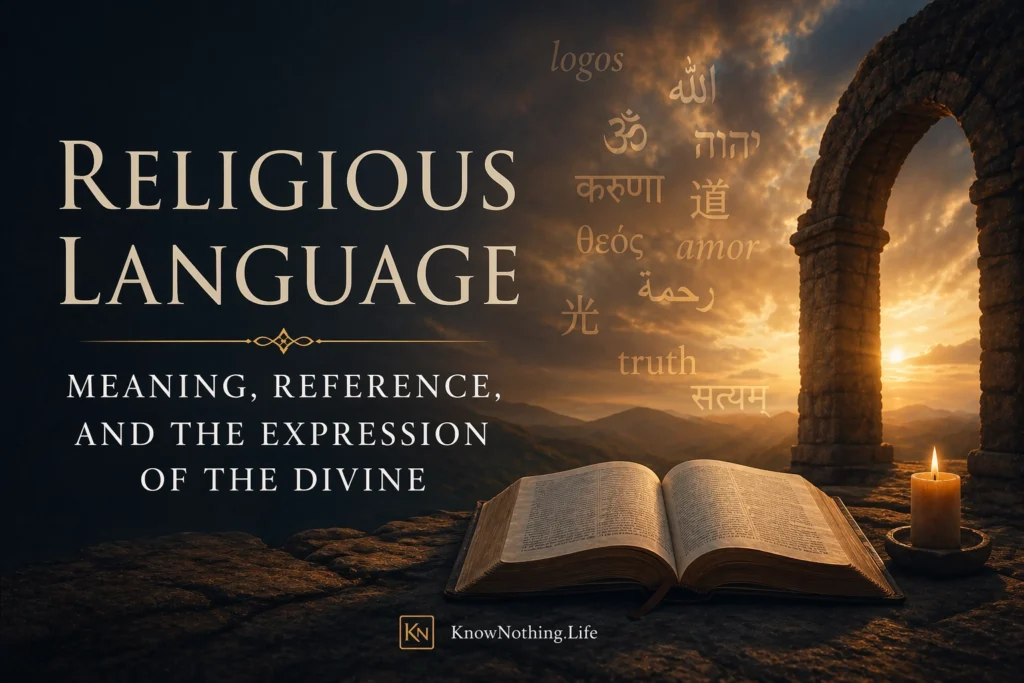
Religious language occupies a unique and contested place in philosophy. It is the medium through which believers describe God, express devotion, and articulate doctrines, yet its meaning is often unclear or debated. When religious traditions speak of God as “all-powerful,” “loving,” or “infinite,” do these terms function in the same way as ordinary language, or do they operate under different rules? The challenge is to determine whether religious language is meaningful, and if so, how it relates to truth and reality.
Philosophers have approached this issue from multiple angles, examining whether religious statements can be verified, whether they refer to anything in the world, and how they function within religious practice. The discussion intersects with broader questions in the philosophy of language, including meaning, reference, and use. As a result, the study of religious language provides insight not only into religion but also into the nature of language itself.
Verification and Meaning
One of the most influential challenges to religious language came from logical positivism, particularly the work of A. J. Ayer. Ayer argued that a statement is meaningful only if it can be empirically verified or is analytically true. Since many religious claims—such as “God exists” or “God is transcendent”—cannot be empirically tested, he concluded that they are not genuinely meaningful but rather expressions of emotion or attitude.
This verification principle posed a serious challenge to traditional religious discourse. If religious statements cannot be verified, then they may lack cognitive content, meaning they do not convey information about the world. This view effectively removes religious language from the domain of knowledge, placing it instead in the realm of subjective expression.
Critics of verificationism have argued that the principle itself is not empirically verifiable and therefore undermines its own standard. Moreover, they contend that many meaningful statements, such as those in ethics or aesthetics, are not empirically testable. These criticisms have led to a broader understanding of meaning that accommodates a wider range of linguistic practices.
Falsification and Religious Claims
In response to verificationism, some philosophers proposed falsification as a criterion for meaningfulness. Antony Flew argued that for a statement to be meaningful, it must be possible to specify what would count as evidence against it. He famously illustrated this point with the parable of the invisible gardener, suggesting that religious claims are often modified to avoid falsification, thereby losing their explanatory power.
According to Flew, if no conceivable evidence could disprove a claim, then it does not assert anything about reality. This critique challenges religious believers to clarify the conditions under which their claims could be considered false, emphasizing the importance of testability in meaningful discourse.
In response, philosophers such as R. M. Hare and Basil Mitchell offered alternative interpretations. Hare introduced the concept of “bliks,” suggesting that religious beliefs are not factual claims but fundamental perspectives that shape how individuals interpret the world. Mitchell, on the other hand, argued that religious claims can be meaningful even if they are not easily falsifiable, as they involve commitment and trust rather than empirical proof.
Analogical and Symbolic Language
Another approach to religious language focuses on analogy and symbolism. Thomas Aquinas argued that language about God cannot be univocal (having exactly the same meaning as in ordinary use) or equivocal (having entirely different meanings), but must be analogical. When we say that God is “good,” we do not mean exactly the same thing as when we describe a person as good, but there is a meaningful similarity.
Analogical language allows for meaningful discourse about God while acknowledging the limitations of human understanding. It recognizes that divine attributes may transcend human concepts, requiring a flexible use of language. This approach preserves the meaningfulness of religious language without reducing it to literal description.
Symbolic interpretations take this idea further, suggesting that religious language functions primarily through symbols that point beyond themselves. Symbols convey meaning not through direct reference but through association and interpretation. This perspective emphasizes the experiential and interpretive aspects of religious language, highlighting its role in shaping belief and practice.
Religious Language as Practice
A significant shift in the philosophy of language came with the later work of Ludwig Wittgenstein, who emphasized the role of use in determining meaning. According to Wittgenstein, language is embedded in “forms of life,” and its meaning arises from its use within specific practices. This perspective has been applied to religious language, suggesting that its meaning is found in the context of religious life rather than in external verification.
From this viewpoint, religious language is part of a language game with its own rules and standards. Statements about God, prayer, and worship are meaningful within the practices and traditions of a religious community. Attempting to evaluate them using criteria from other domains, such as science, may misunderstand their function.
This approach shifts the focus from truth conditions to practical use, emphasizing how language operates in lived experience. It allows for a pluralistic understanding of meaning, where different forms of discourse are evaluated according to their own standards.
Metaphor and Narrative
Religious language often employs metaphor and narrative to convey meaning. Metaphors allow speakers to express complex or abstract ideas by relating them to more familiar concepts. For example, describing God as a “father” or “shepherd” uses metaphorical language to convey aspects of care, guidance, and authority.
Narratives, such as sacred texts and stories, play a central role in religious traditions. These narratives are not always intended as literal accounts but as vehicles for conveying moral, spiritual, and existential truths. They provide a framework for understanding the world and one’s place within it.
The use of metaphor and narrative highlights the richness and flexibility of religious language. It suggests that meaning is not confined to literal description but can be conveyed through imaginative and symbolic forms. This perspective broadens the scope of what counts as meaningful discourse.
Challenges and Contemporary Debates
Despite these various approaches, the question of whether religious language is meaningful remains contested. Some philosophers maintain that religious claims lack clear reference or empirical grounding, while others argue that they express truths that cannot be captured by scientific or literal language.
Contemporary debates often focus on the relationship between religious language and truth. Can religious statements be true or false in the same sense as scientific claims, or do they operate under different criteria? This question reflects broader issues about the nature of truth and the diversity of linguistic practices.
Another area of debate concerns interfaith dialogue and the translation of religious concepts across cultures. Differences in language and interpretation can lead to misunderstandings, raising questions about the universality and specificity of religious meaning.
Conclusion
The study of religious language reveals the complexity of expressing ideas about the divine. From the verificationist critiques of A. J. Ayer to the analogical insights of Thomas Aquinas and the pragmatic approach of Ludwig Wittgenstein, philosophers have developed a range of perspectives on how religious language functions.
While no single account resolves all questions, the ongoing exploration of religious language deepens our understanding of meaning, reference, and the limits of expression. It shows that language is not merely a tool for describing the world but a complex and dynamic medium for engaging with the deepest questions of existence.