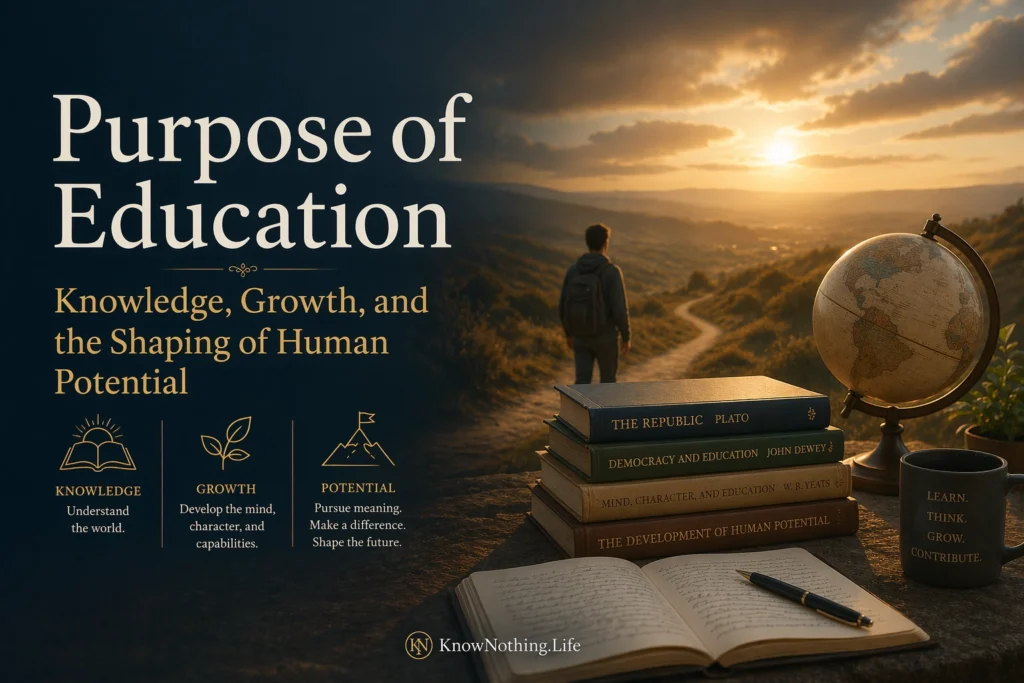
The purpose of education is one of the most enduring and contested questions in philosophy. At a basic level, education equips individuals with knowledge and skills, but its deeper significance lies in shaping how people think, act, and understand the world. It is both a personal and social endeavor, influencing not only individual development but also the structure and direction of societies. To ask about the purpose of education is to ask what kind of human beings we want to become and what kind of world we hope to build.
Across history, philosophers have offered competing visions of education’s role. For Plato, education was a means of guiding the soul toward truth and virtue. For modern thinkers like John Dewey, it became a dynamic process of growth and democratic participation. These perspectives reveal that education is not merely about transmitting information but about cultivating the intellectual, moral, and social capacities that define human life.
Education as the Pursuit of Knowledge
One of the most traditional views holds that the primary purpose of education is the pursuit and transmission of knowledge. From this perspective, education serves to preserve and expand humanity’s intellectual achievements, passing them from one generation to the next. Subjects such as science, mathematics, literature, and history are valued not only for their practical applications but also for their intrinsic contribution to understanding the world.
Philosophers like Aristotle emphasized the importance of knowledge as a component of human flourishing. For Aristotle, intellectual development was central to achieving a well-lived life, as it enabled individuals to reason effectively and make informed decisions. Education, in this sense, is not merely instrumental but foundational to the cultivation of rationality.
However, the emphasis on knowledge raises questions about what counts as valuable knowledge and how it should be prioritized. In a rapidly changing world, the body of available information is vast and constantly expanding. This challenges educational systems to balance depth with breadth, ensuring that students gain both a solid foundation and the ability to adapt to new information and contexts.
Education as Personal Development
Beyond the acquisition of knowledge, education plays a crucial role in personal development. It shapes cognitive abilities, emotional intelligence, and the capacity for self-reflection. This broader view recognizes that education is not simply about what individuals know but about who they become.
Thinkers such as Jean-Jacques Rousseau argued that education should nurture the natural development of the individual, allowing learners to grow in accordance with their own capacities and experiences. Rousseau’s emphasis on the learner’s perspective challenged more rigid, authority-driven models of education, highlighting the importance of autonomy and individuality.
Modern educational philosophy continues to build on this insight, emphasizing skills such as critical thinking, creativity, and adaptability. These qualities enable individuals to navigate complex and uncertain environments, making education a lifelong process rather than a finite stage. Personal development, in this sense, becomes both a goal and a guiding principle of education.
Education and Moral Formation
Education is deeply intertwined with moral development, shaping values, attitudes, and ethical reasoning. Schools and educational institutions do more than impart knowledge; they influence how individuals understand right and wrong, responsibility, and their relationship to others. This raises important questions about the role of education in cultivating moral character.
For Immanuel Kant, education was essential for developing autonomy and the capacity to act according to moral principles. Kant believed that individuals must be taught to think for themselves and to act in ways that respect the dignity of others. This perspective emphasizes the importance of fostering independent moral judgment rather than simply enforcing rules.
At the same time, moral education often involves social and cultural dimensions, reflecting shared values and norms. Educational systems must navigate the challenge of promoting ethical development while respecting diversity and pluralism. This balance underscores the complexity of integrating moral formation into the broader purposes of education.
Education and Socialization
Education also serves as a means of socialization, preparing individuals to participate in the social, economic, and political life of their communities. Through education, individuals learn the norms, practices, and skills necessary for cooperation and collective living. This function highlights the role of education in maintaining social cohesion and continuity.
Sociological perspectives emphasize how education transmits cultural knowledge and reinforces social structures. While this can promote stability, it also raises concerns about inequality and the reproduction of existing hierarchies. Educational systems may inadvertently perpetuate disparities by providing unequal access to resources and opportunities.
Addressing these challenges requires a critical approach to the social role of education. By fostering awareness of social dynamics and encouraging active participation, education can become a tool for empowerment and transformation. In this way, socialization is not merely about conformity but about enabling individuals to engage with and shape their societies.
Education and Economic Function
In modern societies, education is often closely linked to economic outcomes. It provides individuals with the skills and qualifications needed for employment, contributing to productivity and innovation. This instrumental view of education emphasizes its role in preparing individuals for the workforce and supporting economic growth.
While this function is undeniably important, it raises questions about the balance between economic and broader educational goals. If education is primarily oriented toward job preparation, other aspects—such as critical thinking, creativity, and moral development—may be undervalued. This tension reflects differing priorities about what education should achieve.
Philosophers like John Dewey argued for a more integrated approach, where education supports both individual fulfillment and social progress. By connecting learning to real-world experiences and challenges, education can bridge the gap between economic utility and personal growth, ensuring that it serves multiple purposes simultaneously.
Education and Democracy
Education plays a vital role in sustaining democratic societies. It equips individuals with the knowledge and skills needed to participate in public life, engage in informed debate, and make collective decisions. This civic dimension of education underscores its importance beyond individual advancement.
For John Dewey, education was inseparable from democracy. He believed that schools should foster habits of cooperation, critical inquiry, and open communication, creating citizens capable of contributing to a democratic society. Education, in this sense, is not just preparation for life but an integral part of living in a democratic community.
However, the relationship between education and democracy is complex. Educational systems can both promote and hinder democratic values, depending on how they are structured and implemented. Ensuring that education supports democratic ideals requires ongoing reflection and commitment, highlighting its role as a dynamic and evolving institution.
Challenges and Changing Contexts
The purpose of education is continually shaped by changing social, technological, and cultural contexts. Advances in technology have transformed access to information, raising questions about the role of traditional educational institutions. In a world where knowledge is readily available, the emphasis may shift from memorization to critical evaluation and application.
Globalization and cultural diversity also influence educational aims, requiring systems to address a wide range of perspectives and experiences. Education must prepare individuals to navigate complex global challenges, from environmental issues to social inequality, emphasizing the need for adaptability and intercultural understanding.
These changes highlight the importance of reexamining the purpose of education in light of new realities. While core principles such as knowledge, development, and social participation remain relevant, their interpretation and application must evolve to meet contemporary needs.
Final Thoughts
The purpose of education cannot be reduced to a single function. It encompasses the pursuit of knowledge, the development of individuals, the cultivation of moral character, and the preparation for social and economic participation. Each of these dimensions contributes to a richer understanding of what education is and what it can achieve.
Philosophical perspectives provide valuable insights into these purposes, revealing both their potential and their tensions. Balancing different aims requires careful consideration and ongoing dialogue, reflecting the complexity of education as a human endeavor.
Ultimately, education is about more than outcomes; it is about shaping the conditions under which individuals and societies can thrive. By engaging with its philosophical foundations, we can better understand how education can fulfill this role, fostering growth, understanding, and a more just and meaningful world.