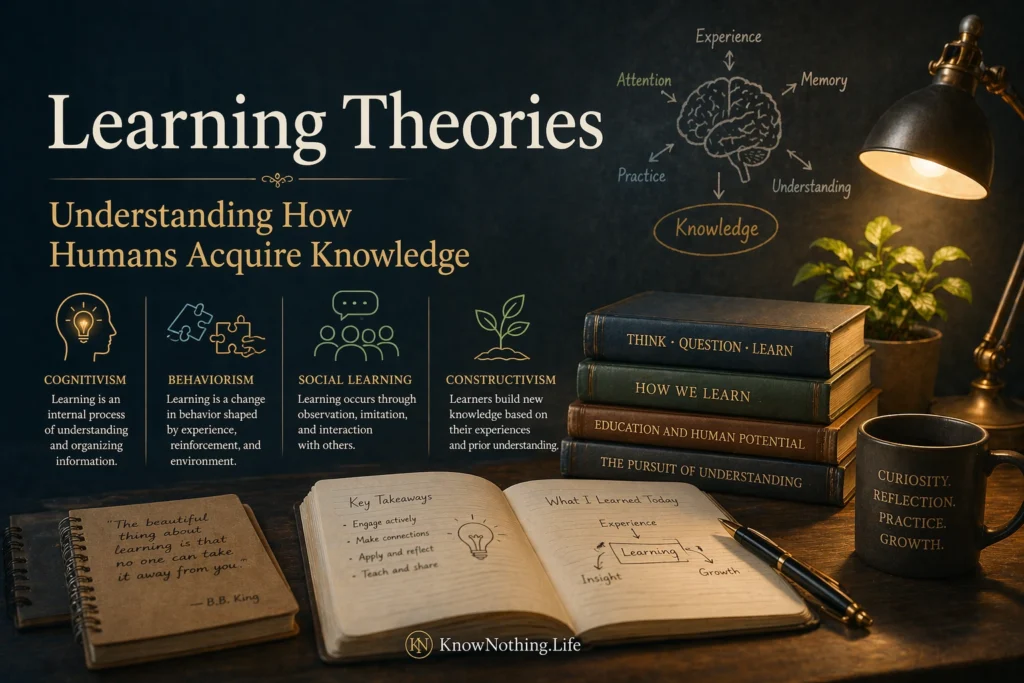
Learning theories seek to explain one of the most fundamental aspects of human existence: how we acquire knowledge, skills, behaviors, and understanding. These theories provide frameworks for interpreting how individuals process information, respond to environments, and develop intellectually over time. Far from being abstract philosophical models, learning theories shape real-world practices in education, psychology, and even technology, influencing how teaching is designed and how learning environments are structured.
Across history, scholars have approached learning from different angles, emphasizing behavior, cognition, social interaction, and experience. From the conditioning experiments of Ivan Pavlov to the cognitive insights of Jean Piaget, each perspective offers a distinct lens on how learning occurs. Together, these theories reveal that learning is not a single, uniform process but a complex and multifaceted phenomenon shaped by biological, psychological, and social factors.
Behaviorism: Learning as Observable Change
Behaviorism represents one of the earliest systematic approaches to understanding learning, focusing on observable behavior rather than internal mental states. According to behaviorists, learning is a process of forming associations between stimuli and responses, shaped by reinforcement and conditioning. This perspective emphasizes measurable outcomes, making it particularly influential in early educational and psychological research.
The work of Ivan Pavlov demonstrated how classical conditioning could produce learned responses through repeated associations. Building on this foundation, B. F. Skinner developed the theory of operant conditioning, which highlights the role of reinforcement and punishment in shaping behavior. Positive reinforcement encourages desired behaviors, while negative consequences discourage unwanted actions.
While behaviorism provides a clear and practical framework, it has been criticized for its limited focus on external behavior. By largely ignoring internal mental processes, it may overlook the complexity of human learning, particularly in areas such as problem-solving and creativity. Nevertheless, behaviorist principles continue to influence educational practices, especially in structured learning environments and skill-based training.
Cognitivism: The Mind as an Information Processor
Cognitivism emerged as a response to the limitations of behaviorism, shifting the focus from observable behavior to internal mental processes. This perspective views the mind as an active system that processes, organizes, and stores information. Learning, in this context, involves changes in knowledge structures rather than simply changes in behavior.
The contributions of Jean Piaget were central to the development of cognitive theory. Piaget proposed that individuals progress through stages of cognitive development, each characterized by different ways of thinking and understanding the world. His concepts of assimilation and accommodation describe how learners integrate new information into existing frameworks and adjust those frameworks when necessary.
Cognitivism emphasizes the importance of memory, attention, and problem-solving in learning. It has led to instructional strategies that focus on understanding rather than rote memorization, encouraging learners to actively engage with material. By highlighting the role of mental processes, cognitivism provides a more comprehensive account of learning, though it may still underemphasize the social and cultural dimensions of knowledge acquisition.
Constructivism: Learning as Active Construction
Constructivism builds on cognitive theory by emphasizing the active role of learners in constructing their own understanding. Rather than passively receiving information, individuals interpret and organize knowledge based on their experiences and prior knowledge. This perspective suggests that learning is inherently personal and context-dependent.
Philosophers and educators like John Dewey and Jean Piaget contributed to the development of constructivist ideas, highlighting the importance of experience and inquiry in learning. Dewey, in particular, argued that education should be rooted in real-life situations, allowing learners to explore and experiment in meaningful ways.
Constructivist approaches have influenced modern educational practices, promoting student-centered learning, collaborative activities, and problem-based instruction. While these methods can enhance engagement and understanding, they also require careful guidance to ensure that learners develop accurate and coherent knowledge. The challenge lies in balancing freedom with structure, allowing learners to explore while providing the support needed for effective learning.
Social Learning Theory: Learning Through Interaction
Social learning theory expands the scope of learning by emphasizing the role of social interaction and observation. According to this perspective, individuals learn not only through direct experience but also by observing others and modeling their behavior. This highlights the importance of context, relationships, and cultural influences in shaping learning.
The work of Albert Bandura was instrumental in developing this approach. Bandura’s concept of observational learning demonstrates how individuals can acquire new behaviors by watching others, particularly when those behaviors are rewarded. His theory also introduced the idea of self-efficacy, the belief in one’s ability to succeed, which plays a crucial role in motivation and learning.
Social learning theory bridges the gap between behaviorist and cognitive perspectives, acknowledging both external influences and internal processes. It has important implications for education, suggesting that learning environments should foster collaboration, mentorship, and positive role models. By recognizing the social nature of learning, this approach provides a more holistic understanding of how knowledge and behavior are developed.
Humanistic Theories: Learning and Self-Actualization
Humanistic learning theories focus on the individual as a whole, emphasizing personal growth, self-awareness, and the pursuit of meaning. Unlike more mechanistic approaches, humanistic theories view learning as a process of becoming, where individuals strive to realize their potential and achieve self-fulfillment.
Thinkers such as Abraham Maslow and Carl Rogers played key roles in shaping this perspective. Maslow’s hierarchy of needs suggests that learning is influenced by the fulfillment of basic needs, with higher-level learning occurring when individuals feel secure and valued. Rogers emphasized the importance of a supportive and empathetic learning environment, where learners feel free to explore and express themselves.
Humanistic approaches highlight the emotional and motivational aspects of learning, often overlooked in other theories. They have inspired educational practices that prioritize student well-being, autonomy, and intrinsic motivation. However, critics argue that these approaches may lack the structure needed for certain types of learning, particularly in highly technical or disciplined fields.
Experiential Learning: Learning Through Experience
Experiential learning emphasizes the role of direct experience in the learning process. According to this perspective, knowledge is constructed through interaction with the environment, reflection on experiences, and the application of insights to new situations. This approach integrates elements of cognition, action, and reflection, creating a dynamic cycle of learning.
The work of John Dewey laid the foundation for experiential learning, highlighting the importance of active engagement and reflection. Later theorists expanded on these ideas, developing models that describe learning as a continuous process of experience, reflection, conceptualization, and experimentation.
Experiential learning has significant implications for education and professional development, encouraging hands-on activities, real-world problem-solving, and reflective practice. By connecting theory and practice, it helps learners develop deeper understanding and transferable skills. However, it also requires careful design to ensure that experiences lead to meaningful learning rather than superficial engagement.
Integrating Learning Theories
While each learning theory offers valuable insights, no single perspective fully captures the complexity of learning. Behaviorism, cognitivism, constructivism, social learning, humanistic approaches, and experiential learning each emphasize different aspects of the process. Integrating these perspectives can provide a more comprehensive understanding, allowing educators and researchers to draw on multiple approaches.
For example, behaviorist techniques may be effective for developing foundational skills, while cognitive and constructivist approaches support deeper understanding and critical thinking. Social and humanistic theories highlight the importance of context, relationships, and motivation, ensuring that learning is both meaningful and engaging. By combining these insights, educators can create more effective and adaptable learning environments.
This integrative approach reflects the evolving nature of educational theory, recognizing that learning is influenced by a wide range of factors. It also underscores the importance of flexibility and responsiveness, allowing teaching methods to adapt to different learners, contexts, and goals.
The Future of Learning Theories
As technology and society continue to evolve, learning theories are being reexamined and expanded. Digital environments, artificial intelligence, and online learning platforms are transforming how knowledge is accessed and shared, raising new questions about the nature of learning and the role of educators.
These developments challenge traditional assumptions, emphasizing the need for lifelong learning and adaptability. Learners must navigate vast amounts of information, evaluate sources critically, and apply knowledge in diverse contexts. This requires a shift from static models of learning to more dynamic and flexible frameworks.
At the same time, the core insights of traditional learning theories remain relevant. Understanding how individuals learn continues to be essential for designing effective educational systems and supporting personal development. The future of learning theory lies in its ability to integrate new technologies with enduring principles, ensuring that it remains responsive to changing needs.
Final Thoughts
Learning theories provide essential frameworks for understanding how individuals acquire knowledge and develop skills. From behaviorist models of conditioning to constructivist and humanistic approaches, each theory offers a unique perspective on the learning process.
Together, these perspectives reveal the richness and complexity of learning, highlighting the interplay between behavior, cognition, experience, and social interaction. By engaging with these theories, educators and learners can better understand the processes that shape knowledge and growth.
Ultimately, learning is not a single pathway but a multifaceted journey. By drawing on the insights of diverse theories, we can create environments that support meaningful, effective, and transformative learning experiences.