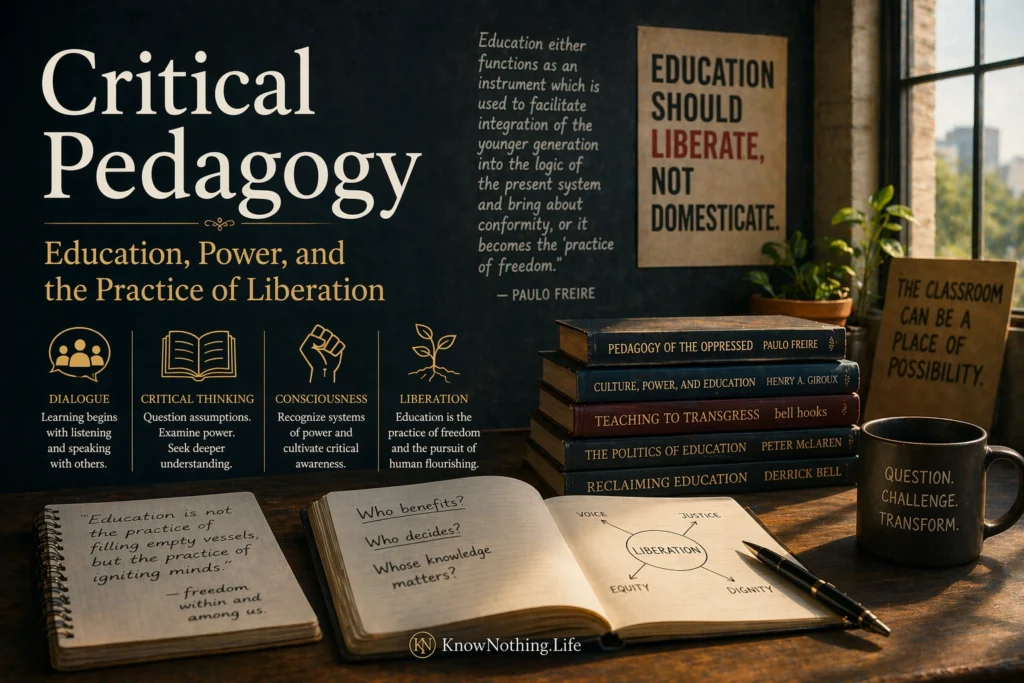
Critical pedagogy is a philosophical and educational movement that examines how education is shaped by power, ideology, and social structures, and how it can be transformed into a tool for liberation. Rather than treating education as a neutral process of knowledge transmission, critical pedagogy argues that schools are deeply embedded in political and cultural systems that influence what is taught, how it is taught, and whose voices are heard. It asks a fundamental question: does education reinforce existing inequalities, or can it challenge and change them?
The roots of critical pedagogy are often traced to the work of Paulo Freire, whose ideas about education as a practice of freedom reshaped how educators understand teaching and learning. Freire’s emphasis on dialogue, critical consciousness, and the relationship between knowledge and power continues to influence contemporary educational theory. Critical pedagogy extends beyond classrooms, offering a broader critique of society and a vision for more just and equitable forms of learning.
The Foundations of Critical Pedagogy
At its core, critical pedagogy is grounded in the belief that education is inherently political. Every curriculum, teaching method, and institutional structure reflects particular values and interests, often aligned with dominant social groups. This perspective challenges the assumption that education is objective or neutral, revealing how it can perpetuate existing inequalities.
Critical pedagogy draws on a range of intellectual traditions, including Marxist theory, critical theory, and postcolonial thought. Influenced by thinkers like Karl Marx, it emphasizes the role of economic and social structures in shaping human experience. Education, from this perspective, is not separate from society but a key site where power relations are reproduced and contested.
This foundational insight leads to a rethinking of the purpose of education. Rather than simply preparing individuals to fit into existing systems, critical pedagogy seeks to empower learners to question, critique, and transform those systems. It positions education as a space for developing awareness and agency, enabling individuals to engage with the world in a more reflective and transformative way.
The Banking Model vs. Dialogical Education
One of the most influential concepts in critical pedagogy is Paulo Freire’s critique of the “banking model” of education. In this model, students are treated as passive recipients of knowledge, with teachers depositing information into their minds. Learning becomes a process of memorization and repetition, reinforcing hierarchical relationships between teacher and student.
Freire argued that this approach not only limits intellectual development but also mirrors and sustains oppressive social structures. By positioning students as passive, it discourages critical thinking and reinforces dependency on authority. The banking model, in this sense, is not merely ineffective but actively harmful, as it prevents learners from developing the capacity to question and challenge the world around them.
In contrast, Freire proposed a dialogical model of education, where learning is based on dialogue, collaboration, and mutual respect. Teachers and students engage in a shared process of inquiry, exploring ideas and experiences together. This approach fosters critical consciousness, or conscientização, enabling learners to recognize and challenge the forces that shape their lives. Dialogue becomes a means of both understanding and transformation, reshaping the educational experience.
Critical Consciousness and Empowerment
Central to critical pedagogy is the concept of critical consciousness—the ability to perceive and analyze social, political, and economic contradictions and to take action against oppressive elements of reality. Education, in this framework, is not just about acquiring knowledge but about developing the capacity to understand and change the world.
Critical consciousness involves moving beyond surface-level understanding to examine underlying structures and assumptions. It requires learners to question dominant narratives, recognize power dynamics, and consider alternative perspectives. This process can be transformative, reshaping how individuals see themselves and their place in society.
Empowerment is a key outcome of this process. By developing critical awareness, learners gain the tools needed to act as agents of change. This does not necessarily mean engaging in overt political action but includes the ability to make informed decisions, challenge injustice, and contribute to more equitable social arrangements. Critical pedagogy thus links education with broader goals of social transformation.
The Role of the Teacher
In critical pedagogy, the role of the teacher is fundamentally redefined. Rather than acting as an authority figure who transmits knowledge, the teacher becomes a facilitator of dialogue and a co-learner in the educational process. This shift reflects a broader commitment to equality and mutual respect within the classroom.
Teachers are encouraged to create environments where students feel valued and empowered to express their ideas. This involves recognizing the diverse experiences and perspectives that learners bring to the classroom and integrating them into the learning process. Education becomes a collaborative endeavor, where knowledge is constructed through interaction rather than imposed from above.
At the same time, the teacher retains an important role in guiding and supporting learning. Critical pedagogy does not eliminate expertise but repositions it within a more democratic framework. Teachers help students navigate complex ideas, develop critical skills, and engage with challenging material, balancing structure with openness.
Curriculum, Culture, and Power
Critical pedagogy also examines the content of education, questioning whose knowledge is represented and whose is marginalized. Traditional curricula often reflect the perspectives of dominant cultural groups, excluding or minimizing alternative voices. This can reinforce existing inequalities and limit students’ understanding of the world.
By incorporating diverse perspectives and experiences, critical pedagogy seeks to create a more inclusive and representative curriculum. This involves not only adding new content but also reexamining existing material to uncover hidden assumptions and biases. Education becomes a site of cultural negotiation, where different viewpoints are explored and valued.
This approach highlights the connection between knowledge and power. What is taught in schools shapes how individuals understand history, society, and themselves. By critically examining curriculum, educators can challenge dominant narratives and open space for more inclusive and equitable forms of knowledge.
Criticisms and Challenges
Despite its influence, critical pedagogy has faced criticism from various perspectives. Some argue that it can become overly ideological, prioritizing political goals over academic rigor. Critics worry that emphasizing social critique may lead to biased teaching or undermine the objectivity of education.
Others point to practical challenges in implementing critical pedagogy. Creating truly dialogical and participatory learning environments requires time, resources, and training, which may not always be available. Additionally, educational systems are often constrained by standardized curricula and assessment methods, limiting the scope for transformative approaches.
There are also debates about the balance between critique and construction. While critical pedagogy excels at identifying problems and injustices, it must also offer constructive pathways for change. Addressing these challenges requires ongoing reflection and adaptation, ensuring that critical pedagogy remains both effective and relevant.
Critical Pedagogy in Contemporary Context
In the modern world, critical pedagogy continues to evolve in response to new challenges and opportunities. Issues such as globalization, digital media, and social inequality have expanded the scope of critical inquiry, requiring educators to address increasingly complex and interconnected problems.
The rise of digital technology, for example, has transformed how information is accessed and shared, raising questions about media literacy and the role of education in navigating digital environments. Critical pedagogy provides tools for analyzing these developments, encouraging learners to question sources, evaluate information, and understand the broader implications of technology.
At the same time, movements for social justice have renewed interest in the transformative potential of education. Critical pedagogy offers a framework for engaging with issues such as inequality, discrimination, and environmental sustainability, linking education with broader efforts to create a more just and equitable world.
Final Thoughts
Critical pedagogy represents a powerful reimagining of education, challenging traditional assumptions and emphasizing the role of learning in shaping society. By focusing on dialogue, critical consciousness, and empowerment, it transforms education from a passive process into an active and participatory practice.
While it faces challenges and criticisms, its core insights remain highly relevant. Education is not merely about knowledge but about power, identity, and possibility. By engaging with these dimensions, critical pedagogy opens new pathways for understanding and change.
Ultimately, critical pedagogy invites us to rethink what education can be. It challenges us to move beyond conformity and toward transformation, creating learning environments that not only reflect the world but also have the potential to reshape it.