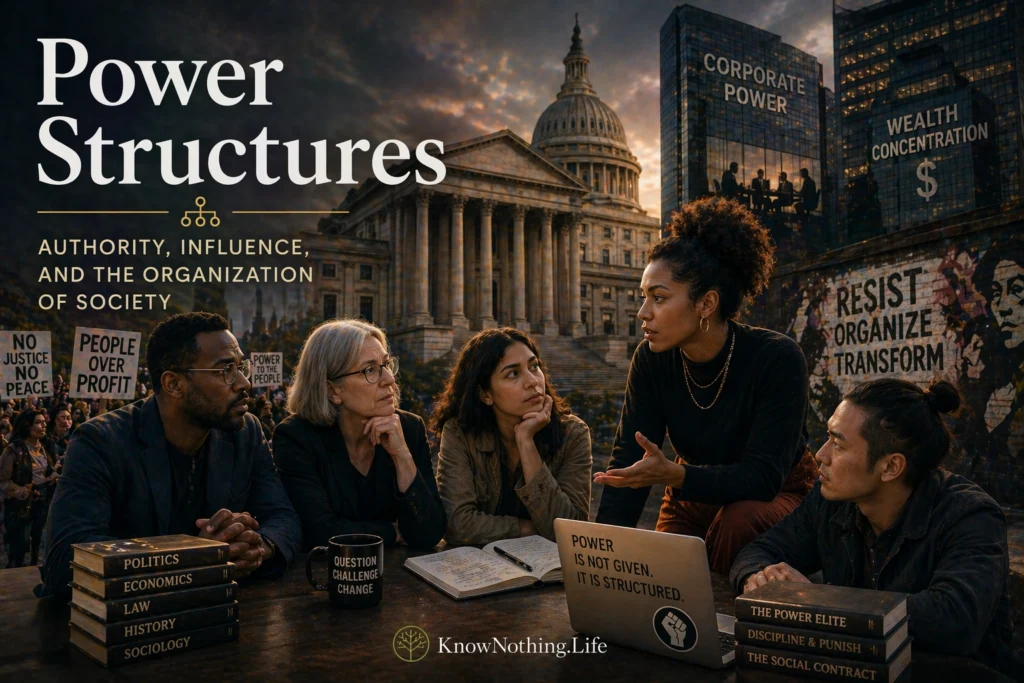
Power structures are the systems and relationships through which authority, influence, and control are exercised within societies. They shape how decisions are made, how resources are distributed, and how individuals and groups interact. Power is not confined to formal institutions such as governments or corporations; it permeates social life, influencing norms, behaviors, and identities in subtle and often invisible ways. Understanding power structures is essential for analyzing inequality, governance, and social change.
Philosophically, power structures raise fundamental questions about legitimacy, justice, and freedom. Who has the right to exercise power, and under what conditions is it justified? How do power dynamics influence knowledge and perception? Can power be distributed more equitably, or is inequality an inevitable feature of social organization? By examining these questions, the study of power structures reveals the underlying mechanisms that shape human societies and the possibilities for transforming them.
Classical Foundations of Power
Philosophical reflection on power dates back to ancient thought, where questions of authority and governance were central concerns. In classical Greece, Plato explored the idea of rule by philosopher-kings, suggesting that those with knowledge and wisdom are best suited to govern. This perspective links power to expertise, emphasizing the importance of rational authority.
Aristotle offered a more practical approach, analyzing different forms of government and their implications for justice. He distinguished between rule for the common good and rule for private interest, highlighting the ethical dimensions of power. These early discussions established a foundation for understanding the relationship between authority and legitimacy.
In the early modern period, Thomas Hobbes presented a stark view of power as necessary for maintaining order. In his account, individuals in a state of nature are driven by self-interest, leading to conflict and instability. To avoid chaos, they establish a sovereign authority with the power to enforce laws. This perspective emphasizes the role of power in securing stability, even at the cost of individual freedom.
Power and Legitimacy
A central issue in the study of power structures is legitimacy—the justification of authority. Power can be exercised through force or coercion, but legitimacy involves the recognition and acceptance of authority as rightful. Philosophers have explored the conditions under which power becomes legitimate, linking it to concepts such as consent, justice, and fairness.
John Locke argued that legitimate power arises from the consent of the governed. According to this view, individuals grant authority to institutions in exchange for the protection of their rights. This framework has been highly influential in shaping modern democratic systems, emphasizing accountability and the rule of law.
In contrast, Max Weber identified different types of legitimate authority, including traditional, charismatic, and legal-rational forms. Weber’s analysis highlights the ways in which power can be justified and maintained, reflecting the complexity of social organization. Understanding legitimacy is essential for evaluating power structures and their impact on society.
Power, Knowledge, and Discourse
One of the most influential modern approaches to power comes from Michel Foucault, who redefined power as a pervasive and relational force rather than a centralized possession. Foucault argued that power operates through knowledge and discourse, shaping what is considered true, normal, or acceptable. This perspective shifts the focus from overt control to the subtle ways in which power influences thought and behavior.
According to Foucault, institutions such as schools, hospitals, and prisons play a key role in producing and maintaining power structures. They establish norms and categories that define individuals, influencing how people understand themselves and others. This process is not merely restrictive but also productive, creating forms of knowledge and identity.
The connection between power and knowledge raises important philosophical questions about objectivity and truth. If knowledge is shaped by power, how can it be evaluated independently? Foucault’s analysis challenges traditional notions of neutrality, suggesting that understanding power requires examining the systems that produce knowledge itself.
Social Hierarchies and Inequality
Power structures often manifest as social hierarchies, where certain groups hold more influence and resources than others. These hierarchies can be based on factors such as class, race, gender, and economic status, creating patterns of privilege and disadvantage. Philosophical analysis seeks to understand how these hierarchies are formed and maintained.
The concept of structural inequality highlights how power operates at a systemic level. Inequality is not merely the result of individual actions but is embedded in institutions and practices that shape opportunities and outcomes. Philosophers examine how these structures can be challenged and reformed to promote greater fairness.
Karl Marx provided a critical analysis of power in relation to economic systems, arguing that control over resources leads to dominance over labor and social life. His work emphasizes the role of economic structures in shaping power dynamics, highlighting the connection between material conditions and social relations. This perspective continues to influence discussions of inequality and social justice.
Power and Resistance
While power structures can be pervasive and entrenched, they are not absolute. Resistance is an essential aspect of power dynamics, as individuals and groups challenge existing systems and seek change. Philosophers explore how resistance emerges and what forms it can take, from individual acts of defiance to collective movements for social transformation.
Foucault’s analysis of power includes the idea that where there is power, there is resistance. This suggests that power is not a one-sided force but a dynamic relationship involving multiple actors. Resistance can take many forms, including protest, reform, and the creation of alternative structures.
The study of resistance also raises questions about effectiveness and ethics. What strategies are most effective in challenging power, and what moral considerations should guide these efforts? Understanding resistance is crucial for exploring the possibilities of social change and the transformation of power structures.
Power in Contemporary Context
In the modern world, power structures have become increasingly complex, shaped by globalization, technology, and interconnected systems. Governments, corporations, and international organizations all play roles in shaping global dynamics, influencing economic, political, and cultural outcomes.
Technology, in particular, has transformed the nature of power. Digital platforms and data systems enable new forms of influence and control, raising questions about privacy, surveillance, and autonomy. These developments highlight the need for ongoing philosophical analysis, as traditional frameworks may not fully capture the implications of new technologies.
Contemporary discussions of power also emphasize the importance of inclusivity and representation. Efforts to address inequality focus on creating more equitable systems that reflect diverse perspectives. This involves rethinking existing structures and exploring new models of governance and participation.
Conclusion
Power structures are fundamental to the organization of society, shaping how authority is exercised and how resources are distributed. Philosophical inquiry reveals that power is not a simple or static phenomenon but a complex and dynamic system involving relationships, institutions, and ideas. Understanding power requires examining its sources, its justifications, and its effects.
The study of power structures highlights the importance of legitimacy, fairness, and accountability. It reveals how inequalities are produced and maintained, as well as how they can be challenged. By analyzing power, philosophy provides tools for understanding and addressing the conditions that shape human life.
Ultimately, power structures are not fixed but subject to change. Through critical reflection and collective action, individuals and societies can transform the systems that govern them. The philosophy of power thus offers not only insight but also the possibility of a more just and equitable world.