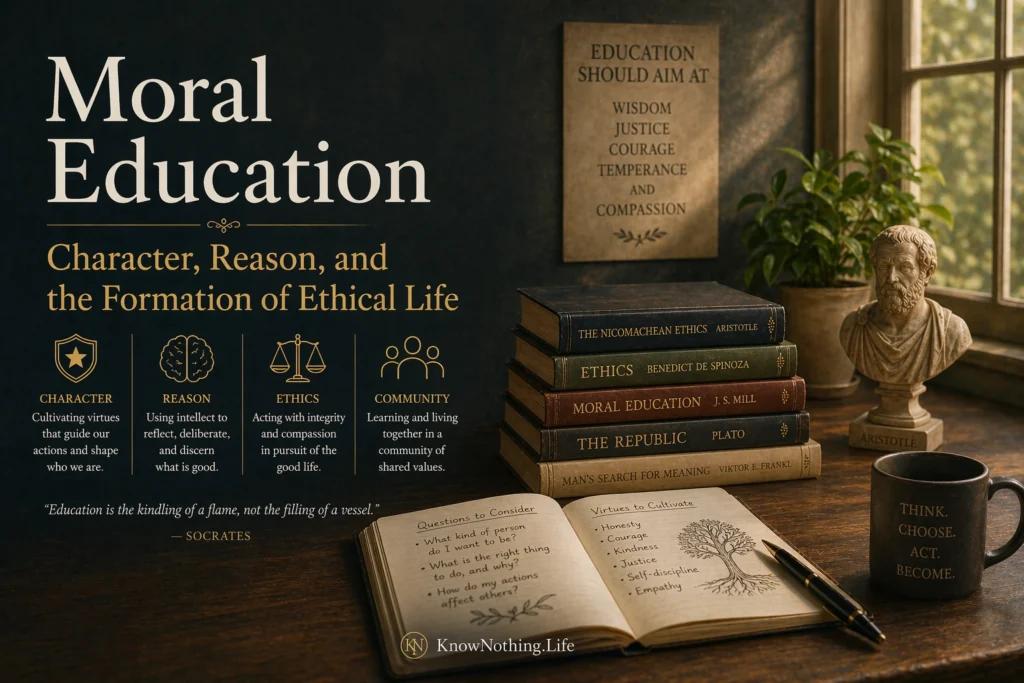
Moral education addresses one of the most enduring aims of human development: the cultivation of individuals who can think ethically, act responsibly, and contribute to the well-being of others. While education is often associated with the transmission of knowledge and skills, it has always carried a deeper purpose—shaping the values, dispositions, and judgments that guide behavior. Moral education, in this sense, is not an optional supplement but a central dimension of what it means to educate.
The philosophical roots of moral education stretch back to antiquity, where thinkers like Aristotle viewed ethical development as essential to human flourishing. In modern philosophy, figures such as Immanuel Kant emphasized the role of reason and autonomy in moral life. These traditions offer differing but complementary perspectives on how individuals come to understand right and wrong, and how education can support that process. Together, they reveal moral education as a complex interplay of reasoning, habit, emotion, and social context.
The Aims of Moral Education
At its core, moral education seeks to develop individuals who are capable of making sound ethical judgments and acting upon them. This involves more than teaching rules or codes of conduct; it requires fostering an understanding of moral principles and the ability to apply them in diverse situations. The aim is not simply conformity but the cultivation of moral agency—the capacity to think critically about ethical issues and to act with integrity.
Different philosophical traditions articulate these aims in distinct ways. For Aristotle, moral education was about developing virtues—stable dispositions that enable individuals to act appropriately across a range of circumstances. Virtue, in this sense, is acquired through practice and habituation, suggesting that moral education must involve lived experience as well as instruction.
In contrast, Immanuel Kant emphasized the importance of rational autonomy. For Kant, moral education should cultivate the ability to act according to principles that can be universally justified, rather than simply following external authority. This perspective highlights the role of reasoning and reflection in ethical development, suggesting that moral education must engage both the intellect and the will.
Moral Development and Psychological Perspectives
Philosophical accounts of moral education are complemented by psychological theories that explore how moral understanding develops over time. These perspectives provide insight into the stages and processes through which individuals acquire ethical awareness, offering practical guidance for educational practice.
One influential account comes from Lawrence Kohlberg, who proposed a stage-based theory of moral development. According to Kohlberg, individuals progress through levels of moral reasoning, from a focus on punishment and reward to an understanding of social norms and, eventually, to principled reasoning based on universal ethical principles. This framework suggests that moral education should be tailored to the developmental stage of the learner, encouraging progression toward more sophisticated forms of reasoning.
Other psychologists, such as Carol Gilligan, have critiqued and expanded these models, emphasizing the role of relationships, care, and context in moral development. Gilligan’s work highlights the importance of empathy and interpersonal understanding, suggesting that moral education must address not only abstract reasoning but also emotional and relational dimensions of ethical life.
Virtue, Character, and Habituation
The concept of virtue remains central to many approaches to moral education. Virtue ethics, rooted in the work of Aristotle, emphasizes the development of character traits such as honesty, courage, and compassion. These traits are not innate but are cultivated through practice, guidance, and reflection.
Habituation plays a key role in this process. By repeatedly engaging in virtuous actions, individuals develop stable dispositions that shape their behavior. This suggests that moral education must involve more than theoretical instruction; it requires opportunities for practice and reinforcement in real-life contexts. Schools, families, and communities all contribute to this process, providing environments in which virtues can be developed and sustained.
At the same time, virtue-based approaches must address the challenge of diversity in values and cultural contexts. What counts as a virtue may vary across societies, raising questions about how moral education can balance universality with cultural specificity. This tension underscores the need for dialogue and critical reflection within moral education.
Moral Reasoning and Ethical Inquiry
In addition to character formation, moral education involves the development of reasoning and inquiry. Individuals must learn to analyze ethical dilemmas, consider different perspectives, and justify their decisions. This aspect of moral education aligns closely with philosophical inquiry, encouraging critical thinking and reflection.
Ethical inquiry often involves grappling with complex and ambiguous situations, where there are no clear or universally accepted answers. By engaging with such challenges, learners develop the ability to navigate moral uncertainty and to make informed, thoughtful decisions. This process fosters intellectual humility and openness, recognizing that moral understanding is often provisional and subject to revision.
Philosophical dialogue can play a valuable role in this context, providing a space for discussion and exploration. Through dialogue, learners can encounter diverse viewpoints, test their assumptions, and refine their understanding. This approach emphasizes the collaborative nature of moral learning, highlighting the importance of communication and shared inquiry.
The Role of Emotion and Empathy
Moral education is not solely a matter of reasoning; it also involves the development of emotional capacities such as empathy, compassion, and sensitivity to others. These qualities enable individuals to connect with others and to respond appropriately to their needs and experiences.
Empathy, in particular, plays a crucial role in ethical life. By understanding and sharing the feelings of others, individuals are better equipped to act in ways that promote well-being and avoid harm. Moral education must therefore address the emotional dimension of human experience, fostering the ability to recognize and respond to the perspectives of others.
This emphasis on emotion complements rather than replaces rational approaches. Effective moral education integrates both aspects, recognizing that ethical behavior arises from the interaction of thought and feeling. By cultivating both empathy and reasoning, education can support more holistic and effective moral development.
Moral Education in Social Context
Moral education takes place within social and cultural contexts that shape its content and practice. Schools, families, and communities all contribute to the formation of moral values, reflecting broader societal norms and expectations. This raises questions about the relationship between individual autonomy and social influence in moral development.
Educational institutions often serve as microcosms of society, where individuals learn to interact with others, resolve conflicts, and navigate diverse perspectives. These experiences provide opportunities for moral learning, reinforcing the importance of social context in ethical development. At the same time, they can also expose tensions and challenges, such as inequality and bias, that require critical engagement.
Understanding the social dimension of moral education highlights the need for inclusive and equitable practices. By addressing issues of fairness, respect, and diversity, education can promote a more just and cohesive society. This perspective underscores the broader significance of moral education as a foundation for social life.
Challenges and Contemporary Debates
Moral education faces a range of challenges in contemporary society, including cultural diversity, secularism, and differing views about the role of education in shaping values. In pluralistic societies, there may be disagreement about which values should be emphasized, raising questions about neutrality and inclusivity.
Some argue that schools should focus on universal principles, such as respect for persons and fairness, while avoiding more contentious issues. Others contend that moral education must engage directly with social and political questions, encouraging critical reflection on issues such as justice and inequality. These debates reflect broader tensions about the purpose and scope of education.
Technological and social changes also present new challenges. Issues such as digital communication, environmental responsibility, and global interdependence require new forms of ethical understanding. Moral education must adapt to these changing conditions, ensuring that individuals are prepared to navigate complex and evolving moral landscapes.
Final Thoughts
Moral education is a central and indispensable aspect of human development, shaping the ways in which individuals think, feel, and act in relation to others. By integrating philosophical insights with psychological understanding, it offers a comprehensive framework for cultivating ethical life.
The diversity of approaches—ranging from virtue ethics to rational autonomy and care-based perspectives—reflects the complexity of moral development. Each contributes valuable insights, highlighting different dimensions of ethical growth. Together, they underscore the need for a balanced and holistic approach to moral education.
Ultimately, moral education is about more than teaching right and wrong; it is about fostering the capacities that enable individuals to live well and contribute to the common good. By engaging with its philosophical foundations, we can better understand how to support this process, creating educational practices that nurture both individual integrity and collective well-being.