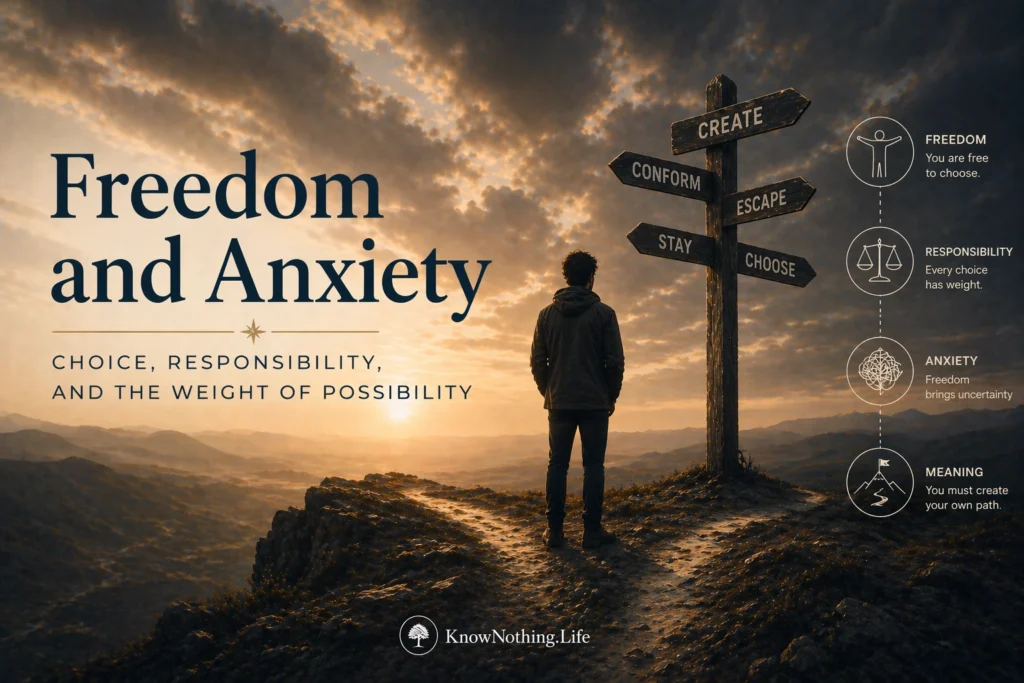
Freedom is often celebrated as one of the highest human values—the ability to choose, to act, and to shape one’s own life. Yet alongside this ideal lies a less comfortable companion: anxiety. The recognition of freedom does not merely open possibilities; it also introduces uncertainty, responsibility, and the burden of decision. The relationship between freedom and anxiety reveals a central tension in human existence, where the very condition that enables self-determination also generates unease.
Philosophers such as Søren Kierkegaard, Martin Heidegger, and Jean-Paul Sartre explored this connection in depth, arguing that anxiety is not merely a psychological disturbance but a fundamental feature of being human. Rather than viewing anxiety as something to eliminate, they understood it as a revealing experience—one that exposes the nature of freedom and the responsibilities it entails.
The Nature of Freedom
Freedom, in its most basic sense, refers to the capacity to make choices and to act according to one’s will. However, philosophical discussions of freedom go beyond simple definitions, examining the conditions under which individuals can truly be considered free. Is freedom merely the absence of external constraints, or does it involve deeper forms of autonomy and self-determination?
For existential philosophers like Jean-Paul Sartre, freedom is not a property that individuals possess but a condition of existence. Human beings are always free in the sense that they must choose how to respond to their circumstances, even when those circumstances are restrictive. This view challenges the idea that freedom is something that can be gained or lost; instead, it is an unavoidable aspect of being human.
At the same time, freedom is not limitless. Social, cultural, and biological factors shape the range of available choices, influencing how freedom is experienced. Understanding freedom requires recognizing both its possibilities and its constraints, highlighting the complexity of human agency.
Anxiety as the Awareness of Possibility
Anxiety arises when individuals become aware of their freedom and the possibilities it entails. Unlike fear, which is directed toward specific threats, anxiety is more diffuse, reflecting the open-ended nature of existence. It is the feeling that accompanies the recognition that one’s life is not predetermined and that multiple paths are always available.
Søren Kierkegaard famously described anxiety as the “dizziness of freedom.” This metaphor captures the sense of vertigo that can occur when individuals confront the vastness of their possibilities. The realization that one can choose differently, that one’s life could take radically different directions, can be both exhilarating and overwhelming.
This form of anxiety is not inherently negative. It reveals the depth of human freedom and the potential for self-creation. However, it also introduces uncertainty, as there is no guarantee that one’s choices will lead to desired outcomes. The tension between possibility and uncertainty lies at the heart of existential anxiety.
Responsibility and the Burden of Choice
Freedom is inseparable from responsibility. To choose is to take ownership of one’s actions and their consequences, a task that can be both empowering and burdensome. The recognition that one’s decisions shape one’s life—and, in some cases, the lives of others—adds weight to the act of choosing.
Jean-Paul Sartre emphasized that individuals are “condemned to be free,” meaning that they cannot escape the responsibility that comes with freedom. Even refusing to choose is itself a choice, and individuals cannot avoid the implications of their actions. This perspective highlights the inescapable nature of responsibility in human life.
The burden of choice can lead to what existentialists call “anguish,” a deep form of anxiety that arises from the awareness of responsibility. This anguish is not simply a reaction to difficult decisions but a recognition of the broader implications of freedom. It reflects the understanding that one’s choices contribute to the shaping of one’s identity and, in a broader sense, to the human condition.
Bad Faith and the Avoidance of Freedom
Faced with the anxiety of freedom, individuals may seek ways to avoid or deny their responsibility. Jean-Paul Sartre described this tendency as “bad faith,” a form of self-deception in which individuals pretend that they are not truly free. By attributing their actions to external forces or fixed roles, they attempt to escape the burden of choice.
Bad faith can take many forms, from rigid adherence to social expectations to the belief that one’s identity is fixed and unchangeable. While these strategies may provide temporary relief from anxiety, they ultimately limit the individual’s capacity for authentic living. By denying freedom, individuals also deny the possibility of self-creation and growth.
Recognizing and overcoming bad faith is a key aspect of existential philosophy. It involves confronting the reality of one’s freedom and accepting the responsibility that comes with it. This process is challenging, as it requires individuals to face the very anxiety they may wish to avoid.
Authenticity and the Embrace of Anxiety
Authenticity offers an alternative to the avoidance of freedom. To live authentically is to acknowledge one’s freedom and to act in accordance with values that one has consciously chosen. This does not eliminate anxiety but integrates it into the experience of living.
For Martin Heidegger, anxiety plays a crucial role in revealing authentic existence. In moments of anxiety, individuals are confronted with the reality of their being, stripped of the distractions and conventions that often obscure it. This experience can prompt a reevaluation of priorities and a deeper engagement with life.
Authenticity involves embracing the uncertainties and challenges of freedom rather than seeking to eliminate them. It requires a willingness to act without absolute guarantees, trusting in one’s capacity to navigate the complexities of existence. In this sense, anxiety becomes not a barrier but a gateway to more genuine living.
Freedom, Anxiety, and Modern Life
In contemporary society, the relationship between freedom and anxiety is particularly pronounced. The expansion of personal choice in areas such as career, relationships, and identity has created new opportunities for self-determination. At the same time, it has increased the complexity of decision-making, leading to heightened levels of anxiety.
The abundance of options can create what some psychologists describe as “choice overload,” where the difficulty of making decisions leads to stress and dissatisfaction. This phenomenon reflects the paradox of freedom: while more choices can enhance autonomy, they can also intensify the burden of responsibility.
Modern life also introduces new sources of anxiety, including social expectations, economic pressures, and the rapid pace of change. Navigating these challenges requires not only practical skills but also an understanding of the deeper dynamics of freedom and anxiety. Philosophical insights can provide valuable tools for addressing these issues, offering a framework for interpreting and responding to the complexities of contemporary life.
Psychological Perspectives on Anxiety
While existential philosophy provides a conceptual understanding of anxiety, psychological perspectives offer insights into its mechanisms and effects. Anxiety can manifest in various forms, from mild unease to severe distress, influencing both mental and physical well-being.
Psychologists emphasize the importance of coping strategies and emotional regulation in managing anxiety. Techniques such as mindfulness, cognitive restructuring, and social support can help individuals navigate the challenges associated with freedom and responsibility. These approaches complement philosophical insights, providing practical tools for addressing anxiety.
At the same time, psychological perspectives recognize that anxiety is not always pathological. In many cases, it serves as a signal, drawing attention to important issues or decisions. By understanding anxiety as both a challenge and a resource, individuals can develop more balanced and effective responses.
The Transformative Potential of Anxiety
Despite its often negative connotations, anxiety has the potential to be transformative. By confronting the realities of freedom and responsibility, individuals can develop greater self-awareness and resilience. This process involves moving beyond avoidance and engaging with the deeper questions that anxiety raises.
Existential philosophers viewed anxiety as an opportunity for growth, a moment in which individuals can reassess their lives and make more intentional choices. Rather than seeking to eliminate anxiety entirely, they encouraged individuals to understand and integrate it into their experience.
This transformative potential highlights the dual nature of anxiety. It can be a source of distress, but it can also serve as a catalyst for reflection and change. By engaging with anxiety in a constructive way, individuals can deepen their understanding of themselves and their place in the world.
Final Thoughts
The relationship between freedom and anxiety reveals a fundamental aspect of human existence. Freedom provides the capacity for choice and self-determination, while anxiety reflects the weight of that capacity. Together, they shape the experience of being human, highlighting both the possibilities and challenges of living.
Philosophical and psychological perspectives offer complementary insights into this relationship, emphasizing the importance of awareness, responsibility, and engagement. By understanding freedom and anxiety as interconnected, individuals can navigate their lives with greater clarity and intention.
Ultimately, the challenge is not to eliminate anxiety but to learn from it. By embracing the realities of freedom and responsibility, individuals can transform anxiety into a source of growth and authenticity, creating lives that are both meaningful and deeply human.