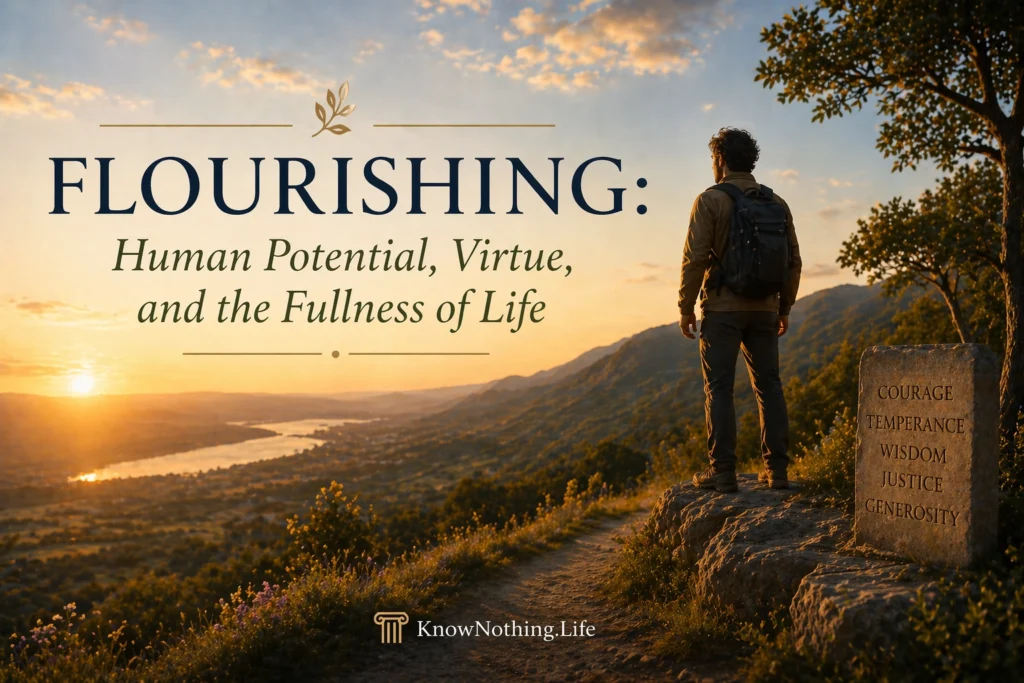
Flourishing is a central concept in philosophy, capturing the idea of living well in a deep and comprehensive sense. It goes beyond momentary happiness or satisfaction, referring instead to the full realization of human potential. To flourish is to develop one’s capacities, engage meaningfully with the world, and achieve a state of well-being that reflects both internal harmony and external success. This concept, often associated with the Greek term eudaimonia, has shaped philosophical discussions of the good life for centuries.
The idea of flourishing raises fundamental questions about human nature and value. What does it mean to live fully? Is flourishing determined by personal achievement, moral character, relationships, or some combination of these factors? Philosophers have offered diverse answers, reflecting different views of what it means to be human. By exploring these perspectives, the concept of flourishing provides a framework for understanding how individuals can lead meaningful and fulfilling lives.
Ancient Foundations of Flourishing
The philosophical roots of flourishing can be traced to ancient Greek thought, particularly the work of Aristotle. Aristotle’s concept of eudaimonia is often translated as flourishing, emphasizing a life of activity in accordance with virtue. For Aristotle, flourishing is not a passive state but an ongoing process of living well, guided by reason and shaped by moral and intellectual excellence.
Aristotle argued that every being has a function, and the good for that being consists in fulfilling its function effectively. For humans, this function involves rational activity, as reason distinguishes humans from other forms of life. Flourishing, therefore, is achieved through the cultivation and exercise of rational capacities, supported by the development of virtues such as courage, justice, and wisdom.
This ancient framework highlights the importance of balance and harmony. Flourishing requires the integration of different aspects of life, including thought, emotion, and action. It also emphasizes the role of community, as individuals achieve their potential within a social context. These ideas have had a lasting influence on philosophical discussions of well-being, shaping how flourishing is understood in both historical and contemporary contexts.
Virtue and Character Development
Virtue is a cornerstone of the concept of flourishing. According to Aristotle and subsequent virtue ethicists, flourishing depends on the development of stable character traits that enable individuals to act and feel appropriately. These virtues are not innate but cultivated through practice, reflection, and habituation. Over time, they shape how individuals perceive and respond to the world, guiding behavior in a consistent and meaningful way.
The development of virtue involves finding a balance between extremes. Each virtue represents a mean between excess and deficiency, reflecting the idea that flourishing requires moderation and judgment. Courage, for example, lies between recklessness and cowardice, while generosity lies between extravagance and stinginess. By cultivating these virtues, individuals create a foundation for a stable and fulfilling life.
Character development also involves aligning emotions with reason. A flourishing individual does not merely act rightly but feels appropriately, experiencing emotions that are proportionate and well-directed. This integration of thought and feeling reflects the holistic nature of flourishing, which encompasses both internal harmony and external action.
Flourishing and External Conditions
While virtue is central to flourishing, external conditions also play a significant role. Factors such as health, wealth, relationships, and social stability can influence an individual’s ability to live well. A life marked by extreme hardship or deprivation may hinder the realization of human potential, even if the individual possesses strong character.
Philosophers have debated the extent to which flourishing depends on these external factors. Some, like Aristotle, acknowledge their importance while maintaining that virtue remains the primary determinant of a good life. Others, such as the Stoics, argue that true flourishing is independent of external circumstances, focusing instead on inner freedom and rational control.
This debate highlights a tension within the concept of flourishing. On one hand, it suggests that well-being is influenced by factors beyond individual control. On the other hand, it emphasizes the importance of personal agency and resilience. Understanding flourishing requires balancing these perspectives, recognizing both the role of external conditions and the power of internal development.
Flourishing, Meaning, and Purpose
Flourishing is closely linked to the idea of meaning and purpose. A flourishing life is not only one that is pleasurable or virtuous but one that is meaningful, providing a sense of direction and coherence. Meaning arises from engaging in activities that align with one’s values and contribute to something larger than oneself.
Philosophers such as Friedrich Nietzsche emphasized the importance of creating meaning through struggle and self-overcoming. While Nietzsche’s perspective differs from Aristotle’s, it shares a focus on active engagement with life. Flourishing, in this sense, involves not only achieving comfort or stability but embracing challenges that foster growth and development.
The connection between flourishing and purpose highlights the dynamic nature of well-being. It suggests that a fulfilling life is not static but evolves over time, shaped by changing goals and experiences. By pursuing meaningful activities, individuals can achieve a deeper sense of fulfillment that transcends momentary satisfaction.
Flourishing in Social and Cultural Context
Flourishing is not an isolated achievement; it is deeply embedded in social and cultural contexts. Human beings are inherently social, and their well-being is closely tied to relationships and community. Social structures provide the opportunities and constraints that shape individual lives, influencing the conditions under which flourishing is possible.
Philosophers such as Alasdair MacIntyre have argued that individual flourishing is inseparable from participation in social practices and traditions. According to this view, understanding what it means to live well requires considering the cultural narratives and values that shape human life. Flourishing, therefore, is both a personal and collective endeavor.
At the same time, cultural differences can lead to diverse interpretations of flourishing. What constitutes a good life may vary across societies, reflecting different priorities and values. This diversity highlights the importance of context in understanding flourishing, suggesting that it cannot be reduced to a single universal standard.
Contemporary Perspectives on Flourishing
In modern philosophy and psychology, the concept of flourishing has gained renewed attention as a framework for understanding well-being. Contemporary approaches often integrate insights from multiple disciplines, combining philosophical analysis with empirical research. These perspectives emphasize the multidimensional nature of flourishing, including factors such as emotional well-being, personal growth, and social connection.
Psychologists have identified key components of flourishing, such as autonomy, competence, and relatedness. These elements reflect the importance of both individual development and social engagement, aligning with philosophical accounts that emphasize the integration of different aspects of life. Flourishing is thus understood as a holistic state, encompassing both internal and external dimensions.
At the same time, modern society presents new challenges for achieving flourishing. The pressures of competition, the influence of technology, and the complexities of global interconnectedness can create obstacles to well-being. These challenges underscore the importance of philosophical reflection, providing guidance for navigating the demands of contemporary life.
Conclusion
Flourishing represents a rich and comprehensive vision of the good life, encompassing the full realization of human potential. Rooted in ancient philosophy and developed through centuries of thought, it emphasizes the importance of virtue, meaning, and engagement with the world. Flourishing is not a simple or static state but a dynamic process that unfolds over time, shaped by both internal qualities and external conditions.
Philosophical exploration reveals that flourishing requires balance—between reason and emotion, individual and society, stability and change. It involves cultivating character, pursuing meaningful goals, and navigating challenges with resilience and insight. By integrating these elements, individuals can achieve a state of well-being that reflects the depth and complexity of human life.
Ultimately, the concept of flourishing invites individuals to consider what it means to live fully and authentically. It challenges simplistic notions of happiness, encouraging a deeper engagement with life’s possibilities. In doing so, it offers a powerful framework for understanding the nature of well-being and the pursuit of a truly meaningful existence.