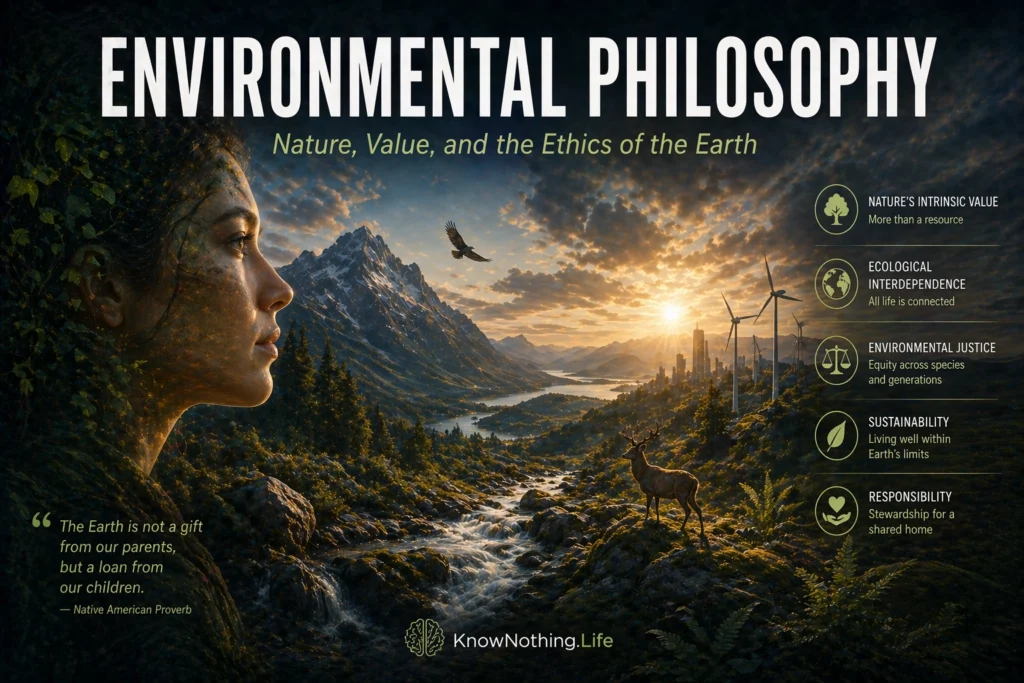
Environmental philosophy examines the relationship between human beings and the natural world, asking fundamental questions about value, responsibility, and the limits of human action. As ecological crises become increasingly urgent—climate change, biodiversity loss, resource depletion—philosophy plays a critical role in clarifying what is at stake. It asks not only how we should act, but why nature matters at all, and what kind of relationship humans ought to have with the environment.
At its core, environmental philosophy challenges deeply rooted assumptions about human superiority and the instrumental use of nature. It explores whether nature has value beyond its usefulness to humans and whether ethical concern should extend beyond our species. These questions reshape traditional ethical frameworks, expanding the scope of moral consideration and redefining what it means to live responsibly within a shared ecological system.
Historical Foundations of Environmental Thought
Although environmental philosophy is often seen as a modern field, its roots extend back to earlier philosophical traditions. In ancient thought, Aristotle viewed nature as a hierarchical system in which each being has a purpose, often placing humans at the top. This teleological perspective influenced later views that justified the use of nature for human ends.
However, alternative perspectives also emerged. Stoic thinkers emphasized living in accordance with nature, suggesting a form of harmony between human life and the natural order. While not explicitly environmentalist, these ideas introduced the notion that human well-being is connected to the broader ecological context.
In the modern period, the rise of science and industrialization transformed the relationship between humans and nature. Francis Bacon advocated for the mastery of nature through scientific knowledge, promoting a view of the environment as a resource to be controlled and exploited. This perspective contributed to technological progress but also laid the groundwork for environmental challenges. The emergence of environmental philosophy reflects a response to these developments, seeking to reevaluate the ethical and metaphysical assumptions underlying human interaction with nature.
Anthropocentrism and Its Critics
A central issue in environmental philosophy is anthropocentrism—the view that human beings are the primary or sole bearers of moral value. According to this perspective, the environment is valuable only insofar as it serves human interests. This view has historically dominated ethical thought, shaping policies and practices that prioritize human needs over ecological concerns.
Critics of anthropocentrism argue that it fails to account for the intrinsic value of non-human entities. Philosophers such as Aldo Leopold proposed a “land ethic” that extends moral consideration to the entire ecological community. In this framework, humans are members of a broader system rather than masters of it, and ethical action involves preserving the integrity and stability of that system.
This shift challenges traditional boundaries of moral concern, raising questions about the status of animals, plants, and ecosystems. If non-human entities have intrinsic value, then ethical responsibility must extend beyond human interests. This perspective has profound implications for how societies approach environmental issues, emphasizing conservation, sustainability, and respect for nature.
Intrinsic Value and the Moral Status of Nature
The concept of intrinsic value is central to environmental philosophy. It refers to the idea that something has value in itself, independent of its usefulness to others. Applying this concept to nature suggests that ecosystems, species, and even individual organisms may possess value simply by existing.
Philosophers such as Arne Naess, the founder of deep ecology, argued for a radical rethinking of human-nature relationships. Deep ecology emphasizes the interconnectedness of all life and the inherent worth of every living being. This perspective challenges the idea that humans have a privileged moral status, advocating instead for a more egalitarian view of the natural world.
However, the notion of intrinsic value raises complex questions. How can value be assigned to non-human entities, and what criteria should be used? Some argue that intrinsic value is grounded in the capacity for life or consciousness, while others emphasize ecological relationships and systemic integrity. These debates highlight the difficulty of extending ethical concepts beyond the human sphere, while also underscoring the importance of doing so.
Environmental Ethics and Responsibility
Environmental philosophy also addresses practical questions about responsibility and action. Environmental ethics seeks to determine what individuals and societies ought to do in response to ecological challenges. This involves balancing competing interests, such as economic development and environmental preservation, and considering the long-term consequences of current actions.
One key concept is intergenerational justice—the idea that present generations have obligations to future ones. Environmental decisions often have lasting impacts, affecting the availability of resources and the health of ecosystems for years to come. Philosophers argue that ethical reasoning must account for these future consequences, ensuring that actions today do not undermine the well-being of future generations.
Another important issue is global responsibility. Environmental problems often transcend national boundaries, requiring collective action and cooperation. This raises questions about fairness and distribution, as different regions and populations contribute to and are affected by environmental issues in unequal ways. Environmental philosophy thus intersects with political and social theory, addressing the complexities of global ethics.
Technology, Progress, and Sustainability
The relationship between technology and the environment is a central concern in contemporary environmental philosophy. Technological advancements have enabled significant improvements in human well-being, but they have also contributed to environmental degradation. This dual impact raises questions about the role of technology in shaping the future of the planet.
Philosophers examine whether technological solutions alone can address environmental challenges or whether deeper changes in values and behavior are required. The concept of sustainability reflects an attempt to balance progress with ecological preservation, emphasizing the need to meet present needs without compromising the ability of future generations to meet theirs.
This approach involves rethinking economic and social systems, considering how growth and consumption can be aligned with environmental limits. It also raises questions about the nature of progress itself. Is progress defined solely by technological advancement, or should it include considerations of ecological health and well-being? Environmental philosophy encourages a broader understanding of progress, one that integrates human and environmental concerns.
Environmental Philosophy in Contemporary Context
In the modern world, environmental philosophy has become increasingly interdisciplinary, drawing on insights from science, economics, and cultural studies. Climate change, in particular, has brought philosophical questions about value, responsibility, and action to the forefront. Addressing such complex issues requires integrating empirical knowledge with ethical reasoning.
Contemporary discussions also emphasize the role of cultural perspectives in shaping environmental attitudes. Indigenous philosophies, for example, often emphasize the interconnectedness of humans and nature, offering alternative frameworks for understanding environmental responsibility. These perspectives challenge dominant Western approaches, highlighting the importance of diversity in addressing ecological challenges.
At the same time, environmental philosophy continues to grapple with practical questions about policy and implementation. How can ethical principles be translated into effective action? What role should governments, corporations, and individuals play in addressing environmental issues? These questions underscore the ongoing relevance of philosophical inquiry in shaping responses to global challenges.
Conclusion
Environmental philosophy provides a critical framework for understanding the relationship between humans and the natural world. It challenges assumptions about value, responsibility, and progress, offering new ways of thinking about ecological issues. By examining concepts such as intrinsic value, sustainability, and intergenerational justice, it expands the scope of ethical consideration beyond the human sphere.
The study of environmental philosophy reveals that addressing ecological challenges requires more than technical solutions; it demands a rethinking of values and priorities. It highlights the interconnectedness of all life and the importance of preserving the integrity of the natural world. This perspective encourages a more holistic approach to living, one that recognizes the limits of human control and the need for balance.
Ultimately, environmental philosophy invites individuals and societies to reflect on their place within the broader ecological system. It emphasizes the responsibility to care for the environment, not only for its utility but for its intrinsic worth. In doing so, it offers a vision of a more sustainable and ethically grounded future.