Deep ecology is a radical and transformative approach within environmental philosophy that challenges conventional views about the relationship between humans and the natural world. Unlike more moderate environmental positions that focus on managing resources for human benefit, deep ecology argues that nature possesses intrinsic value independent of its usefulness to humanity. It calls for a fundamental shift in how individuals understand themselves—not as separate from nature, but as integral parts of a larger ecological whole.
The emergence of deep ecology reflects growing dissatisfaction with anthropocentric frameworks that prioritize human interests above all else. Environmental crises have exposed the limitations of such perspectives, prompting philosophers to reconsider the ethical foundations of human interaction with the Earth. Deep ecology seeks not merely to address environmental problems but to transform the underlying worldview that gives rise to them, advocating a profound reorientation of values, attitudes, and practices.
Origins and Development of Deep Ecology
The term “deep ecology” was introduced by Arne Naess in the 1970s, marking the beginning of a new direction in environmental thought. Naess distinguished between “shallow” environmentalism, which focuses on pollution and resource management, and “deep” ecology, which addresses the deeper philosophical and ethical questions about the place of humans within nature. For Naess, environmental issues could not be solved without examining the values and assumptions that shape human behavior.
Naess’s philosophy was influenced by a variety of sources, including Eastern traditions, ecological science, and earlier philosophical ideas about unity and interconnectedness. He emphasized the concept of “biospheric egalitarianism,” the idea that all living beings have an equal right to live and flourish. This principle challenges hierarchical views that place humans above other forms of life, advocating instead for a more inclusive ethical framework.
The development of deep ecology has involved contributions from numerous thinkers who have expanded and refined its principles. While interpretations vary, the core idea remains consistent: the need for a fundamental transformation in how humans relate to the natural world. This transformation involves not only changes in policy but also a shift in consciousness, emphasizing ecological awareness and respect for all forms of life.
The Concept of Intrinsic Value
A central tenet of deep ecology is the belief that nature has intrinsic value. This means that natural entities—animals, plants, ecosystems—are valuable in themselves, not merely as means to human ends. This perspective challenges the dominant view that nature’s worth is determined by its utility, such as its economic or practical benefits.
The concept of intrinsic value raises important philosophical questions. How can value be attributed to non-human entities, and what criteria determine this value? Deep ecologists argue that the capacity for life itself is sufficient to ground intrinsic value, suggesting that all living beings deserve moral consideration. This view expands the scope of ethics beyond the human sphere, requiring a rethinking of moral responsibility.
Critics of intrinsic value argue that it is difficult to justify and apply in practice. They question how competing interests should be balanced when all forms of life are considered equally valuable. Deep ecology responds by emphasizing the importance of ecological balance and systemic integrity, suggesting that ethical decisions should aim to preserve the health and diversity of ecosystems as a whole.
Interconnectedness and the Ecological Self
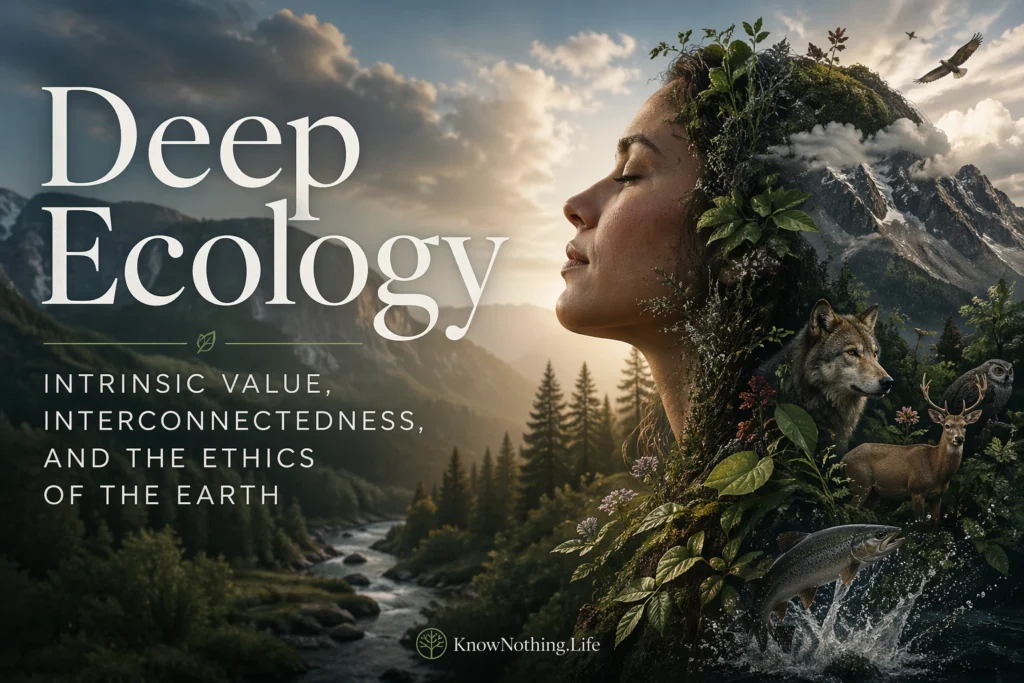
Deep ecology emphasizes the interconnectedness of all life, viewing the natural world as a complex web of relationships. This perspective is grounded in ecological science, which shows that organisms are interdependent, relying on one another for survival and stability. Philosophically, this interconnectedness challenges the notion of the individual as a separate and autonomous entity.
Naess introduced the idea of the “ecological self,” a concept that expands the sense of identity beyond the individual to include the broader natural world. According to this view, individuals can come to identify with ecosystems, recognizing that their well-being is inseparable from that of the environment. This expanded sense of self fosters a deeper sense of responsibility and care for nature.
The ecological self also has implications for how individuals experience the world. By recognizing interconnectedness, individuals may develop a greater appreciation for the complexity and beauty of nature. This shift in perspective can lead to changes in behavior, encouraging practices that support ecological balance and sustainability.
Ethical Implications of Deep Ecology
The ethical framework of deep ecology extends beyond traditional human-centered ethics, advocating for a more inclusive and holistic approach. It calls for a reduction in human impact on the environment, emphasizing the need to preserve biodiversity and maintain ecological integrity. This often involves challenging existing economic and social systems that prioritize growth and consumption.
Deep ecology also raises questions about rights and responsibilities. If all living beings have intrinsic value, what obligations do humans have toward them? This perspective suggests that humans have a duty to minimize harm and support the flourishing of other forms of life. It also implies that human interests may need to be limited in order to protect the environment.
However, applying these principles in practice can be challenging. Balancing the needs of humans and non-human entities requires careful consideration and often involves difficult trade-offs. Deep ecology does not provide simple solutions but encourages a shift in values that can guide ethical decision-making in complex situations.
Critiques and Debates
Deep ecology has been the subject of significant debate within environmental philosophy. Critics argue that its emphasis on equality among all living beings can be impractical or even problematic. For example, treating all forms of life as equally valuable may make it difficult to prioritize human needs or address urgent social issues.
Some critics also contend that deep ecology overlooks the role of social and economic factors in environmental problems. They argue that issues such as poverty and inequality must be addressed alongside ecological concerns, suggesting that a purely ecological focus may be insufficient. This has led to the development of alternative approaches, such as social ecology, which emphasize the connection between environmental and social justice.
Despite these critiques, deep ecology remains a powerful and influential perspective. Its emphasis on intrinsic value and interconnectedness continues to shape discussions about environmental ethics, providing a foundation for rethinking human relationships with nature.
Deep Ecology in Contemporary Context
In the modern world, deep ecology has gained renewed relevance as environmental challenges become more pressing. Climate change, habitat destruction, and species extinction highlight the need for a fundamental rethinking of human behavior. Deep ecology offers a framework for addressing these issues by emphasizing the importance of ecological balance and long-term sustainability.
The influence of deep ecology can be seen in various movements and practices, including conservation efforts, sustainable living, and environmental activism. It has also contributed to the development of environmental policies that prioritize ecosystem health and biodiversity. While not universally accepted, its ideas continue to inspire efforts to create a more sustainable and equitable relationship with the natural world.
At the same time, deep ecology faces challenges in translating its principles into action. The complexity of modern societies and the demands of economic systems can make it difficult to implement its ideals. Nevertheless, its emphasis on transformation and awareness remains a valuable contribution to contemporary thought.
Conclusion
Deep ecology represents a profound rethinking of the relationship between humans and the natural world. By emphasizing intrinsic value, interconnectedness, and the ecological self, it challenges conventional views that prioritize human interests. It calls for a transformation in both thought and action, encouraging individuals to see themselves as part of a larger ecological system.
While deep ecology raises difficult questions and faces significant critiques, its core insights remain compelling. It highlights the need for a more inclusive and holistic approach to ethics, one that recognizes the value of all forms of life. In doing so, it provides a foundation for addressing the environmental challenges of the modern world.
Ultimately, deep ecology invites a shift in perspective, from domination to coexistence, from exploitation to respect. It offers a vision of a world in which humans live in harmony with nature, guided by a deeper understanding of their place within the web of life.